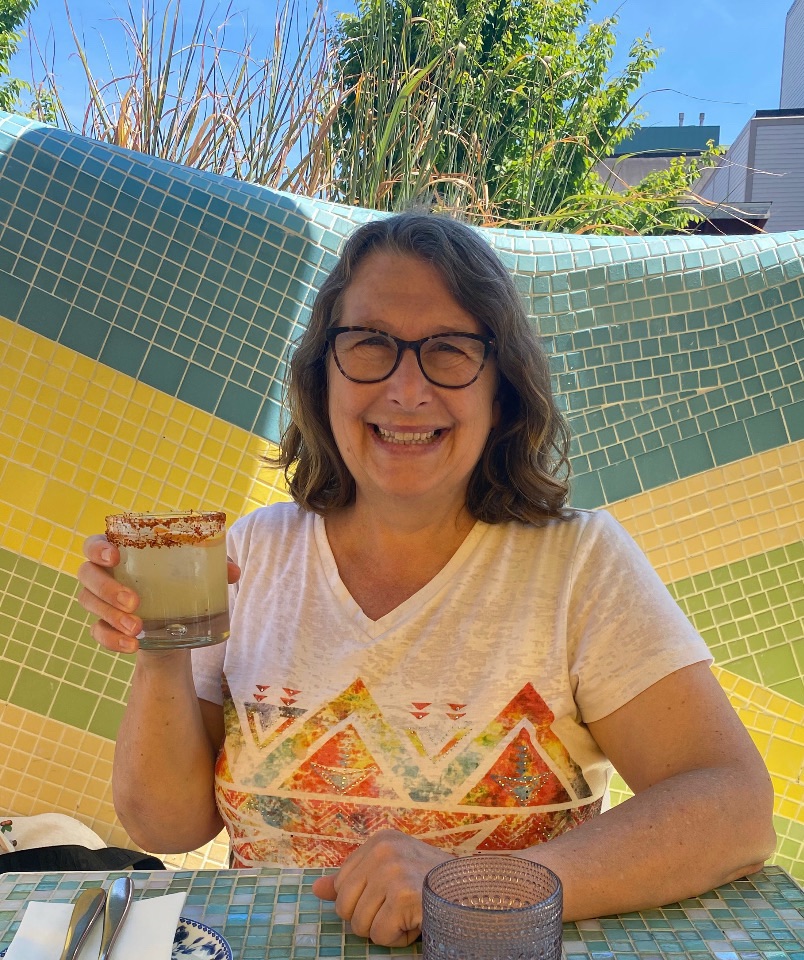
Alison Luke is a witty, artsy intellectual who I had the great good fortune to meet in the schoolyard when our first-born darlings entered kindergarten together. A founding member of the “Coffee Mommies” collective, the setting for so many rich and sumptuous mornings of coffee and conversation, and the genesis of a great many stimulating and enduring friendships, Alison was always that triple threat friend: maker of tasty baked goods, a scintillating conversationalist and a formidable academic, well versed in a wide spectrum of subjects, always happy to engage on topics ranging from literature and art to philosophy and politics. Her eyes shine brightest when she gets her teeth into questions of class, culture and power.
Perhaps the best way to describe Alison is like a character in a Woody Allen film, one of the better ones, maybe Manhattan Murder Mystery …think urban, cultured, a perfect dinner party guest. Curious, thoughtful and ethically grounded, Alison is verbally agile, vivacious, and delightfully funny, especially when existentially alarmed. In short, she is most excellent company and an exceptional friend to call one’s own.
Born in Belfast, Northern Ireland, Alison’s father, a British South African engineer was in the UK doing graduate work when he met and married a small-town girl from Lincolnshire, England. A poverty activist and social worker, Alison’s mother was instrumental in establishing the first homeless shelter for men in Fredericton, NB, calling them her ‘angels.’ Growing up in Fredericton where her father taught at the University of New Brunswick, Alison developed an early and lifelong interest in politics, excelling in debate and model parliament. Today, she is a proud card-carrying member of the NDP, an ideologue, who votes her conscience in a well-established two-party system, and remains deeply left of center on the political spectrum when much of her cohort has crept quietly to the midlands.
Originally planning on becoming a country doctor, but confounded by the multiple-choice format exams, Alison finished her first degree in English Literature with a drama option in theatre, and completed a PHD in Sociology in 2010, remotely from the Maritimes while raising a family. No small accomplishment. I asked her how she landed on Sociology. “Sociology is the study of society, trying to understand why we do the things we do but rooted in social structures. Marxism, Feminism, Critical Race Theory…all that comes out of Sociology. My PhD looked at how our attitudes change over time around things like religious identities and sexual/gender identities…not as much of a political bent to it as I might have liked but at the PhD level you learn very quickly that you need to do something you can finish…and that was something I could finish,” she laughs.
Today Alison works as Associate Research Director at the Center for Research and Integrated Care at UNB, which focuses on models of care designed to improve health care delivery. “We are working on making health care less fragmented and more integrated, so we do assessments and implement pilot projects like patient navigation or case management and then evaluate to see how it’s working. My work is all about health service delivery, and everything we do is patient oriented which means we always have patient partners or care givers or more broadly people with lived experience who sit on our research team and inform everything we do.”
Timely work indeed. I asked Alison if she feels her team is making any real progress within the maelstrom of the current health care crisis. “Frankly one thing that drives me nuts, working with the government who use the language of efficiency and cost-cutting, is that they always want more for less. I’m often the person in the meeting…at 58 I don’t care so much about optics now…I speak up and say maybe the answer might actually be that we need to invest more in primary care, because we don’t invest as much in primary care as say the UK. If you’re worried about the ER overflowing with people and long wait times, and people lying in hospital beds and worried about whether they should be there, then invest more in primary care.”
In the last few years, Alison recently took up the tuba and the euphonium or ‘little tuba’, lovingly described as “the cello of the concert band” and plays in Saint Mary’s Band as well as a lovely local ensemble called The Second Chance Band, an orchestra of enthusiastic, eclectic and quirky amateur musicians whom she affectionately likens to the “land of misfit toys.” “I have band practice three nights a week and have reclaimed a lot of joy in having music in my life again. A band is a beautiful thing.”
Tell me your life story in seven sentences or less?
I grew up with a strong sense of community and a love for helping others and a strong belief that everyone should be treated with dignity and respect. My mother was an extremely strong influence…maybe not the most nurturing person in the world, but she showed me how to be strong and passionate and to care about the world around me. My dad taught me a love of learning, to be interested and curious about the world…wanting to know about everything and I like to think I embody those qualities. I have always been interested in debate and public speaking and politics and even theatre which I think is a way of showcasing passion. I love the whole performance aspect. I was always involved in music and theatre; it was a big part of my formative years. Later I got to travel a bit around Canada. I think I got a pretty good education, I had two amazing children, and eventually settled in Saint John…and the rest as they say is history.
What is the best thing about getting older?
I think it’s not giving a fuck. I’ve heard that before, I’ve read it, but it really resonates with me. I do think there is some freedom in getting older and I don’t care so much about most things these days. Now with that, there is the whole other thing about being a woman getting older. Invisibility, which can be freeing, is also wrapped up in all this ageism stuff. We become little old ladies and people maybe start to treat you a little differently, and that can be a bit demeaning. But overall, the freedom I think on the whole is good.
What is the worst thing about getting older?
It’s kind of two sides of the same coin. I work with a lot of people who are under 40, so a lot of young people, and you do hear a lot of little jokes about the fact that maybe Alison can’t hear very well, which I can laugh about, but it is interesting to me. Somebody at work once referred to a pair of shoes suggesting they must belong to Alison because they look like old lady shoes, so I promptly called him out. I do find ageism very interesting. I saw it with my mother when she became sick, people talking over her or making an assumption that she couldn’t answer for herself. And so even though I’m not yet 60, you start to see this creep in of ageism and it kind of pisses me off. The worse part of it is imagining someday being seen as having no value at all.
What would you title this chapter of your life?
Autumn. The Fall is my favourite season. There is a sense of comfort and plenty in the Fall season. You’re not trying to fit into bikinis, it’s the season of comfy sweaters and layering. Back to school is my favourite time of year and it reminds me of this season of my life.
If you could retain or retrieve one quality from your youth, what would it be?
Sometimes I wish I was more easy-going. As we age, we maybe worry a bit more about certain things. I wish I could just have people over and not worry so much about what my house looks like, I don’t know when that happened. I never used to care quite so much about those things. Maybe we become our parents a bit more as we age. I think of us now as the accumulation of all the things we were when we were young and I don’t think those things are gone. But as we mature, maybe we soften, and maybe some of our younger insecurities are gone now, but new worries take hold, like worrying about not being around for your kids someday.
What’s the most important lesson you’ve learned so far?
To focus on what’s in front of you and to live your life in the moment. I think we spend so much time thinking about regrets or worrying about something that hasn’t happened yet, and I think it’s enough to just focus on what’s in front of you today. And that may be a problem to solve or maybe something really awful that’s happening in the moment. I’m not some Pollyanna saying “Don’t worry, be happy in the moment” but I’ve learned to focus on what’s right in front of me and let that be enough for now.
Do you have a favourite quote?
Yes, it’s a quote by Anton Chekhov. It’s a line in the Cherry Orchard about a character being teased for being a perpetual student. It’s not a fancy quote, it’s more the idea. “He moved through the world as a perpetual student, more interested in understanding life, than in ever mastering it.” For me it’s about having a lifelong interest in learning and staying curious.
Do you have a favourite word?
Melancholy. I love the word melancholy. It’s a great sounding word. I love it because it’s kind of that interesting place where you’re not euphoric but you’re not sad … but you’re not quite content either. It’s this sweet place, like a Fall day, it feels kind of cloudy, or windy, maybe late in Fall, and you’re bundling up to go outside, or settling down to a good book. I think we reflect when we’re melancholy. I think of the Romantic poets, and this idea of being in the depths of despair, like Anne Shirley in Anne of Green Gables…I guess I like getting caught up in the idea of being tragically cast sometimes.
Describe your perfect day.
My perfect day would be sleeping in a little bit for a start. I don’t like to get up really early. Working full time, I long for days when I can work from home and push the snooze till about 8 am. After that, I would love to have a really good cup of coffee, probably two. Then I’d like to do my New York Times puzzles. And on a perfect day with no housework or anything like that, I would want to go for a really great hike in the Fundy area with ocean views. After that, I would like to go to a pub for a nice craft beer and come home for a good dinner, listen to some music, talk politics, put the news on, maybe watch a show and I would be sure to carve out a good hour or so to read in bed, a favourite pastime.
If you could have tea with anyone, real or fictional, dead, or alive, who would it be and what would you talk about?
Well, if I really think about someone I’ve always wanted to sit down to tea with, it would be Karl Marx. He believed that if people can suddenly wake up from their sleep, we can realize that our numbers mean we can change the world. Our numbers are our power and there is hope in that. I see Marx as very hopeful, and I would just love to pick his brain. I’d love to hear his take on what’s going on now around the world. We would talk about politics, of course. I want to sit with him in some smoky old pub, drink a beer and smoke a cigarette and talk to Karl Marx about the state of the world.
Tell me three things that bring you joy.
Hard to narrow it down to three. I mean there is the obvious, my children, and my children do bring me huge joy but if I was to think of just me, it would be reading. Reading brings me great joy. Also camping in my little camper. It was a pandemic purchase that has brought so much joy. Our favourite place to camp and hike is Fundy National Park. We have a little heater and a functional bathroom…I love it so much, I love the Maritimes; I love everything about where we live and with the camper, we can explore it all. A third joy would be spending time with family. My dad visits every weekend and time with family and friends means everything to me.
Name a guilty pleasure.
I don’t feel guilty about any pleasure. I love wine and I love chocolate. I love to eat…I love good food… I love butter. But I try very hard to not to think of them as guilty pleasures, they’re just pleasures, they’re my pleasures. One of my favourite ways to spend an evening is to go out for a good meal or make a nice meal at home…some nibblies and wine and maybe trying a new recipe.
Do you believe in life after death? What does it look like?
Well, I’ve thought a lot about this one, and though I was raised going to church, I’ve never believed in the whole idea of this place called Heaven. In all of my various sociology of religion courses, I was always a big fan of the eastern traditions, like Buddhism and even Hinduism, and I’m very drawn to the idea that energy is neither created or destroyed. But also, there is a side of me as well, the existentialist, who hates the idea of living for something better after death. That sort of thinking can work to oppress people and keep people poor, ‘Oh don’t worry, at least you’ll go to heaven.’ I think people need to make the best of the life they have right now…act now, and make this life a good one. But at the same time, I pair that with an idea that once we go, I think we’re in the trees and the birds and we may even be reincarnated. That would be more where my thoughts might go to as a belief system, if there is anything. My practical brain says I become good compost, and that’s also great. I’d be eaten by worms or be food for a tree, and then become the tree or the birds. Bury me in the ground, I want a compost burial. I hope that kind of thing is available as an option around here.
What would you like your eulogy to say?
I’ve thought a lot about this one as well. There is what you think you’d like people to say, what people will say, and then you’ve got the self-deprecating person who might wonder if anyone will say anything nice at all. ‘Maybe nobody will come to my party,’ Alison laughs. But what I’d like my eulogy to say is that I was passionate, that I cared about people, that I had a love for life and that I was compassionate.
 Little Old Lady … in Waiting
Leave a comment