Tag: retirement-planning

  • In Conversation with Dr. Cheryl Fury

    I met Cheryl Fury on the page before I met her in person. A published academic and popular history professor at UNB, I was first introduced to her irrepressible humor in a series of side-splitting social essays for The Reader, the weekend magazine of the Telegraph Journal.   Her writing was belly-laugh hilarious, whether chronicling the Pokeman world of a boy mom, or narrating a ferociously funny tale of a well-deserved weekend away with her girlfriends, her essays invited you in for a close up look at the busy, messy, unruly life of a thinking woman in her prime.  Her pieces were fresh, honest and recognizable, her voice unique, her writing capturing the unsung work and experience of a modern, educated woman in the heavy-lifting years of motherhood. Her stories were my story, and the story of a cohort of women raising children, managing careers, and working to preserve a life of the mind.  Her essays told the well-kept truth about what Irish actress, Jesse Buckley, recently called the “beautiful chaos of a mother’s heart.” She made me laugh out loud about the sticky-fingered, crayon coloured life we lead for a time, and I will always be grateful to her for that.

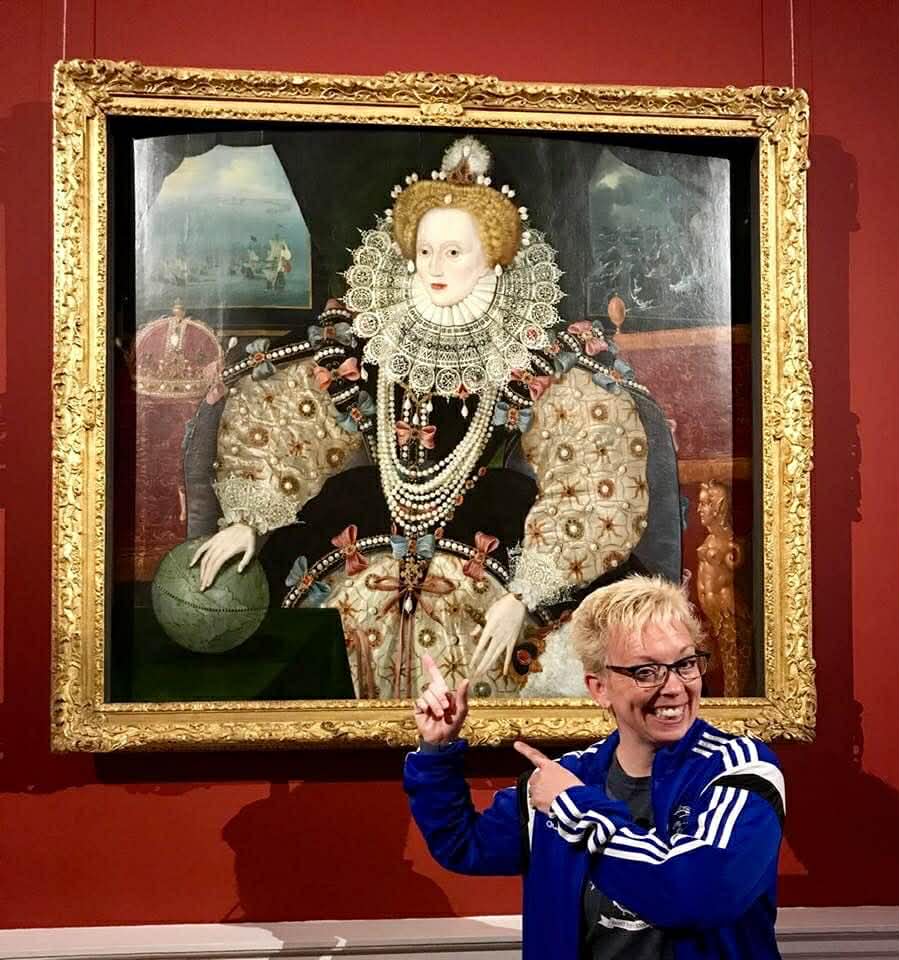
    Fast forward 20 years, Cheryl is an ageless, fit, and still very funny little old lady in waiting who runs 10 k a day, a sports enthusiast who played soccer until age 50.  Modelling a spiky, blond pixie cut and a triple-helix ear stack, her t-shirt reads, I incite this meeting to Rebellion.  She had me at hello. A tenured professor of history, and a Fellow at the Gregg Centre for War and Society, and the Royal Historical Society (UK), Cheryl grew up in Fredericton and earned her PhD at McMaster University.   She teaches courses in European and British history including early modern women and queenship, as well as modern Europe, with a special interest in the Holocaust and Fascism. Specializing in the social history of English sailors in the 16th and 17th centuries, she has published several books on seafarers, the men of the early English East India Company, and her current project examines the relationship between diet, disease and disorder on the high seas in the early 17th century. “Me and my sailors have a long, long romance,” she smiles.

    Cheryl is also a Holocaust educator who has worked as an editor on a number of research projects and a memoir with survivor Vera Schiff, who passed away a few years ago. Cheryl took part in a March of the Living Tour in Germany and Poland in 2010.  I asked her which of the concentration camps was the most horrific.  She told me that Majdanek in Poland was by far the worst. “There is a big concrete mausoleum at the back of the property that looks like a space ship…it holds seven tonnes of human ash.”  Cheryl also recalls an unsettling visit to the Wannsee Conference House where in 1942 the Final Solution of the Jewish question was first announced to the Nazi elite.  She describes a beautiful space right on the river, with people out in paddle boats waving on a sunny July day.  “It was so surreal…I had to leave…we had the lunch menus of what the Nazis dined on after the announcement.”

    I asked the history professor if she could encapsulate the lesson to be learned in the Holocaust, or a wisdom teaching that survivor, Vera Schiff, would want her to share with the world.  “Vera always quoted Edmund Burke,” she tells me. “The only thing that it takes for evil to triumph is for good men to do nothing.”

    Professor Fury’s top tags in online student assessments include, “hilarious”, “amazing lectures”, “tough grader”, and “get ready to read,” with 100 percent of respondents stating they would take her course again.  Cheryl smiles recalling one student who wrote “overrated.” She laughs and suggests that maybe that’s true too.  On her role as an academic, Cheryl has a lot to say about the blight of AI on campus.  “Chat GPT has some amazing uses but it’s not a good tool to find academic sources. It both astonishes at times and then makes stuff up – like a smart but bad, possibly drunk boyfriend.”

    “My role, I hope, is to cultivate independent thinking, writing and researching skills and now, more and more, the ability to identify what is real and not real in the age of AI. Learning how to check facts and cross reference is critical.  In the current moment, the world is so unbelievable that it makes it doubly hard to separate fact from misinformation, so the ability to check credible sources and have an interior base of knowledge is essential.”

    With no plans of retirement, Cheryl jokes that there are days when she and a fellow academic flirt with the idea of managing a convenience store or some little book nook where they can be their own bosses.  At least, I hope she is joking.  It makes me sleep better at night knowing that there is a strong, clear, and tolerant voice on campus competing with Chat GPT for the minds, hearts and souls of the next generation, entrusted to remember our history lessons.

    Tell me your life story in seven sentences or less? 

    I was born and raised in Freddy Beach. Played some soccer and some music. Had some schooling and some laughs.  Really like dead people.  Got married and became a boy mom.  Much professing.  Still love all those things.

    What is the best thing about getting older?

    Knowing who you are. You’ve figured it out. You’ve got your life partner…you’ve had your kids. You’re kind of watching them find themselves and you’re just so much more in tune with yourself… you know what makes you tick.  I know who I am in a way I was still trying to figure out when I was twenty.

    What is the worst thing about getting older?

    The lack of metabolism.  Watching various body parts expire their best before dates. Maybe in the 16th Century when we expired a little earlier…maybe that’s really what’s supposed to happen. Today whenever something starts to hurt, I don’t even hesitate, straight to physio…I’ve got coverage. I still run…I do it to run off the crazy.  I don’t even enjoy it at the time, I hate it…I run because it centers me.  I do it for how I feel afterwards.

    What would you title this chapter of your life?

    Embracing Your Inner and Outer Crone.

    If you could retain or retrieve one quality from your youth, what would it be?

    I think that I’ve retained the things that I really value.  I have a lot of  childlike joys in my life like my love of Halloween, something that I’ve carried with me from childhood, only now I have more money for animatronics. I loved playing Pokeman Go with my kids and I still play it. I am a top shelf Pokeman Go player.  I love Disney…I love The Grinch. Now I can afford like an 8 ft tall Grinch for my front yard. So, there are a lot of things that I truly loved in my childhood that I’ve carried along with me.

    I would say that I’m definitely more jaded at this point in my life.  I’m not the cock-eyed optimist of my youth.  I’m no longer thinking ‘Why can’t we all get along’ or ’surely humanity is moving in a better direction… women are getting more rights, right?’ I mean humanity is kind of losing its mind right now…its collective knowledge of things, and it may have to go and re-experience those things.  Our parents and grandparents could have told you that fascism is a bad thing… that totalitarian regimes aren’t good for the humans, but we’re seeing this resurgence of the fascist-curious, and many countries are flirting with the far right… and then hopefully pulling themselves back at the last moment because they have that collective memory.  

    What’s the most important lesson you’ve learned so far?

    Kindness.  I think kindness is the most important thing in life. That’s what makes the world go round.  Not everyone needs a lecture on the Industrial Revolution from me, but you might need a kind word, on a given day in particular.  So, leading with kindness is important to me and I would hope that my kids would get that more than anything else…to be kind to people because they need it.  We’re all going through God knows what, especially now. 

    Also, that less is more.  I’m not trying to swing for the fences anymore.  When I teach students, I’m not trying to dazzle them with every fact and statistic and every bit of my knowledge. I want to give them a basic interest and the idea that it gets more intricate the farther up they go in terms of courses and years at university, but it’s usually the simple stuff, and the basic stuff and maybe something a little funny or quirky that gets their attention, or the occasional bit of profundity if you’ve picked it up along the way…you drop that into the conversation and give them something to chew on. I always advise young academics to keep it simple, keep it entertaining, tell people a story…hook them with a good story that reveals something about humanity, and if they’re intrigued they’ll come back for more.

    Do you have a favourite quote?

    Well behaved women seldom make history.” I think you have to be a shit-stirrer, whether you’re male or female, or gay or straight, most of the time our rights are not given to us on a silver platter. Along the way you may have to get in the streets.  The first time the government tried to turn the university into a polytechnic I took my boys with me into the streets.  I was fighting for their education and the education of all their friends.  It’s not necessarily a comfortable place for most of us… to pick up a placard and get out there, but sometimes that’s what you have to do if you want to advance the ball, especially these days when we now have to defend things that we’ve held dear for years.

    Do you have a favourite word?

    Shit” That is my most frequently used word because shit can be a good thing, shit can be a bad thing, or it can be sort of a neutral thing like, “I don’t know shit,’ or ‘that’s some good shit,” and “that’s some baaaad shit.”  I mean really, it’s all shit…it’s truly one of the most versatile words.

    Describe your perfect day.

    I tend to think it would be some sort of turbo history nerd adventure. Some sort of haunted castle somewhere that I could explore, some backrooms that nobody else has seen.  Or it could just be a day outside with a bonfire and a bunch of guitars, friends and family and several bottles of prosecco. And I like my own company too, so sometimes a good day is when there is nobody in my house and I can have supper at 3 in the afternoon if it suits,  and if I want to stay up until 4 in the morning with the music going that’s fine too …I’m not disturbing anyone. 

    If you could have tea with anyone, real or fictional, dead, or alive, who would it be and what would you talk about?

    Well, I lost my mom quite a few years ago so it would be her. I want to catch up, so she would be my obvious first choice. Just a check in…I’m sure she does that anyway but it would be lovely to have a more productive two-way conversation.  But if it wasn’t her…I mean clearly, I’d like to have some conversations with Jesus but I’ll save that discussion for your afterlife question.  I would like to talk to certain historical figures to find out if we have things right.  I mean, I would really like to know for sure what caused the fall of Ann Boleyn. Those sorts of conversations would be pretty cool.

    Tell me three things that bring you joy.

    Knowing that my kids are becoming who they are, finding their vocation and jobs that have meaning for them. I also love my work. It’s so much fun to get into the archives and have a really good day there. Of course, there is a lot that is boring detective work as well but some days you find a great letter or something and it’s amazing.  I really love the old book smell too…it’s like a drug.  Just the idea of working in the same rooms as people like Karl Marx once did.  I also have a childlike fascination with Halloween.  The planning for Halloween 2026 is already underway.  You always need new gear, new animatronics, new costumes.  I love being scared…I love ghost stories. 

    Name a guilty pleasure.

    I don’t have a lot of guilt in my pleasures anymore.  In my 20’s I probably wouldn’t have admitted I liked some Abba songs but not now.  Things that might make people embarrassed like playing Pokeman Go or certain types of disposable pop music…you know what…if it’s a good song I’ll put it on my running mix and take it off when I get tired of it.  I’ll listen to it if it gives me pleasure. Micro pleasures are what help us survive.  My last sabbatical, my side quest was to source the perfect cup of coffee for me.  And, for me, its Jingle Java from Piccadilly coffee in Sussex. It’s seasonal, its only available around Christmas, so I literally get pounds of it and freeze it.  There is nothing about it that I identify as particularly ‘Jingly’…unless I’ve had six or seven of cups that is…and I flirt with other brands but Jingle Java is my preferred cup of coffee.  Its ruined me for pretty much everything else. 

    Do you believe in life after death? What does it look like?

    I absolutely believe in life after death. There has to be justice in the next life for some of the really bad actors. I mean I don’t think that hell will look like fire and brimstone and things like that, but I do think that there is some place of perdition if you’ve been just an absolute arsehole your entire life, that there is something nasty waiting for you in the afterlife.  I choose to believe that because if I think that people are going to escape all kinds of consequences in this life, that really bothers me a great deal.  You know conversely, I look at some people and, my god, they just can’t get a break in this life, and they’re the nicest most jubilant people and have all this joy and no reason to be joyful.  They are just a light to everyone around them.  They don’t have anything, and they would literally give you the shirt off their back.  There has to be a kind of payoff other than the good regard of those around them.  I tend to think there is something good waiting, and it might not look like various theologies tell us, maybe it looks a little bit different for everybody.  Like for me it will probably be going around interviewing all these historical figures and learning what really happened in the Russian Revolution, for example.   My heaven will be full of puppies and kitties and all kinds of critters.  I choose to believe, and if I’m wrong, I won’t know it.

    What would you like your eulogy to say?

    That ass though.”  It’s not original, I stole it from Facebook, but I’m taking it.


  • In Conversation with Dr. Alison Luke

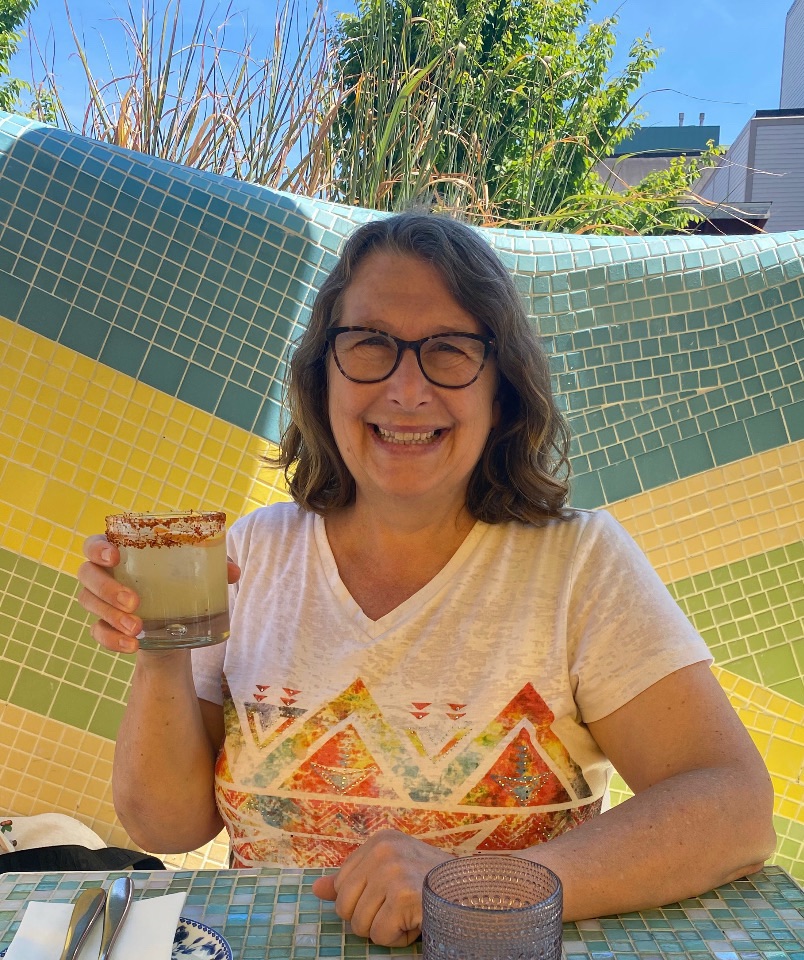
    Alison Luke is a witty, artsy intellectual who I had the great good fortune to meet in the schoolyard when our first-born darlings entered kindergarten together. A founding member of the “Coffee Mommies” collective, the setting for so many rich and sumptuous mornings of coffee and conversation, and the genesis of a great many stimulating and enduring friendships, Alison was always that triple threat friend: maker of tasty baked goods, a scintillating conversationalist and a formidable academic, well versed in a wide spectrum of subjects, always happy to engage on topics ranging from literature and art to philosophy and politics.  Her eyes shine brightest when she gets her teeth into questions of class, culture and power. 

    Perhaps the best way to describe Alison is like a character in a Woody Allen film, one of the better ones, maybe Manhattan Murder Mystery …think urban, cultured, a perfect dinner party guest.  Curious, thoughtful and ethically grounded, Alison is verbally agile, vivacious, and delightfully funny, especially when existentially alarmed.  In short, she is most excellent company and an exceptional friend to call one’s own.

    Born in Belfast, Northern Ireland, Alison’s father, a British South African engineer was in the UK doing graduate work when he met and married a small-town girl from Lincolnshire, England.  A poverty activist and social worker, Alison’s mother was instrumental in establishing the first homeless shelter for men in Fredericton, NB, calling them her ‘angels.’  Growing up in Fredericton where her father taught at the University of New Brunswick, Alison developed an early and lifelong interest in politics, excelling in debate and model parliament.  Today, she is a proud card-carrying member of the NDP, an ideologue, who votes her conscience in a well-established two-party system, and remains deeply left of center on the political spectrum when much of her cohort has crept quietly to the midlands.

    Originally planning on becoming a country doctor, but confounded by the multiple-choice format exams, Alison finished her first degree in English Literature with a drama option in theatre, and completed a PHD in Sociology in 2010, remotely from the Maritimes while raising a family. No small accomplishment. I asked her how she landed on Sociology. “Sociology is the study of society, trying to understand why we do the things we do but rooted in social structures. Marxism, Feminism, Critical Race Theory…all that comes out of Sociology.  My PhD looked at how our attitudes change over time around things like religious identities and sexual/gender identities…not as much of a political bent to it as I might have liked but at the PhD level you learn very quickly that you need to do something you can finish…and that was something I could finish,” she laughs.

    Today Alison works as Associate Research Director at the Center for Research and Integrated Care at UNB, which focuses on models of care designed to improve health care delivery. “We are working on making health care less fragmented and more integrated, so we do assessments and implement pilot projects like patient navigation or case management and then evaluate to see how it’s working. My work is all about health service delivery, and everything we do is patient oriented which means we always have patient partners or care givers or more broadly people with lived experience who sit on our research team and inform everything we do.”

    Timely work indeed.  I asked Alison if she feels her team is making any real progress within the maelstrom of the current health care crisis. “Frankly one thing that drives me nuts, working with the government who use the language of efficiency and cost-cutting, is that they always want more for less. I’m often the person in the meeting…at 58 I don’t care so much about optics now…I speak up and say maybe the answer might actually be that we need to invest more in primary care, because we don’t invest as much in primary care as say the UK.  If you’re worried about the ER overflowing with people and long wait times, and people lying in hospital beds and worried about whether they should be there, then invest more in primary care.”

    In the last few years, Alison recently took up the tuba and the euphonium or ‘little tuba’, lovingly described as “the cello of the concert band” and plays in Saint Mary’s Band as well as a lovely local ensemble called The Second Chance Band, an orchestra of enthusiastic, eclectic and quirky amateur musicians whom she affectionately likens to the “land of misfit toys.” “I have band practice three nights a week and have reclaimed a lot of joy in having music in my life again. A band is a beautiful thing.”

    Tell me your life story in seven sentences or less? 

    I grew up with a strong sense of community and a love for helping others and a strong belief that everyone should be treated with dignity and respect.  My mother was an extremely strong influence…maybe not the most nurturing person in the world, but she showed me how to be strong and passionate and to care about the world around me. My dad taught me a love of learning, to be interested and curious about the world…wanting to know about everything and I like to think I embody those qualities.  I have always been interested in debate and public speaking and politics and even theatre which I think is a way of showcasing passion. I love the whole performance aspect. I was always involved in music and theatre; it was a big part of my formative years. Later I got to travel a bit around Canada.  I think I got a pretty good education, I had two amazing children, and eventually settled in Saint John…and the rest as they say is history.

    What is the best thing about getting older?

    I think it’s not giving a fuck. I’ve heard that before, I’ve read it, but it really resonates with me. I do think there is some freedom in getting older and I don’t care so much about most things these days.  Now with that, there is the whole other thing about being a woman getting older. Invisibility, which can be freeing, is also wrapped up in all this ageism stuff. We become little old ladies and people maybe start to treat you a little differently, and that can be a bit demeaning. But overall, the freedom I think on the whole is good.

    What is the worst thing about getting older?

    It’s kind of two sides of the same coin.  I work with a lot of people who are under 40, so a lot of young people, and you do hear a lot of little jokes about the fact that maybe Alison can’t hear very well, which I can laugh about, but it is interesting to me.  Somebody at work once referred to a pair of shoes suggesting they must belong to Alison because they look like old lady shoes, so I promptly called him out.   I do find ageism very interesting.  I saw it with my mother when she became sick, people talking over her or making an assumption that she couldn’t answer for herself. And so even though I’m not yet 60, you start to see this creep in of ageism and it kind of pisses me off.  The worse part of it is imagining someday being seen as having no value at all.

    What would you title this chapter of your life?

    Autumn. The Fall is my favourite season. There is a sense of comfort and plenty in the Fall season. You’re not trying to fit into bikinis, it’s the season of comfy sweaters and layering. Back to school is my favourite time of year and it reminds me of this season of my life.

     If you could retain or retrieve one quality from your youth, what would it be?

    Sometimes I wish I was more easy-going. As we age, we maybe worry a bit more about certain things.  I wish I could just have people over and not worry so much about what my house looks like, I don’t know when that happened.  I never used to care quite so much about those things.  Maybe we become our parents a bit more as we age.  I think of us now as the accumulation of all the things we were when we were young and I don’t think those things are gone.  But as we mature, maybe we soften, and maybe some of our younger insecurities are gone now, but new worries take hold, like worrying about not being around for your kids someday.

    What’s the most important lesson you’ve learned so far?

    To focus on what’s in front of you and to live your life in the moment.  I think we spend so much time thinking about regrets or worrying about something that hasn’t happened yet, and I think it’s enough to just focus on what’s in front of you today.  And that may be a problem to solve or maybe something really awful that’s happening in the moment.  I’m not some Pollyanna saying “Don’t worry, be happy in the moment” but I’ve learned to focus on what’s right in front of me and let that be enough for now.

    Do you have a favourite quote?

    Yes, it’s a quote by Anton Chekhov.  It’s a line in the Cherry Orchard about a character being teased for being a perpetual student. It’s not a fancy quote, it’s more the idea.  “He moved through the world as a perpetual student, more interested in understanding life, than in ever mastering it.” For me it’s about having a lifelong interest in learning and staying curious.

    Do you have a favourite word?

    Melancholy. I love the word melancholy.  It’s a great sounding word.  I love it because it’s kind of that interesting place where you’re not euphoric but you’re not sad … but you’re not quite content either.  It’s this sweet place, like a Fall day, it feels kind of cloudy, or windy, maybe late in Fall, and you’re bundling up to go outside, or settling down to a good book.  I think we reflect when we’re melancholy. I think of the Romantic poets, and this idea of being in the depths of despair, like Anne Shirley in Anne of Green Gables…I guess I like getting caught up in the idea of being tragically cast sometimes.

    Describe your perfect day.

    My perfect day would be sleeping in a little bit for a start.  I don’t like to get up really early.  Working full time, I long for days when I can work from home and push the snooze till about 8 am.  After that, I would love to have a really good cup of coffee, probably two.  Then I’d like to do my New York Times puzzles. And on a perfect day with no housework or anything like that, I would want to go for a really great hike in the Fundy area with ocean views. After that, I would like to go to a pub for a nice craft beer and come home for a good dinner, listen to some music, talk politics, put the news on, maybe watch a show and I would be sure to carve out a good hour or so to read in bed, a favourite pastime.

    If you could have tea with anyone, real or fictional, dead, or alive, who would it be and what would you talk about?

    Well, if I really think about someone I’ve always wanted to sit down to tea with, it would be Karl Marx.   He believed that if people can suddenly wake up from their sleep, we can realize that our numbers mean we can change the world. Our numbers are our power and there is hope in that.  I see Marx as very hopeful, and I would just love to pick his brain. I’d love to hear his take on what’s going on now around the world. We would talk about politics, of course. I want to sit with him in some smoky old pub, drink a beer and smoke a cigarette and talk to Karl Marx about the state of the world.

    Tell me three things that bring you joy.

    Hard to narrow it down to three.  I mean there is the obvious, my children, and my children do bring me huge joy but if I was to think of just me, it would be reading.  Reading brings me great joy. Also camping in my little camper.  It was a pandemic purchase that has brought so much joy.  Our favourite place to camp and hike is Fundy National Park. We have a little heater and a functional bathroom…I love it so much, I love the Maritimes; I love everything about where we live and with the camper, we can explore it all. A third joy would be spending time with family.  My dad visits every weekend and time with family and friends means everything to me.

    Name a guilty pleasure.

    I don’t feel guilty about any pleasure.  I love wine and I love chocolate. I love to eat…I love good food… I love butter. But I try very hard to not to think of them as guilty pleasures, they’re just pleasures, they’re my pleasures. One of my favourite ways to spend an evening is to go out for a good meal or make a nice meal at home…some nibblies and wine and maybe trying a new recipe.

    Do you believe in life after death? What does it look like?

    Well, I’ve thought a lot about this one, and though I was raised going to church, I’ve never believed in the whole idea of this place called Heaven. In all of my various sociology of religion courses, I was always a big fan of the eastern traditions, like Buddhism and even Hinduism, and I’m very drawn to the idea that energy is neither created or destroyed. But also, there is a side of me as well, the existentialist, who hates the idea of living for something better after death. That sort of thinking can work to oppress people and keep people poor, ‘Oh don’t worry, at least you’ll go to heaven.’   I think people need to make the best of the life they have right now…act now, and make this life a good one.  But at the same time, I pair that with an idea that once we go, I think we’re in the trees and the birds and we may even be reincarnated.   That would be more where my thoughts might go to as a belief system, if there is anything.  My practical brain says I become good compost, and that’s also great.   I’d be eaten by worms or be food for a tree, and then become the tree or the birds. Bury me in the ground, I want a compost burial.  I hope that kind of thing is available as an option around here.

    What would you like your eulogy to say?

    I’ve thought a lot about this one as well. There is what you think you’d like people to say, what people will say, and then you’ve got the self-deprecating person who might wonder if anyone will say anything nice at all.  ‘Maybe nobody will come to my party,’ Alison laughs.  But what I’d like my eulogy to say is that I was passionate, that I cared about people, that I had a love for life and that I was compassionate.


  • In Conversation with Michelle Hooton

    I met Michelle Hooton a little over 20 years ago when I accepted an invitation to attend a book club evening at the home of a mutual friend.  We’ve been meeting once a month ever since with a small, stimulating, always surprising set of eclectic readers, opening our homes and our cookbooks, hosting rigorous debate, developing literary discussion points, and reciting deeply meaningful or contentious passages with the power to engage, transform and elevate. Not a bad way to spend some 200 evenings together, sharing meals, and laughter, drinking wine, and exploring a lot more than plot twists, and prose.

    You can learn a great deal about a person after perusing their bookshelves, and far more still, in the way a person approaches a book, what they find meaning in, passages they deem beautiful or poignant, what moves them to tears, what makes them angry, what words they underline to read out loud again later.

    I can tell you that Michelle Hooton is an intelligent and discerning woman, a reflective and respectful reader, less prone to deconstruction, always in earnest, mining an authors’ artwork for the gold within.  She is an immersive reader, with an ear attuned to a well-crafted story, and is often drawn to quieter books, with characters who have earned their place in the narrative, settings that transport the reader, inform, and enhance our experience, and ideally leave us with something to take away, to hold dear.

    If Michelle was a book, she would be a well-researched one. The cover design would be expertly engineered eye candy. The prose would be succinct and distilled.  There would be multiple passages where the reader could pause and rest a while in serene, inspired settings.  The heroine would be original and authentic, a self-made woman who believed in hard work, and her own powerful magic, and the ending would never disappoint.

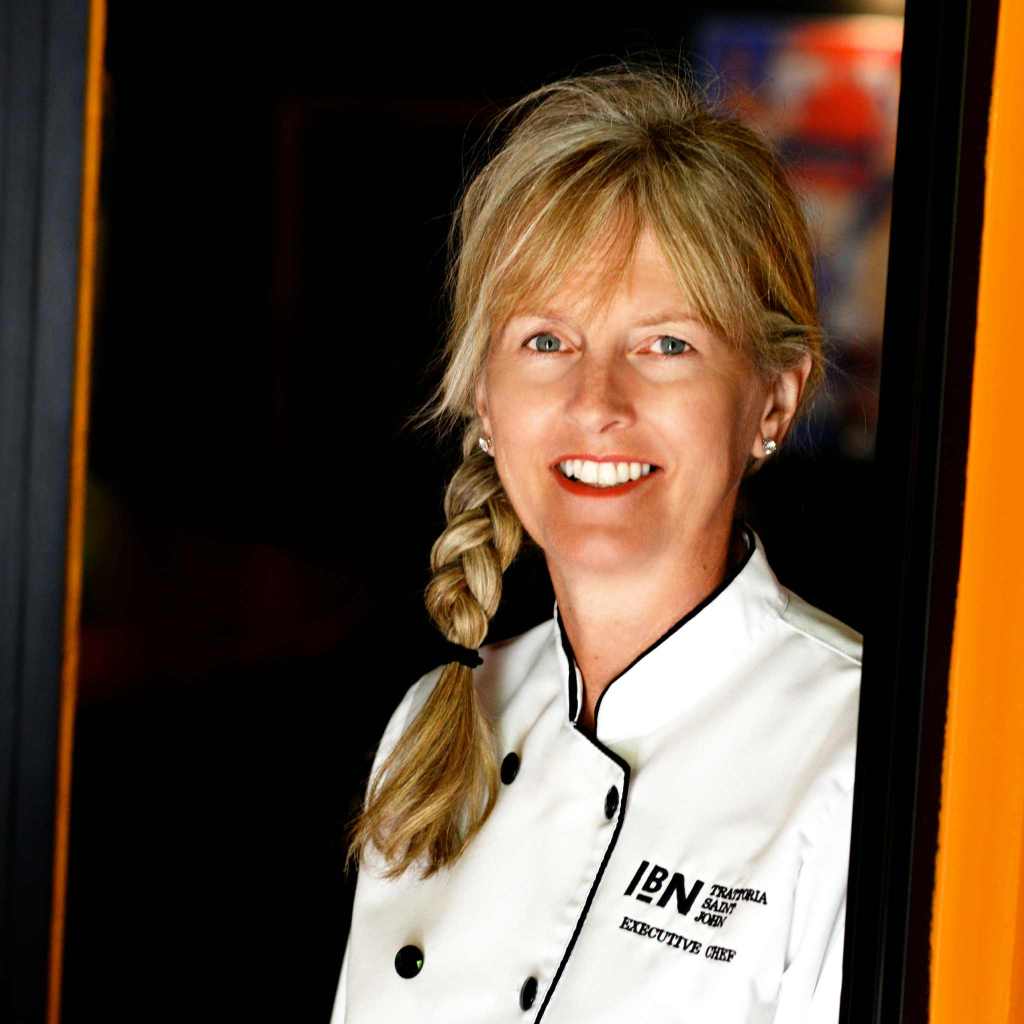
    Michelle has the kind of confidence that comes from many years of self-reliance and trusting her inner compass. She is charismatic, a polished conversationalist, a flawless hostess, a gifted gardener, a celebrated chef, and an accomplished and award-winning entrepreneur.  An astute businesswoman, she is also a creative, and excels at designing beautiful settings and spaces where her circle of friends and family, may repose in charmingly rendered rooms that inspire and delight, while being treated to her many gifts, not the least of which, is her mastery in the kitchen.  As I sit in her highly photographable home, decked out in her curated Christmas finery, I feel a deep sense of comfort and joy. She tells me it’s her love language. It’s how she expresses her gratitude for you giving her your time.

    Michelle describes herself as a “serial entrepreneur” launching her first business venture at age 17. “Growing up I never heard the words ‘You can’t do it’…it was … ‘How are you going to do it?’ Once I realized that I could steer my own course and succeed, that was it.  I have worked for other people, but I didn’t care for it.  Whoever I worked for, I felt like I gave them my best, but I always operated like I owned the business, and when it got to the point where we were conflicting about the work …that was it…it was time to go”

    In 1982, Michelle opened Body Electric, an aerobic exercise studio in uptown Saint John.  A year later she opened Body Electric Aerobics on Broadway, in NYC, and a year after that, was listed as one of the top studios in Manhattan by the New York Times.

    In 1992, now back in Saint John, she opened The Secret Garden, specializing in fresh and dried florals shipping throughout Canada and the United States. In 1999, Michelle opened Sisters Italian Foods, a small Italian deli and imported food shop located in the City Market. She ran both businesses concurrently, until selling Sisters in 2005 after being elected Deputy Mayor for the City Saint John, serving from 2004-2008.

    Thirty-eight years and five businesses later, Michelle fulfilled a lifelong dream, opening Italian by Night in 2016 with business partners, Elizabeth Rowe and Gord Hewitt. This premier Saint John dining experience has been featured on Open Table’s ‘Most Romantic’ list for Canada for seven consecutive years, Best Italian Restaurants in Canada in 2017 and Top 100 Most Beloved Restaurants in Canada in 2022, accolades based exclusively on guest ratings.

    “My lifelong dream was to create the best Italian restaurant in Atlantic Canada. I don’t believe geography limits one’s ability to produce a world-class product. Achieving this requires intense knowledge, focus, the ability to inspire those around you to share your dream, and the passion and spirit to believe you can do it.”

    Michelle won Entrepreneur of the Year at the Saint John Chambers Outstanding Business Awards in 2024 and her immensely popular food blog Bite by Michelle enjoys a worldwide audience, surpassing 4,500,000 views. Her recipes are hearty and time honoured and easy to follow for even the most recalcitrant cook. They are, each one, small works of art…Michelle’s secret ingredient is love.

    Tell me your life story in seven sentences or less? 

    At a really young age I had experienced great joy and great tragedy. At that young age I chose joy for the rest of my life.  I somehow always had the ability to follow my true north. I trusted my gut, but sometimes my gut feeling was wrong. When I made a mistake, I was never too proud to admit it, and then fix it.  So…on my second try I married the love of my life, raised the three most spectacular women I will ever know, and have built the life of my dreams. I’ve had the great fortune to have been able to turn every passion that I ever had into a way to make a living.  And that’s really the story of my life…that’s it.

    What is the best thing about getting older?

    Clarity.  You just get to that point where you don’t need to see the world as grey anymore because you’ve had so many life experiences. I think people are kidding themselves when they don’t know the difference …when they can’t see whether its’ black or white.  I think it’s safer to live in the grey…and I don’t have any interest in that.

    What is the worst thing about getting older?

    Running out of time. I’m in an industry right now where I am two and a half times older than the national average…and you know there is just so much more to learn, and figure out, and experience and time is not on my side anymore.

    What would you title this chapter of your life?

    Grace. I want to finish this chapter of my life with grace. The life Ralph and I built together has given me a gift—this time to live gracefully and with gratitude. I feel incredibly grateful, constantly. It’s like a prayer, like saying grace before a meal—giving thanks. For me, it’s an internal conversation, a continuous acknowledgment of how grateful I am. And I hope that gratitude shows to the world in a graceful way.

    If you could retain or retrieve one quality from your youth, what would it be?

    The belief in endless possibilities.  It didn’t matter if I made the wrong decision when I was young because I had time…I could fix it …I was always gonna have time until all of a sudden I don’t.

    What’s the most important lesson you’ve learned so far?

    There is no finish line. All my life there was always that imaginary…when I get there…when I do this…when I accomplish that… Once I realized there is no finish line, I was free. Life is wide open. You just keep going. Be open to the universe and whatever else is thrown at you. Just keep going, without that nagging feeling that you’re running towards something.

    Do you have a favourite quote?

    Definitely, and it’s the mantra of my life.  I cross stitched it and framed it and it hung beside the door in my house so the kids would see it every morning on their way to school.

    Whatsover thy hand findeth to do, do it with thy might; for there is no work, nor device, nor knowledge nor wisdom, in the grave, whither thou goest.” (Ecclesiastes 9:10)

    I’ve lived that way my whole life, in the way I work, and the way I love, the way I garden, the way I cook…everything that is a part of my life… that was just the way I approached it.

    Do you have a favourite word?

    Grammy. I adore my children, and I never thought I could love like that again. But I do—it’s remarkable. Being with my grandchildren is incredible. When I hear them say “Grammy,” my body experiences a molecular shift. No other word gives me that feeling.

    Describe your perfect day.

    I’ve had this day and I hope to have many more of them. Its summertime…I’m at the farm and all of my family are home.  I’m the first one up. I put on the coffee… and start to make breakfast. One by one they slowly start waking up. We have breakfast on the verandah. We drink slow coffee while the girls use ‘all their words’ …thats an expression the girls use when they they tell me everything that’s going on in their lives. We spend the day on the boat. We have a place further upriver where we like to swim…its magical. I take a picnic with Prosecco, some beer, and all sorts of treats. We’ll stay there until 5 or 6 o’clock and then it’s back to the farm. We get supper ready. My mom and dad will join us. We’ll dine on the veranda under  candle light. We graze until 10 or 11 o’clock at night.  We finish off by the fire table.  Yawns start and we all go to bed, and it is a perfect day.

    If you could have tea with anyone, real or fictional, dead, or alive, who would it be and what would you talk about?

    So, I took some political license here.  If I could do that, I would come back many decades from now and have tea with my elderly grandchildren and we would talk about their lives, and all the things I’ll miss.

    Tell me three things that bring you joy.

    The people I love.  Creating beauty.  And anticipating…anticipating Christmas, anticipating family coming home…anticipating what we’re going to do next… I love it.

    Name a guilty pleasure.

    Dairy Queen. The first time that I ever tasted it, it was like a taste explosion…I couldn’t believe something could taste that good. and I’ve never lost that love of it. You could put the most fabulous European dessert on the table and a peanut buster parfait, and I guarantee you I’m gonna take the peanut buster parfait every time. It’s a special little treat and I usually have it alone.

    Do you believe in life after death? What does it look like?

    I guess it depends on how you characterize life. I believe that we have an inextinguishable life force and I believe that life force carries on after our physical bodies expire.  I’d like to think that my life force will find its way into future generations of my family.

    What would you like your eulogy to say?

    Life was not a dress rehearsal for her.  She lived her life like it was the opening night of the greatest performance she had the honour of playing.

  • The Richness of Retreat

    .

    “Silence is also a conversation” – Ramana Maharshi

    “Be a loner. That gives you time to wonder, to search for the truth.” – Albert Einstein

    I have never lived alone, and at 59 and a half, I can count on one hand the number of nights I’ve spent alone in my home.  So, when my daughter announced that she was off to Australia for a fortnight, and asked if I might cat sit, I decided to embark on a private retreat of my own, a silent, mind-spa staycation, an experiment in the single life, an escape to a ‘room of one’s own’. The setting was LOLIW perfect… posh, urban, ceilings to God, a spiral staircased brownstone apartment in the heritage quarter, the dream home of a much younger version of myself.  The street was Orange, the mood, indigo, and the first song I danced to, with abandon, in far too many years, was Yellow.

    I have always shared living space with close friends or loved ones.  I have never experienced the kind of solitude and silence that singletons exalt in daily, the bliss of soundless mornings, the peace of uninterrupted afternoons, the effortless, evening meal for one, or the coveted hours spent in one’s own sweet company, time whiled away without reference to the wishes or inclinations of another living soul. To keep one’s own good counsel and consult no one else (save an agreeable cat with excellent manners and clear boundaries) on how best to spend the day…what a gift to give yourself, perhaps most especially as a little old lady in waiting. There is a magic to be mined, an enchantment, a real richness of experience to be savoured in retreat. 

    As with any adventure, I overthought and planned every minute detail down to the quick. I packed separate bags for the gym, for work, and for pickleball. I made sure to include enough loungewear and smalls to avoid even the notion of laundry, and a series of comfy sweaters and toasty wool socks, as you do, unfamiliar with the heating in my new abode, a Canadian girl down to  my bones. One can’t be too careful when it comes to creature comforts.  I prepared and packaged enough food to last me about ten days, individually portioned, so I wouldn’t be troubled with cooking or cleaning dishes during my retreat.  I planned to supplement my defrostables with a few evenings of restaurant meals, I was on vacation after all…there were friends to be met, and those naan nachos from Thandi’s are a siren call that cannot be ignored.

    My car was already packed the morning I set off to drive my daughter to the airport. I kissed my husband and hugged my son and small geriatric dog goodbye.  A little old lady herself, I had a quick word and cuddle with my last true dependent.  I let her know it was alright if she had an accident or two in my absence, as the menfolk aren’t as attuned to her bathrooming pecadillos, an easy concession as I wouldn’t be there to look after any mess.  I wished her well and promised to make it up to her.  We settled on half my breakfast bacon for a period no shorter than one year, and a promise that she could come away with me next time.  Oh yes, spoiler alert, there will be a next time.

    After imparting a steady stream of last-minute motherly advice to my savvy, world travelling daughter, advice she did not need, but tolerated as best she could, I watched my baby pass through security, before discarding whatever illusion of control I still harboured, and then, mentally slipping off my mother cape, a favourite cloak, I turned with a little tear in my eye, before going dark, the start of a full-blown smile forming on my lips. I was a stranger in a strange land, alive to the endless opportunities that waited for me. I decided on a quick stop to Costco (I mean …I was in the neighbourhood) for a few emergency supplies…ready made bacon, the Christmas fruitcake (singletons host friends too) and then it was straight back to the little uptown palace I would call home for the next two weeks, party of one.

    I made my escape in mid-November, an excellent time of year for retreat, just at the onset of the introspective months of the Canadian winter, but before the circus of Christmas pageantry that engulfs most matriarchs in December and doesn’t let go until after New Year’s day. For the first few days I sat in a kind of meditative slumber, wonderstruck by the tidied rooms, the luxurious silence, the fragrance of aloneness, the cadence of a single set of steps. I floated from room to room, I listened to the voice of a girl set free from a set of inherited instructions for living, a voice that spoke softly at first, but eventually commanded my entire attention. 

    Most of what she told me is private of course, you understand, what happens on Orange stays on Orange, and anyway it would probably be lost in translation.  I can share that I never once felt lonely during my retreat, that it took several days to miss the loved ones I live with, and if there were any monsters under the bed I slept in alone at night, they kept to their dark recesses and didn’t intrude on my peace. Suffice to say, I was away long enough to remember that there is no better counsel than your own, there is no truer friend than yourself, and if you’ve been neglecting that friendship, then it is time to take yourself away for a long overdue conversation, the kind where you listen more than you speak. Our words can physically influence the world around us, most especially the words we recite incessantly to ourselves silently, in a closed circuit.  The truth is that every cell in our body is listening to us, which makes the quality of the interior dialogue so critical. Do we settle for questions like, “what’s for dinner?” or even “where to travel next year?”  or do we ask ourselves how we might best build joy today? Or “what exactly Elliot meant when he wrote, “I grow old…I grow old…I shall wear the bottoms of my trousers rolled. Shall I part my hair behind?  Do I dare eat a peach?’

    If you, like me, prefer Elliot’s poetry to a cookbook, these are the essential rules of retreat. There must be quiet. Your mind must be calm and unleashed from the concerns and demands of those closest to you.  So much of our action in life is economically or socially determined. Even love can feel like a Chinese finger trap some days. As we get older the claims of our immediate environment, our preferred living arrangement, can be so pervasive that we can actually lose sight of ourself in the family photograph, beneath the Wifee sweatshirt, behind the sacred veil of motherhood, to the woman who waits within like a nested Russian doll. We can become so consumed with what we perceive as the requirements of daily living; nutritious meals, a tidy home, daily exercise, the social scene, that we forget ourselves and our real work, discovering and exploring the beauty and mystery that lies within.

    Finding a quiet place to stoke your inner fire is an essential and sacred ritual, an absolute necessity for every little old lady in waiting. If you can’t get away for a dedicated retreat, then lay claim to a certain hour every day, a space of time inviolate to family or friends, where the news of the world cannot reach you, and where you do not recognize or acknowledge what is owed to others.  A space where you are free to simply experience who you are, and what you might be, a place of creative incubation, a venue to challenge your everyday assumptions, to grow, to follow the winds of your own inclinations, to feel your courage, and to care for yourself, like the treasure you are.

    At first it may feel like you’re wasting time.  If that is your experience, at least initially, I would encourage you to hold fast, it is, after all, your time to waste. We have a limited lease of time apportioned to each of us, and whether you spend that time truly awake or asleep in the detritus of daily living is entirely up to you.  Life has no pause button or rewind setting.  If you read this blog post all the way to then end, each of us is 5 minutes closer to our demise than when you started.  If you can stay present to this moment, if you can be here now, and genuinely engaged in pursuits that bring you joy, then you know the secret to a beautiful life. So often we become embroiled in activities we do not relish and have not chosen for ourselves but believe are required of us.   Fresh from my retreat I have begun to question everything I habitually tell myself needs doing. I engage in small acts of rebellion as often as possible.  I eat cereal for dinner some nights, my bed often goes unmade, sometimes I skip the gym to write or read …there is a feathery owl atop my Christmas tree this year, slightly askew, and it has never looked more beautiful to me.  I hold space for myself to wonder and to consider questions outside the realm of my daily routine. “Do I dare eat a peach?”

    It’s true that to create a pleasant and harmonious environment in our lives together with loved ones we need the cooperation of all those we choose to hold close in our immediate circle, but pleasure carried within ourselves, within our own body and mind, and within that part of ourselves that has no name, that is our business alone. This dark season of early nights and twinkling lights, I wish for you a happy retreat…I invite you to cast your eyes to the wintry sky, to stand alone sometimes, to “look at the stars and see how they shine for you.”

  • In Conversation with Jan Lucy

    I wasn’t looking for a new friend when I met this captivating woman.  She was waiting for me in what we now refer to as the ‘therapy pool,’ the LOLIW early morning aquacise class at the local YMCA.  A large part of me believes she was sent to me by someone who now ‘walks invisible.’ Jan’s scientific rationalist core would smile at the notion, but there are days when I believe I have her half convinced in the power of a good God Box.  Exquisitely kind, intelligent, politically progressive, community minded, and sea-loving, Jan moved to Saint John from Ontario with her husband, Don, three years ago to be close to the water in retirement. 

    Graduating with a degree in English from the University of Guelph, a proud Guelph ‘Griffin’, excelling in competitive swimming, Jan lived and worked for much of her career as a campus administrator at a satellite campus of Nipissing University in a small Ontario town called Bracebridge, cottage country for the rich and famous including such stars as Stephen Spielberg, Goldie Hawn and Martin Short.  ‘I bumped into Kurt Russell at a bar once,’ she laughs. 

    Born in Picton, Ontario, her early childhood was spent in Germany as her father was a meteorologist seconded to the military. She grew up in Ottawa and met her husband by putting an ad in the Toronto Star classifieds. ‘Where are all the Alan Aldas in the world?’ she wrote.  ‘He was a feminist, he was a humorist, and he was political,’ she explains. She received 44 responses. ‘Don was in my ‘no’ pile,’ she laughs.  ‘It was my girlfriend who pulled out Don’s letter and said, ‘What’s wrong with this guy?‘  So, I wrote to him, and he wrote back and the rest, as they say, is history.’

    After a series of unsuccessful pregnancies and adoption attempts, Jan eventually privately adopted her first child, Vincent, from Brazil.  ‘It was my labour,’ she remembers, describing the painful journey that eventually led to the great joy of bringing home their first son.  ‘When he was 4, I knew I really wanted another child and so it was back to Children’s Aid to begin again. This time it was different. Now we were considered a ‘black family,’ and so it was more a case of how many do you want?  We went to the front of the line and through a progressive adoption process we eventually welcomed our second son, Omar.  I was 39 by the time he arrived, and he was like a kitten climbing the drapes.’

    Since arriving in Saint John three years ago, Jan, socially dexterous, with charming old-world manners, and an earnest desire to connect and give back, has worked with new Canadians helping them navigate and acclimate, she has become an active member of the Saint John Naturalist Society, engaging in  ‘citizen science’. and data collection, and is a member of the Lift Community Choir, singing and supporting local causes. Most days she can be found hiking or bird watching in our beautiful province in the company of her husband, Don, and her LOL dog, Siskin.

    Tell me your life story in seven sentences or less? 

    I grew up the youngest of 3 children in a loving home. I lost my father at aged 14, when he died in a British-European plane crash…no survivors.  I went to the University of Guelph and received a degree in English where I was also a Guelph Griffin, a synchronized swimmer.  I have been married to my husband Don for 38 years, after meeting him through the Toronto Star’s Companions Wanted section. I have 4 children, two stepdaughters and two adopted boys…I like to say they were all born in my heart.  I worked for 20 years as a campus administrator for Nipissing University’s Muskoka campus where I had the best students and faculty to grow along with.  I moved to Saint John three years ago at the age of 64, buying my house online, not knowing what would come next or who I would meet.

    What is the best thing about getting older?

    The best thing…is that I’ve had the opportunity to get older.  So many people don’t. Whether it’s disease or accidents or suicide…and I think maybe it’s because of Vincent (son) being ill… and family member struggles with mental health…this idea that it could end for any of us.  So just to make it this far has been great…I hope I still have many more years, but you don’t know.

    What is the worst thing about getting older?

    Feeling like I’m running out of time…and again maybe it’s because my dad died so suddenly…he was only 46, that I worry about my life being taken away from me before I’m finished doing the things I want to do.  I’ve always been a big list maker and I like to accomplish many things in a day. What’s that old expression, “I want to arrive at the graveside all dishevelled, skid in and say, ‘Wow, what a ride!’ I don’t want to sit in a lazy boy…that’s not my thing.

    If you could retain or retrieve one quality from your youth, what would it be?

    Being more playful, I think.  I grew up with this ‘What will the neighbours think?’ mentality.  So not worrying so much about what’s expected, not worrying if your socks match.  I almost didn’t give my husband a second date because he didn’t put his cutlery together on his plate.  Or when someone is coming over…are there dust balls?  I was more playful as a younger woman.  We stayed outside and played until the streetlights went out.  So, I find if I’m given an opportunity now, I try to be more spontaneous, less wary.

    What’s the most important lesson you’ve learned so far?

    I don’t know who said it to me about your impact on your environment or on the world…that a single drop of water can overflow a cistern or a well… so not to underestimate what your small gesture or your small action can do, positively. So, I try to lift others up…I need to listen more…I know that…but by listening… if others want my advice, to try and provide what is needed. I also know I need that too. So…we all struggle in life, and I guess that’s why I love the pool so much…and why we call it the ‘therapy pool.’ It’s sharing those struggles that helps us remain optimistic and hopeful. And celebrating the high notes too, like when your son asks to speak to your friend on the phone, because he knows she is important to you.

    Do you have a favourite quote?

    “Don’t tell me not to worry, the things I worry about never happen.” (Unknown author). The other thing that my mother used to say all the time that kind of ties in to that is…’this too shall pass.’  And the whole idea that anxiety happens in the past or in the future but not when you are truly here, in the present.

    Do you have a favourite word?

    I do. It’s a made-up word, it’s ‘snigg.” So my mom and my grandmom were very progressive with their use of technology…I think they were probably emailing before I was.  My mom meant to type, after a very sentimental message, the word ‘sniff’…like after a sad story, ‘sniff’.  But typed ‘snigg’ instead.  So we’ve all taken on this accidental word whenever we come across anything sentimental or that touches our heart, we’ll always write ‘snigg,’  And what’s kind of cool is that my son does it now too, so it’s a three generational thing now.

    Describe your perfect day.

    This one was a little more challenging for me, but it has to do with water…being near water, being on it, being in it…that’s where the day starts…with water.  And then learning, I’d like to learn something and whether that’s something I’ve read, something I’ve researched, gone to a lecture or a play, but something that I’ve learned.  And lastly sharing thoughts and time with friends. 

    If you could have tea with anyone, real or fictional, dead, or alive, who would it be and what would you talk about?

    So… I thought about this one and I think it would be my mom’s mom, my grandmother. She was born in 1894. I just thought she was amazing.  She was an equal partner in her marriage to my grandfather who was Professor Emeritus of Botany at the University of Alberta.  She always felt it was important to be an intellectual equal with him and provide him with companionship.  She was pretty educated for her era as well.  She attended Alma College, a liberal arts college, but she also helped my grandfather type and illustrate his work for his PhD. And she raised two amazing, strong women, my aunt and my mother.  One of the stories that sort of exemplifies her is that on her 100th birthday there was a big reunion of family and she remembered everyone’s name, what they did, what their partners did, and asked wonderful questions.  Also, that same year, she was in a nursing home at that time, and she played the Virgin Mary and was on the front page of the Victoria paper wearing her blue scarf and holding a live baby, a little brown baby.  Before she died, there was a picture of her in the pageant by her bed, and her last words to my mother were, ‘I like to look at that picture and imagine I’m holding baby Vincent.’ Snigg.

    Another story is that when she first learned that I was moving in with Don, my grandmother’s response was, ‘Does she have a prenup?’ And then, I have a gay older brother, and it was just at the peak of the AIDS epidemic when he came out and he didn’t know how she would respond, and he went to her apartment and said, ‘am I allowed to come in?’ and she just reached out her arms to him.  So, I would like to have a discussion with her around how she became so wise, beyond her years, when there was homophobia, there was racism, and women were subservient in society…what drew her to be more? What was her thought process?

    Tell me three things that bring you joy.

    Taking some risk..like joining a choir…I mean, not bungee jumping, but I guess maybe moving to New Brunswick. I think sometimes life can be too comfortable. Do you know the story about the lobster?  The whole thing about how a lobster grows…how it has to shed its shell because it’s getting too tight, and becomes very vulnerable because it doesn’t have its hard exoskeleton. It could be dashed against the rocks…but to grow it  has to shed its shell. I always loved that story.

    The other is obviously learning new things. I never thought I would be a bird watcher until I moved here.  I love the fact that we are so multicultural here too because where I used to live it was very white…boring…one dimensional.

    And then helping others…which is a big part of my experience in Africa. It started with my sister probably fifteen years ago or more when she went on her dream vacation to Tanzania, and she met a young safari guide who had dreams of owning his own safari vehicle. She befriended him and helped with a website and referring some clients and creating itineraries for guests.  The guide’s wife was a schoolteacher, but she donated her salary back to their community.  They are incredibly lovely people and wanted to do more for their village. The guide eventually became a village elder and reached out to my sister for some help, initially for water, and then for a school.  They started very small… educating the village children and then as time progressed and climate change was affecting their livestock and food, our family became more involved.

    We ended up doing a sibling safari and as part of that, my brother who is a huge permaculture believer, suggested we might bring in a specialist from Kenya who had some success there, to see if there were possibilities for the village. We thought if they could start a small farm, then they could harvest the fruits and vegetables to feed the school.  They started teaching farming skills in the school and the kids began working with the permaculture and redirecting water runoff, and within 3 months they were feeding the kids at the school. After that some of the mammas started planting as well and the school expanded, and we were able to fund kids who couldn’t afford school fees through the ones who could, and the garden was expanded to 7 acres, and they sold the extra produce.  This all happened over the course of many years but we still talk to the village the first Friday of every month. I asked them once if I could ever be a Maasai chief.  Women don’t traditionally have much position, but I was told, not long ago by that same guide who my sister befriended, ‘Jan, you’ll be happy to know, I have three women on my advisory board now.’ Helping others brings me joy…we’re a ripple in the pond.

    Name a guilty pleasure.

    I try not to feel guilty…but I do. It’s around sweet things, specifically chocolate…really good chocolate. I never feel guilt over a kitkat…I mean going out and spending a fortune on high end truffles, because it’s money for sugar.  I feel like it’s a drug and it seems so silly and petty and something I should just let go of but at the same time, as it provides me with pleasure, why should I feel guilty about it…why don’t I deserve it?

    Do you believe in life after death? What does it look like?

    Ahh…I wish I did. I believe energy leaves me when I pass.  I want to hope there is something … maybe it’s living with a scientist. I don’t think there is, but I’ve also had these things happen…and I can’t explain it …so maybe there is something beyond what we know…but I don’t know what it is.  Is it the pearly gates…I don’t think so.  When I went on my sibling safari with my brother and sister…we were in Kenya and we were sitting at a resort and this man was wandering around singing, and all of a sudden he started singing ‘You Lift Me Up’ by Josh Groban  which was my mother’s funeral song and my brother and sister and I all looked at each other…I mean…in the middle of Africa…a song so meaningful to us all.  So, it’s those kind of things, but at the same time…I don’t know.

    What would you like your eulogy to say?

    I think I would like it to say…and this is a big task but…’She left the world a little better than when she arrived.’

  • In Conversation with Margo Beckwith-Byrne

    At the grand dame age of 65, Margo Beckwith-Byrne self-identifies as a ‘little old lady’ proper, although her trim, athletic figure and sporty lifestyle are characteristic of a much younger woman. An avid tennis and pickleball player, Margo is a spitfire that punches well above her fighting weight in any given scenario. She is confidant and decisive, and a natural born manager of men. On the personality tests that assign an animal archetype I’d guess Margo is more at home in the shark tank than the petting zoo. She is spirited, and salty, and strong…she’s had to be strong. Widowed at 42 when her husband went out for a swim on a family vacation and never came back in, she became a single working mom overnight, her kids were then 2,5 and 7.

    Equipped with a B.Ed. in Home Economics, Margo taught for two years in Labrador City before transferring her skills to work more in keeping with her natural aptitudes and temperament. She became a boss.  With the mind of an engineer, and an innate understanding of process and efficiency, Margo started her career in business, first at the Saint John General Hospital, where she very quickly assumed a supervisor role, and later in HR, first at Fundy Cable and later at Labatt Breweries, as an HR Manager.  Her last job was as Senior Vice President at Wyndham.  She was downsized at 54, which today she describes as a gift, one she did not recognize at the time.  An astute businesswoman and investor, Margo never worked another day, and is a poster girl for how to retire well.

    About a year ago, Margo visited the ER with what she describes as stomach discomfort and was eventually diagnosed with stage 4 colorectal cancer. Since then, she has undergone surgery, and chemotherapy which she says is “the most miserable thing you could ever do.’ Margo tells me she is lucky because the cancer she has, MSI-H, is rare and responsive to her current immunotherapy. Her cancer-versary is July 31st.  She shares that the hashtag for colorectal cancer is ‘KFG…Keep fucking going.’  

    Margo speaks with the clear-cut, resolute voice of a woman who has found her truth, and in the process of documenting her wisdom, I caught myself re-evaluating a little of my own inner engineering. I am grateful for what she shared with me on a sunny afternoon, at her beautiful home that overlooks the sea.

    Tell me your life story in seven sentences or less? 

    I was born a Saint Johner and I grew up wanting to leave.  I had children, and then I wanted to come back.  I went to school first at St. FX and then finished at UNB Fredericton … I really liked sewing, I liked making clothes, I didn’t like cooking so much, but I ended up with a B.Ed. in Home Economics and after that I knew very quickly that I didn’t want to teach.  What was important to me at a young age was financial stability and so I spent the rest of my life trying to achieve that. There were lots of twists and turns but ultimately, I spent my whole life believing that happiness and contentment lay in things outside of me, and now I realize I was wrong.  Not everybody is afforded the knowledge that it’s not the external circumstances but rather the internal…because maybe they don’t achieve as many of their material goals, and I was very lucky to acquire mine, only to find out it doesn’t work. Some people still think it’s that car they’re saving for that will bring you happiness… I know it’s not that. 

    What is the best thing about getting older?

    I know it’s cliché, but it’s not giving a fuck about the good opinion of others. Hands down… the best.  Fuck you all!

    What is the worst thing about getting older?

    Your body breaking down. Not being able to physically do the things that you used to be able to do.

    If you could retain or retrieve one quality from your youth, what would it be?

    Let me flesh it out this way. I wish when I was young, I had had a better sense for how good I really looked.  I spent a lot of time in my youth wrecking vacations, get-togethers, events, thinking about my weight. I resent that time now. The focus growing up in my house and with friends was often about, ‘Are you fat or are you skinny.’  And the thing is, when I look back at my life, I was never fat, but it’s all relative.  Your appearance was more important than any kind of achievement.  I still have high school friends who’ll ask, ‘is she fat or skinny’. I was like 125 poinds and I would be obsessed with my weight.   Recently when I had to weigh in for chemo, the nurse said, ‘that’s great you haven’t lost any weight,’ and my natural thought is well fuck, and I’ve been exercising my ass off.  I guess I’m answering the question in reverse, but I’d like to go back and tell my younger self that no matter what you weigh or how you look, you’re still beautiful. They say youth is wasted on the young.

    But what do I wish I could retain, to answer your original question, my memory… I wish I didn’t have to write everything down to remember it.  But I guess the flip side of that is I can be humbled now because fuck…I can’t remember anything. Some days even with the ball in my hand, I can’t remember who’s serving.

    What’s the most important lesson you’ve learned so far?

    Oh my god… again it’s going to sound so cliché but, happiness is an inside job. It has nothing to do with your external circumstances. I’ll give you an example, someone came to my house and looked out at my view and said, ‘oh my god you must be the happiest person in the world to be able to look at this every day,’ and I looked at them and went, ‘are you out of your fucking mind?’ because ‘wherever you go, there you are.’  I don’t strive for happiness…happiness is relative and the word is overused.  I strive for peace and contentment, and I recognize that it’s a moment-to-moment thing, and the minute I move past where I’m at, to the future or to the past, I lose the present, and that does me no service, nor is it of service to the people around me.

    The other interesting thing that I’ve learned, and I’m going to try and not come off all Christian when I say this, but so many things in my life I have orchestrated, worked hard towards, and wanted so badly, that achieving the result was all I cared about, with the belief that if I achieved that result I would be happy. Things would be good…I’ll finally have what I wanted.  But the things that have brought me the most joy in my life, were unexpected things that I did not orchestrate.  So, I’m gonna say it two different ways… now, I don’t try to determine how the day will unfold… I let the Holy Spirit do it, or to be more universal, I let the universe decide because to quote the Desiderata, “No doubt the universe is unfolding as it should.”

    Do you have a favourite quote?

    “The great way (life) is not difficult for those who have no preferences.” (Seng-ts’an, the 3rd Chinese patriarch of Zen)

    Or Michael Singer, who I love, his take on it is “Life is not difficult for those who prefer everything.”

    Let things come and let them pass through. It’s resistance, our free will to resist, to hold onto all that stuff, that’s what affects us and causes pain.

    Do you have a favourite word?

    Oh, you know I have a favourite word, ‘Fuck.’  It’s so versatile, it is the most versatile word on the planet, and I like it even more that it’s harsh and it’s disapproved of. 

    Describe your perfect day.

    You know I thought about this, I thought about this long and hard, and I don’t have one, and I’ll tell you why. My mother said something to me years ago and I never really understood, but I do now. She said, ‘I am only as happy as my unhappiest child’ and I thought about that and thought, oh my god, she’s right, and no matter how I try to separate myself from the lives of my children in a ‘they’re on their own journey…it’s not my journey…they need to experience whatever they experience and the universe is there to teach them,’ it’s a lifelong lesson for me.  But if you want to know what I love doing everyday- it’s playing a racquet sport and knitting.  I think for me it’s like working a Rubix cube or something…it’s a puzzle. When I’m playing tennis, every game is fresh and different and challenging. When I’m knitting, I can’t knit the same thing over and over again because I’d be bored out of my mind. I like a challenge, and I like to keep my hands busy. Also, I guess I better say this in case my kids read this, I love spending time with my grandchildren…preferably without their parents around.

    If you could have tea with anyone, real or fictional, dead, or alive, who would it be and what would you talk about?

    That would be Anthony De Mello.  I discovered him in 1992, after he died, in 1987. He wrote a book called Awareness. I had been reading Wayne Dyer, but De Mello took me up to a whole different level.  He was a Jesuit priest who woke up one day and thought, the Catholics don’t have all the answers so he incorporated Hinduism and Buddhism and every other ‘ism’ that you could possibly imagine and was basically the first person who helped me understand that it’s all the same.  All religions, at their core, they’re all the same.  And I read his book a million times and gave it to as many people as I could find.  When my husband, George died, De Mello was instrumental in getting me through it all.  It helped me understand the cosmos on a different level.

    We would talk about how he got to where he is, his whole philosophy of life, death, and everything in between.  Now that he’s dead, I’d ask ‘How’s it going on the other side?’  The book, Awareness was released posthumously, it’s  just snippets from talks that he had, and it gave me a whole new lease on life, a whole new way to experience joy in ways I didn’t understand before and it started me on a journey of self-awareness.  I would love to know how he got there.  Here is an example of a story that he told.  He was a Jesuit and a professor, and he travelled extensively, and he was in a rickshaw somewhere and the guy pulling him had TB and had just pre-sold his soon to be corpse for science, for the sum of 10 dollars American. De Mello wrote that the driver was a happy man, and thought he himself, was miserable, always complaining, and so he asked the man why he was happy, and he said, ‘well, why wouldn’t I be, what’s not to be happy about?’ And for De Mello that was a beginning of understanding.

    Tell me three things that bring you joy.

    My grandbabies, my sports, and my kids. 

    Name a guilty pleasure.

    Guilty…I don’t feel guilty about stuff… ever,  so I can’t really think of one.  Maybe lame TV, I mean I’m watching Agatha Raison right now which is really poorly done but set in the Cotswolds… so I don’t care. I like lame tv and lamer murder mysteries and I mean really lame, like Midsomer Murders lame…because I can knit and not pay attention.

    Do you believe in life after death? What does it look like?

    I certainly do, but not in the way we experience it.   Do I think that the avatar Margo goes on? No.  Do I think the consciousness that is watching Margo as she goes through life, the consciousness that neither lives nor dies, continues…yes I do. When I wake up from a dream sometimes, I really have a hard time trying to figure out whether it was a dream or reality.  Sometimes it feels like real life, starring the Margo avatar, the life that we think of as reality, is actually just another kind of dream.  I believe that when we die, we just wake up and go ‘God, that was a rush, what was that about?’

    I remember watching some three-year old’s get into a fight and I remember them being upset and thinking…that’s just kids.   Well, that’s how a higher consciousness is likely looking at us and thinking oh, that will be over soon, don’t worry about it.  I mean how can you possibly believe and take seriously anything happening on this planet when you know that there are billions of other galaxies and multi verses… and you’re gonna take this seriously, I mean, come on. I always thought if Merle Haggard’s mother died when he was 21 and in prison she would have died thinking she was a failure as a Mom.  Ultimately, he ended up a rich, country western singer. Why worry about kids…you don’t know what their journey is gonna be.

    What does life after death look like…It’s impossible to imagine. When I look up at the stars on a really clear night, I say I’m not even gonna try to figure it out. I have no frame of reference. The Buddhists have a saying, something like ‘when the Sage points to the moon, all the idiot sees is the finger, or something like that.

    What would you like your eulogy to say?

    I don’t want a eulogy at all.  I’m not interested in the traditional experience of death. I am not arrogant enough to think that anything I say or do will matter anymore than it did when my great great great great great grandmother said whatever she said. I mean the framework that humans have established, the goalposts for life… buy a house… go to school… all that stuff is just a concept that we all agreed on.  It’s like money, money is only worth something because we’ve agreed that it does, and assigned it a value, but if money means nothing to me now, then you saying it has value is meaningless to me. 

    I never understood Jesus in the desert, when the devil comes to him and says you can have castles and all the money you want and Jesus goes, ‘yeah, no thanks, I’m good’.  I never understood that.  Now I get it.  Because no matter what you get…a big house…a fancy car…then you’ve gotta work your ass off to keep it and worry that its gonna go away. So instead of it being something to aspire to, it’s a thing that loses its joy.

    One of my favourite quotes from when I was in leadership is, “Of a great leader they will say, we did it ourselves.”  So, if I shaped anybody, or if I influenced anybody, it wasn’t because that was my intention.  If they got something out of anything I ever did, power to them, but that was not my intention.  I’m just doing my dance and if other people benefit by my dance, good for them, even if all they’re saying is ‘I hate that dance.”  I never ever wanted to be a leader, but I certainly was someone who wanted to control things, and those are two very different things. It’s funny, every now and then my kids will say, ‘you were a good mom,’ but ten years ago when they were teenagers, they were saying something else entirely…it’s all relative, and it’s all irrelevant.

  • Death, Dying and other Unmentionables

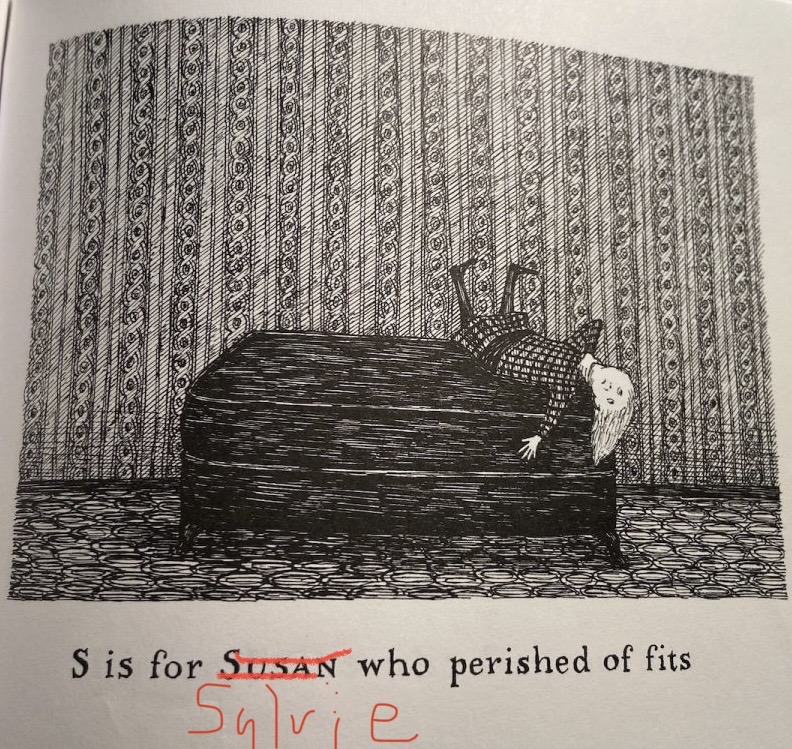
    With apologies to Edward Gorey (The Gashlycrumb Tinies: Edward Gorey’s Alphabet of Death)

    “Death comes equally to us all, and makes us all equal when it comes” – John Donne

    “Memento Mori” (Remember Death)

    I’m not saying I think about death a lot, but my best friend’s husband has nicknamed me ‘Terminal’ Sylvie.  Perhaps a dozen or so years working as a palliative care nurse has left me marginally more noir than what strict social mores decree, but working adjacent to the dying, holding space for their final insights and experience, and catching glimpses through the eyes of those close to death, is a life-altering awakening. It’s difficult to capture with mere words, but as a little old lady… in waiting, let’s just say I feel a certain readiness to share what I’ve learned from the front row seats, as close as anyone can get without taking to the stage themselves.

    Those near death understand a secret thing that we do not. Once you’ve been assigned an expiration date, you come to fully understand that there is nothing that we can truly own, nothing tangible or material that we can keep, there is no permanence, there is only the love we give away, the investment we make in others, and the ripple effect our actions have, for good or ill, is our only real legacy.  Between you and me, I’m hoping for a bit more time to invest my ‘goodwill’ stock and watch my portfolio grow, but I know that nothing is promised.  I try to stay awake to the end game and challenge myself never to overlook an opportunity for kindness.  My record is sketchy at best, I’m a work in progress, of course, but I caution you now, that treating death as a taboo topic and putting our heads in the sand is ill advised, at best.  A good death takes a little planning, and that starts with one irrefutable truth – that no matter how healthy or fit, rich, or connected (spiritually or otherwise), clever or credentialled you may be…no one is getting out of here alive.

    Let’s start with the easy stuff – a quick review of the logistics.  A few years ago, I attended a national palliative conference in Ottawa. There were a lot of very interesting and learned speakers there, but the lecture that got my complete attention was a presentation entitled ‘Getting ready to go.’  The lecturer provided some significant demographic data that suggested that the death trajectory as we currently know it, complete with nursing home beds, hospice care and access to in-hospital palliative care, may not be available to us.  That is to say, we don’t currently have the capacity to accommodate the glut of Boomers that will die in a very concentrated time period.  There is no more room at the ‘End of Days’ inn.  The lecturer advised looking for community resources as we will almost certainly be dying at home. So have a look around you…know any docs or nurses, maybe have your kids practice injecting an orange or two … just thinking out loud here.

    The lecture also included a detailed inventory of ‘good death’ questions for review.  Do your kids know your passwords? Have you got a will, a DNR, a POA (medical vs financial)? What are your thoughts on MAID?  Does you religion dictate that you suffer before death?  Do you understand that if you lose cognitive capacity, MAID is no longer an option for you? Perhaps better to consider your position sooner rather than later and more important still, to communicate your ‘last orders’ to your substitute decision maker.  You have a substitute decision maker… right? Isn’t it a kinder thing to consider your options now before your children or SDMs have to bear that burden?  As a palliative care nurse, I’m reasonably confident that I can keep you comfortable as you lay dying, but my ability to comfort or mediate the pain and sadness of your friends and families sat beside you, holding vigil through the long days or possibly weeks as you lay dying… I know no medicine strong enough for that.

    It’s important to have a think about what constitutes a meaningful life and what factors detract too much from that ideal to be tolerable for you, individually.  It’s a very personal decision.  If you’re asking me, I’m thinking I could possibly tolerate a little incontinence, I’m already acclimating to the indignities of cognitive decline (the forgotten pickleball scores, the word-finding, and could any of us LOLW get home if we didn’t have our key fobs to find our cars…just today I watched a friend open the door to an SUV that wasn’t hers…pretty funny actually, and tolerable I suppose. I’m going to go on record here and say I could, in theory at least, endure a modicum of pain (reserving the option to change my mind at any time on the pain piece…huge fan of pain management…give me the drugs – all of the drugs). However, if I was confined to hospital with no chance of returning home, or if I developed a dementia that meant I no longer recognized the people I love, then maybe a nice little hospital acquired pneumonia isn’t such a poor prognosis. Maybe comfort measures only at a certain point is the most humane treatment option.

    Talk to your kids or your appointed decision makers about what you want and, more importantly, what you don’t want.  I promise you that if I brought you to work tomorrow, even for an hour or two, you would be on the phone with your loved ones by the end of day. Think about who it is you want standing around your deathbed. Invite them to dinner, open a bottle of wine… maybe three. If possible, wait for the dessert course before you dive in to the deep end…ask about their day, tell them how much they mean to you, and as you cut into the pie, begin the difficult but essential conversation about what a ‘good death’ would look like to you. A mildly uncomfortable dessert course now, will spare your loved ones from having to make unthinkable decisions on your behalf at a time when all they’ll want to do is hold your hand, share a laugh about pie night, and find the strength to say goodbye.

    Now, to the really important bit.  It’s been my experience that those who make a happy end…those who die well, are those who live well, investing themselves in the people around them, and in whom others depend.  The best death scenes I’ve witnessed are alive with love and rife with family folklore, where stories are shared of times well spent, and laughter erupts, and perhaps some tears as loved ones share their memories from over the years.  ‘The day I met your dad…the day you were born…remember that big snowstorm…the camping trip from hell…’ or any number of Christmas poemics.  I remember a famous local watercolourist whose family met in his hospital room every day at 5…Happy hour they called it.  The wine was poured liberally, a hand-picked playlist in the background, the dulcet tones of Vera Lynn, ‘I’ll be seeing you in all the old familiar places…‘, the dying man, the guest of honour, enveloped by his chosen few, every afternoon the same bespoke soundtrack, storytelling and laughter, until the music stopped.

    All we accumulate in this life, the acquisitions… the accolades…. they mean nothing in the end.  It’s more about kindness brewed on darkest nights, and passions discovered and developed in ourselves and encouraged in those around us.  What is most important in the end, are the broken hearts we helped to mend, our fortitude, our dedication, and our prowess as a friend, and all the little beauties we cultivate in whatever sort of garden we decide to tend.  What matters most I think, as you take your last breath, is the love you gave away and the joy you helped create, in the time you were here.  It’s our only job really … to love and be kind, if we can, and I have found that those who die well, with peace and with grace, find the time to be kind despite the many burdens they face… some even in their last hours and days. I will never forget a gentleman who rang his call bell at change of shift, with no ask or agenda, only to serenade his night nurse with the most beautiful rendering of ‘Fly me to the moon’ that I will ever know. I can still hear his voice a decade later, and I pray I’ll find it in myself to sing a little song in my last hours, to know such grace.

    For me death is only a door to an unseen place, a speed bump between this world and what comes next, ‘it is the last unprinted snow‘ (Stoker). I think of it as a final adventure, a quest, a magical mystery tour. I know for many it may seem scary… the travel restrictions are untenable, you travel alone, no company, no carry on.  I think the only thing we get to take are the string of moments when we are fully awake… the Fly me to the Moon occasions of human connection, a cache of all the unspeakable beauty we are capable of conjuring … a steadfast heart, a gentle word, an earnest ear, the softest kiss.  All the love we give away is the only investment we need ever make, and the only prayer we need ever pray.  But if, like me, you’re looking to hedge your bets, to grow a little more in the time you have left, there are three little questions I like to ask now and again: am I honouring my gifts, have I learned to love true, and is the world a slightly better place, even a smidgeon, because there was you? If you can answer these questions with any degree of satisfaction, I can almost promise you a beautiful death, where a parting glass will be raised in your name and those who loved you best will stand together in the “coke machine glow” that was you and mourn the loss of your incandescant light.  In the meantime, dig out your rolling pin…it’s time to make pie.

  • On the Merits of Becoming a Maker

    “Every child is an artist.  The problem is how to remain an artist once he grows up.” – Pablo Picasso

    “When my daughter was about seven years old, she asked me what I did at work.  I told her that I worked at the college – that my job was to teach people how to draw.  She stared back at me, incredulous, and said, ‘You mean they forgot?’”     – Howard Ikemoto

    On the recent occasion of my 59th birthday I signed myself up for a workshop on the ancient art of Japanese book binding. I’m not what you would call ‘crafty’, at least not in that sense of the word… a maker of things. I’ve never successfully knit a whole sock, my Christmas decorations come from Canadian Tire, and my sour dough starter-baby died of neglect…twice. I thought it might be the right time to reawaken my inner maker and so, accompanied by my daughter, an artist with a defined skill set, we entered a beautiful old heritage building, the library of my youth, and found seats on the second floor, which once housed the reference section. (For my Zoomers, I refer here to a time before almost every academic question could be answered with a thumb scroll on your smart phone, from the comfort of your couch.)

    We little old ladies in waiting may not have had to walk 10 miles to school through drifts of snow as tall as we were (Boomer narrative), but we did have to leave our homes to look for the answers. We juggled 50-pound encyclopaedias searching for the illusive truth or some reasonable facsimile.  We took notes in an ancient script called cursive.  It was the dark ages kids, before the information age and the internet, before group work started trending and you could pawn the research part off on the kid who would rather disembowel himself than speak in public. 

    But I digress…awkward segue back to the book binding workshop, the setting for a timely and reflective lesson in humility and a powerful endorsement of the restorative power of making art. We were provided with all the necessary materials including what looked like a small ice pick or a long sharp little doorknob. I believe the proper term is an awl, and we were advised not to use it if we weren’t confidant in handling the tool.  ‘Look for a helper’ the instructor advised, making direct eye contact with me as she did so.  I tried not to take it personally, but it did take a little of the glitter off my crafting confidence. I’m happy to report that I wielded that awl like a card-carrying Cape Breton craft guild member.  No blood was lost, and at the end of the day, my paper was pierced to a standard capable of being assembled in a perfectly adequate journal.

    There were a few challenges of course. The eye of my sewing needle was too small to see, my thread refused to cooperate, I may have been overzealous with the glue, and at one point I fell so far behind in the binding instruction I was forced to go freestyle.  I looked over at my daughter for clarification but, after accurately assessing the situation, she shook her head and whispered “I can’t help you” with a smug little art-savvy smile on her face.  I sensed some residual anger about wasting a high UV summer afternoon in musty smelling rooms. There was definitely a mean-girl twinkle in her eye as she effortlessly wove her journal together, her hands adept to any artistic enterprise.  In the end, the teacher took pity on me and salvaged my journal.  I was… accommodated.  It was my birthday after all, and I wasn’t leaving without a finished product.

    A few hours later, sitting by the sea with my bestie, a very successful artist herself, attempting to salvage a little birthday esprit with a few pre-dinner cocktails (code name beach walk), I began to unpack the experience and consider the merits of engaging in art for its own sake, process over product.  How did it feel to create something ? I hand crafted a beautiful journal, with complete artistic control over design and construction…well, maybe not complete control… but every choice, every small flaw or mistake, was my own. It felt…nourishing, making something from scratch, even with unpracticed, non-nimble hands. Cultivating your inner maker feels a lot like play. It’s like leaving your mind for a time and living only in your hands. You spend a few hours purposefully, intentionally, unplugged and unreachable, and when playtime is over you have this lovely little objet d’art, perfectly imperfect, bespoke, hand crafted, and all by you, a maker in the making. 

    In today’s highly specialized world, unless you work as an artist or maybe an entrepreneur, we have, as individuals, lost touch with what it feels like to conceive, design and produce a finished product completely on our own.  Most of us are cogs in the machinery of industry.  We contort ourselves to fit the spaces defined by the job market.  We make ourselves small to succeed as cogs and move up the ladder to coveted cog spots, perhaps with a corner cog office, but in the end, unless you are designing your own work and workday, whether your uniform is a set of scrubs, a pair of overalls, or a thousand-dollar suit, it still says cog in the small print of your contract.

    In Ancient Greek mythology, Procrustes was a thief who offered travellers a bed for the night and then stretched those too short, or cut off the limbs of those too long, to make them fit the bed’s dimensions.  In many ways I feel like I’ve been sleeping on a Procrustean bed my entire working life, perhaps earlier if we consider the public school system as pre-employment prep, conditioning children to conform to an unnatural or arbitrary standard, “a veal-fattening pen” (Copeland) for the cog culture.

    As a quasi-retired, little old lady in waiting, I’m more than ready to embrace the artisan in me. I’m interested in work of my own choosing, designed, and created entirely by me. While I may never be a master book binder, I’m not ready to abandon the maker mindset quite yet. I think a fiber art class in the Fall might suit, or perhaps a creative writing assignment to chip away the icy cold months of the long, reclusive Canadian winter.  I remember enjoying drawing and painting as a younger woman and I may still have all the tools needed to make a cosy east-cost hooked rug, art to keep out the cold. 

    The experience of engaging in making art is tremendously satisfying, especially if your inner maker has been starved to the point of mummification.   I propose making artist dates with yourself: writing morning pages, evenings of experimental cooking, or maybe even acquiring a knitted sock mentor.  Treat the artist within like an honoured guest who inspires and delights and brings out your highest self.   What I’m suggesting is pursuing a path of gentle exploration to set you inner maker free.  Above all, and this is crucially important, never… ever allow your left-brain critic to cut its razor sharp teeth on your vulnerable right-brain art, with its practiced vivisectional rigor. 

    Making art is a clarifying experience.  It opens us and illuminates everything we are inside. The art we produce as little old ladies in waiting may never pay the electric bill, but becoming a maker is an investment in yourself that pays incalculable returns. For me, good art elicits emotion and deals with questions of meaning.  Likely too high a bar for evaluating one’s own artwork.  I’m pretty sure none of my experiments in becoming a maker will ever garner any critical praise. What I do know is that consummating the creative impulse is an immensely pleasurable and stirring experience and one this maker in the making plans to chase habitually and unreservedly.

  • In Conversation with Dr. Margaret Anne Smith

    I sat down with Margaret Anne Smith at a local coffee house with a reputation for good lattes and a spectrum of social justice projects that support many marginalized members of our community.  It seemed a fitting setting for a conversation with a woman who is, among other things, an advocate for the disenfranchised, sitting on the board of a harm reduction enterprise that supports people living with addiction.  Margaret Anne Smith holds a PhD in English Literature, specializing in 20th Century poetry, and has taught her entire career in the post-secondary setting.  She is an academic, a teacher, a poet, and a fiber artist.  She is married, a mother of two, and has the sort of old-world integrity and essential goodness that makes you believe that we are not without hope, no matter what unbelievable chicanery we witness daily on the evening news.  As I listened to her speak, I couldn’t help thinking of the power of a single individual to effect great change in the world around her, especially one armed with a sharp analytical mind trained to notice what others do not see, and gifted with a clear, insightful voice to ask the right questions.  She is currently at work on a book of poetry that celebrates local coastal beauty and lure.  It is a collection I very much look forward to reading someday.

    Tell me your life story in seven sentences or less? 

    I grew up in Saint John and…same sentence… moved back here on purpose, after spending a dozen years away.  I love my extended family and friends. I have been married to David for 36 very good years. We have two great kids. I live near the Bay of Fundy. I am a teacher. I am a reader and a writer.

    What is the best thing about getting older?

    Learning…I was going to say discovering, but it’s not like a momentary discovery, there is no switch that flips, there’s no ‘aha moment’… it’s a gradual process of learning what I care about. And the other side of it, is learning what I don’t give a fuck about, and that list has changed with time.

    What is the worst thing about getting older?

    Joint pain and not being able to see as well as I want to in my 50s. That’s the part that surprised me, the pain came so much earlier than I anticipated.  I’m on the cataract waiting list which depresses me, but I look forward to losing the heavy progressive lenses.

    If you could retain or retrieve one quality from your youth, what would it be?

    My knees and my feet to be honest.  It’s not my optimism…it’s not my hope, it’s not my energy level I’m worried about losing …it’s my joints. I had envisioned at this age, those walking trips in Europe, but there’s no chance.  I couldn’t physically do it… it’s my knees. I want to be able to hike for ten kilometers and I just can’t.

    What’s the most important lesson you’ve learned so far?

    I think it’s probably learning the difference between spending your energy on things you cannot change and spending your energy on things you can.  And that exists on several levels   So there are things that maybe I cannot change about myself,… my feet hurt, I can’t take a walking trip across Ireland. Ok…goodbye to that idea, and now what can I do instead? Because I think spending your energy on things you can’t change makes you bitter, and we don’t want to be bitter little old ladies in waiting… because it would be easy, wouldn’t it?

    So that’s personal, so now let’s take it to the next level to the people in my circle.  There are certain things I can’t change, and you can invest in those relationships but there are some things you just absolutely cannot change.  I like Glennon Doyle’s Podcast?  It’s called “We Can Do Hard Things”.  It’s American and its funny as hell, and they interview  a lot of interesting people and one of the great episodes is about  how to fortify yourself for the holiday season in terms of dealing with your family and expectations.  A great piece of advice he gives is ‘Be not surprised’ because you know Uncle Bob is going to go down the same road he took last year, so don’t be outraged and horrified by it, just adopt an attitude of ‘yeah, whatever, I still love you,’ when people behave in ways they have always behaved, ‘be not surprised.’

    Jewel has a song I really like from 1998, I’m dating myself here, it’s called Life Uncommon. She says ‘no longer lend your strength to that which you wish to be free from.”  It’s about using your voice and that  speaks to me now…where do you use your energy… where do you use your voice.

    The other part of that question is what you do about the global piece and that is much more difficult right now.  I try to be selective and pick the bite-sized things that I can do.  I joined the Board of Avenue B that operates on a harm reduction model.  I have no lived experience with addiction myself, or in my circle, but I thought I can be on the board.  I’m good at policy and procedure…and I try to make choices with some integrity. I don’t live in a tent, I’m not a drug user, but l am devastated by the inhumanity that’s everywhere in our cities and small towns now and how people are being treated so badly and left out.  We talked about water fountains at the meeting last night.  If you were thirsty and unhoused…where do you go?   

    Do you have a favourite quote?

    Yes, it’s a quote by Vaclav Havel.  I like it because he distinguishes between hope and optimism. It’s a quote from his time in prison.  His language is beautiful of course, but for me the beauty is that he isn’t saying, it will all be fine…because so often it is not fine. He takes hope from being a big cartoony rainbow thing and makes it real.

    “The kind of hope I often think about (especially in situations that are particularly hopeless, such as prison) I understand above all as a state of mind, not a state of the world. Either we have hope within us, or we don’t; it is a dimension of the soul; it’s not essentially dependent on some observation of the world or estimate of the situation. Hope is not prognostication. It is an orientation of the spirit, an orientation of the heart; it transcends the world that is immediately experienced, and is anchored somewhere beyond its horizons.

    Hope, in this deep and powerful sense, is not the same as joy that things are going well, or willingness to invest in enterprises that are obviously headed for early success, but, rather, an ability to work for something because it is good, not just because it stands a chance to succeed. The more unpropitious the situation in which we demonstrate hope, the deeper that hope is. Hope is not the same thing as optimism. It is not the conviction that something will turn out well, but the certainty that something makes sense, regardless of how it turns out. In short, I think that the deepest and most important form of hope, the only one that can keep us above water and urge us to good works, and the only true source of the breathtaking dimension of the human spirit and its efforts, is something we get, as it were, from “elsewhere.” It is also this hope, above all, which gives us the strength to live and continually to try new things, even in conditions that seem as hopeless as ours do, here and now.”

    Do you have a favourite word?

    Sea…as in the ocean. The word sea represents all kinds of things metaphorically but for me it is both a personal, and local place of refuge…it always has been …since I was old enough to ride my bike off the cliff, which I did by the way…I was a free-range kid in West Saint john.  I might edit that out for my mother.

    There is something timeless about the sea… I love the rhythm, I love the sound.  It’s also a metaphor for connection, wrapping around the globe, and it’s a measuring stick for what we are doing to the planet which is a big concern for me.  I think because we can see the trees being cut down and we can see the trees on fire on tv, it’s a little harder to ignore, but we could go to Bayshore this morning and think all is well…and it’s not.  We need to pay a bit more attention… we need to pay a lot more attention. 

    Describe your perfect day.

    Sunshine. Great coffee. The ocean.  My husband and my kids and their partners and nothing planned. 

    If you could have tea with anyone, real or fictional, dead, or alive, who would it be and what would you talk about?

    Given the state of the world, I want to sit down with Greta Thunberg.  Three reasons.  She is young and we need to listen to the younger voices, about everything. I mean look at where the power is…still in the hands of old rich white guys and that has to change.  Secondly, she is willing to make incredible sacrifices for the future. I’m interested in asking her, why, what do you see, what do you envision, what are you giving up and what are you giving it up for?  Three would be the climate crisis, it’s going to cook us and were pretending it’s not.  I want to talk about that.

    Tell me three things that bring you joy.

    Real conversations.  Real, not honest, because even honest conversations have a few lies in them.

    David, Kevin, and Maureen …from the beginning all the way to this morning.  So much joy in that little family of mine.

    Time outdoors.  Some of it goes back to the free-range childhood.  Total freedom.  It might have been an illusion, or it might have been quite real, that no one was paying any attention to us kids.   We were free, and time outdoors reminds me of my freedom.  Also, as an artist I appreciate the changing light and the shadows cast by the sun and the changing colours of the season.  My shoulders lower when I step out the door.

    Name a guilty pleasure.

    Ice cream. Too much fat, too much sugar but it hasn’t made me give it up.  It’s a favourite treat.

    Do you believe in life after death? What does it look like?

    I do believe in life after death, but I don’t know what it looks like.  And I don’t even have an assumed visual. I think when I was young, I did have an idea that was based on a religious tradition…heavenly gates…clouds. So now I think there is so much beauty and goodness, despite the horrors, and I don’t think those things can just come to an end.  There has to be something else.  My sense of what that is has changed, because I think there is something else for the right whale as well, and for the pigeon on the roof… that we’re all part of this interconnectedness that we can’t really, fully appreciate now and maybe our great joy in the afterlife is coming to understand what that interconnectedness means.   

    What would you like your eulogy to say?

    I boiled it down to two things. First, I want my children to write it, and I trust them. Second, and how’s this for a mothers’ control, I hope they would say that they saw that I remained engaged until the end of my days.  I don’t like the word engaged… maybe passionate, passionate is better, engaged is so psycho-ed, or maybe that I cared, but that’s too Hallmark.  Passionate works, and passionate about what doesn’t really matter…maybe when I’m 80 I’ll be passionate about my pansy collection.