“Every child is an artist. The problem is how to remain an artist once he grows up.” – Pablo Picasso
“When my daughter was about seven years old, she asked me what I did at work. I told her that I worked at the college – that my job was to teach people how to draw. She stared back at me, incredulous, and said, ‘You mean they forgot?’” – Howard Ikemoto
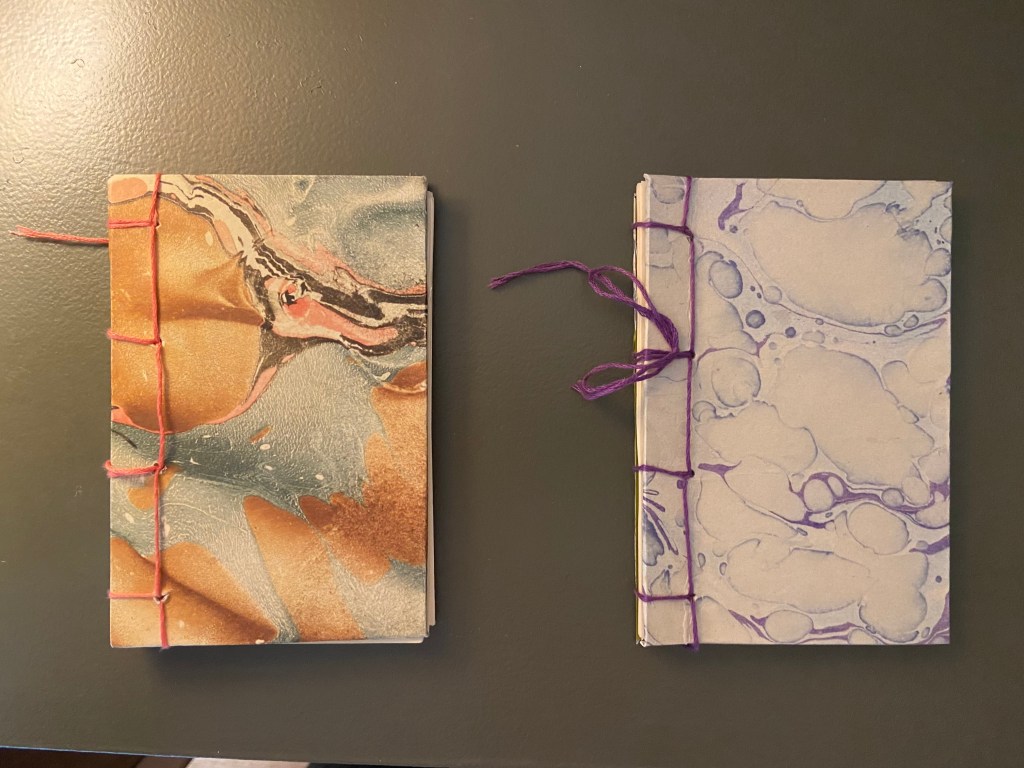
On the recent occasion of my 59th birthday I signed myself up for a workshop on the ancient art of Japanese book binding. I’m not what you would call ‘crafty’, at least not in that sense of the word… a maker of things. I’ve never successfully knit a whole sock, my Christmas decorations come from Canadian Tire, and my sour dough starter-baby died of neglect…twice. I thought it might be the right time to reawaken my inner maker and so, accompanied by my daughter, an artist with a defined skill set, we entered a beautiful old heritage building, the library of my youth, and found seats on the second floor, which once housed the reference section. (For my Zoomers, I refer here to a time before almost every academic question could be answered with a thumb scroll on your smart phone, from the comfort of your couch.)
We little old ladies in waiting may not have had to walk 10 miles to school through drifts of snow as tall as we were (Boomer narrative), but we did have to leave our homes to look for the answers. We juggled 50-pound encyclopaedias searching for the illusive truth or some reasonable facsimile. We took notes in an ancient script called cursive. It was the dark ages kids, before the information age and the internet, before group work started trending and you could pawn the research part off on the kid who would rather disembowel himself than speak in public.
But I digress…awkward segue back to the book binding workshop, the setting for a timely and reflective lesson in humility and a powerful endorsement of the restorative power of making art. We were provided with all the necessary materials including what looked like a small ice pick or a long sharp little doorknob. I believe the proper term is an awl, and we were advised not to use it if we weren’t confidant in handling the tool. ‘Look for a helper’ the instructor advised, making direct eye contact with me as she did so. I tried not to take it personally, but it did take a little of the glitter off my crafting confidence. I’m happy to report that I wielded that awl like a card-carrying Cape Breton craft guild member. No blood was lost, and at the end of the day, my paper was pierced to a standard capable of being assembled in a perfectly adequate journal.
There were a few challenges of course. The eye of my sewing needle was too small to see, my thread refused to cooperate, I may have been overzealous with the glue, and at one point I fell so far behind in the binding instruction I was forced to go freestyle. I looked over at my daughter for clarification but, after accurately assessing the situation, she shook her head and whispered “I can’t help you” with a smug little art-savvy smile on her face. I sensed some residual anger about wasting a high UV summer afternoon in musty smelling rooms. There was definitely a mean-girl twinkle in her eye as she effortlessly wove her journal together, her hands adept to any artistic enterprise. In the end, the teacher took pity on me and salvaged my journal. I was… accommodated. It was my birthday after all, and I wasn’t leaving without a finished product.
A few hours later, sitting by the sea with my bestie, a very successful artist herself, attempting to salvage a little birthday esprit with a few pre-dinner cocktails (code name beach walk), I began to unpack the experience and consider the merits of engaging in art for its own sake, process over product. How did it feel to create something ? I hand crafted a beautiful journal, with complete artistic control over design and construction…well, maybe not complete control… but every choice, every small flaw or mistake, was my own. It felt…nourishing, making something from scratch, even with unpracticed, non-nimble hands. Cultivating your inner maker feels a lot like play. It’s like leaving your mind for a time and living only in your hands. You spend a few hours purposefully, intentionally, unplugged and unreachable, and when playtime is over you have this lovely little objet d’art, perfectly imperfect, bespoke, hand crafted, and all by you, a maker in the making.
In today’s highly specialized world, unless you work as an artist or maybe an entrepreneur, we have, as individuals, lost touch with what it feels like to conceive, design and produce a finished product completely on our own. Most of us are cogs in the machinery of industry. We contort ourselves to fit the spaces defined by the job market. We make ourselves small to succeed as cogs and move up the ladder to coveted cog spots, perhaps with a corner cog office, but in the end, unless you are designing your own work and workday, whether your uniform is a set of scrubs, a pair of overalls, or a thousand-dollar suit, it still says cog in the small print of your contract.
In Ancient Greek mythology, Procrustes was a thief who offered travellers a bed for the night and then stretched those too short, or cut off the limbs of those too long, to make them fit the bed’s dimensions. In many ways I feel like I’ve been sleeping on a Procrustean bed my entire working life, perhaps earlier if we consider the public school system as pre-employment prep, conditioning children to conform to an unnatural or arbitrary standard, “a veal-fattening pen” (Copeland) for the cog culture.
As a quasi-retired, little old lady in waiting, I’m more than ready to embrace the artisan in me. I’m interested in work of my own choosing, designed, and created entirely by me. While I may never be a master book binder, I’m not ready to abandon the maker mindset quite yet. I think a fiber art class in the Fall might suit, or perhaps a creative writing assignment to chip away the icy cold months of the long, reclusive Canadian winter. I remember enjoying drawing and painting as a younger woman and I may still have all the tools needed to make a cosy east-cost hooked rug, art to keep out the cold.
The experience of engaging in making art is tremendously satisfying, especially if your inner maker has been starved to the point of mummification. I propose making artist dates with yourself: writing morning pages, evenings of experimental cooking, or maybe even acquiring a knitted sock mentor. Treat the artist within like an honoured guest who inspires and delights and brings out your highest self. What I’m suggesting is pursuing a path of gentle exploration to set you inner maker free. Above all, and this is crucially important, never… ever allow your left-brain critic to cut its razor sharp teeth on your vulnerable right-brain art, with its practiced vivisectional rigor.
Making art is a clarifying experience. It opens us and illuminates everything we are inside. The art we produce as little old ladies in waiting may never pay the electric bill, but becoming a maker is an investment in yourself that pays incalculable returns. For me, good art elicits emotion and deals with questions of meaning. Likely too high a bar for evaluating one’s own artwork. I’m pretty sure none of my experiments in becoming a maker will ever garner any critical praise. What I do know is that consummating the creative impulse is an immensely pleasurable and stirring experience and one this maker in the making plans to chase habitually and unreservedly.
 Little Old Lady … in Waiting
Leave a comment