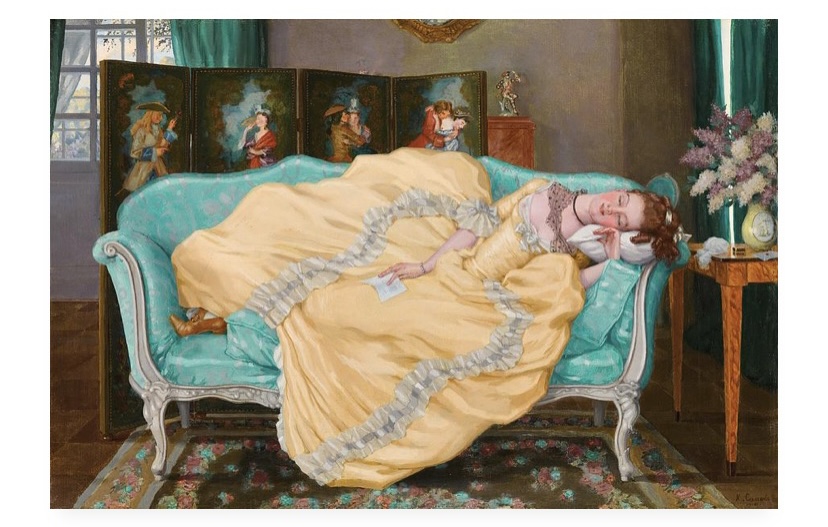
“How beautiful it is to do nothing, and then to rest afterward.” – Spanish Proverb
“Shut your eyes and see.” – James Joyce
I have always resisted the arguable allure of rest, and the notion of daytime napping triggers a little anxiety somewhere deep in my little old lady amygdala. I’m not sure we need to investigate exactly why that is …well …ok, since you asked, it could be fear of lost finite time, or years of positive reinforcement for multi-tasking and maximizing efficiencies… go to work, work out, work at home, homework. For most women, rest is the thing you do 15 minutes before you pass out at the end of the day, while you’re making a to do list for tomorrow, right? Well, those days are done. The truth is, and I’m going to whisper this bit in italics, as a little old lady in waiting, there is not all that much on my to do list anymore. I have more free time than ever before. Shhhh … experiments in daytime napping in progress.
After a few weeks of unstructured bliss in your retirement infancy, you may, like me, find yourself contemplating the most optimal use of your time, and exploring the scientifically proven compensations of good sleep hygiene and the merits of ritualized rest seems a suitable starting point. Leading sleep experts advise 8 plus hours of sleep a night. That’s a big piece of life pie that we’re never getting back, so just how essential is rest, if our goal is to savour as much pie as possible.
The world hangs, quite literally on a good night’s sleep. Mathew Walker, a leading neuroscientist, in his book, “Why We Sleep”, points out that we conduct a worldwide experiment on the significance of sleep twice a year during daylight savings time. Walker’s research indicates that when we Spring ahead, effectively losing an hour of sleep, bad things happen. After only one hour of lost sleep, there are more reported traffic accidents, heart attacks, and suicides, and judges even hand down harsher sentences. Conversely, when we gain an hour of sleep in the Fall, the opposite is true, with statistically less incidences in all categories. Message received… sleep is good and, according to Walker, more sleep is better, indicating that most of us aren’t getting enough.
My husband is like a Zen master when it comes to the impromptu snooze. I find myself studying his napping habits, squinty eyed, coveting his capacity to drift off into restful slumber without a moment’s hesitation, and wonder why it is that the idea of a little mid-afternoon siesta seems so anathema to me. Despite my inherent discomfort with the practice of daylight dozing, my little old lady in waiting body and mind is telling me, even now, that it’s time to embrace the nap habit and all of health benefits associated: enhanced relaxation, mood, alertness and improved performance, reaction time and memory. Staving off cognitive decline is something I have a keen interest in and so, properly incentivized, I have begun experimenting with taking rest when tired, no matter what time of day.
Right now, I’m setting my timer for 30 minutes, and skulking back to bed for a midday nap. I feel a little self-conscious, but two coffees in, I am still sleepy. It’s a sunny day, my deck is calling, the dog needs to be walked, the breakfast dishes are still strewn across the counter, I could be reading right now, but I’m choosing to prioritize my neuroplasticity, I’ll see you in 30. (Half hour time lapse) Initial clinical trials are not promising. When the alarm sounds, I can report only a half hour of horizontal ineptitude, eyes closed, mind wide awake and running, nary a wink of sleep. But I have had some thoughts…a million of them in fact, a chaotic, slip stream of consciousness that feels like the opposite of rest. What I feel now, after a botched nap, is the sensation of lost time. Time I could have been, writing, reading, walking, even cleaning, or maybe just figuring out how to con someone else into making dinner tonight. Also, there is the added aggravation of renewed sleep fatigue, the brain fog that accompanies your first several hundred vertical steps, not to mention the bed head.
Alas, maybe napping is not for me. I know what you’re thinking… give it another go, the Land of Nod wasn’t built in a day, I mean even babies know how to nap. How hard could it be? But the truth is I have always found focused mental or physical activity, engagement for lack of a better word, far more restful that actual sleep. Maybe that’s just how people like me…the tired, the cranky, rest, or maybe I just don’t excel at rest, at least not yet. I’m willing to continue my daytime sleep trials but between you and me, I’ve lowered my expectations considerably.
Perhaps before I attempt a master class like daytime napping, I need to do some preliminary work in getting comfortable with doing nothing…not so easy as you might imagine. Simply to sit, without occupation, no task, no agenda, seems a little like walking into the men’s room by mistake, the crib of some slack teenage manboy in the middle of a growth spurt, or maybe the diary of a little old man in waiting. I’m not sure I have enough testosterone for this.
What I do know is that there is kind of gold to be mined in each of us, and rest is how we frack it. Not only does it allow our brains to reset to the so-called default network that lights up like a Christmas tree when we are at rest, it also opens a conduit to connect disparate ideas and potentially solve problems in new and imaginative ways. This is the value of going quiet, being still and resting. Stopping the assembly line of constant activity for a short time each day, turns out can be pretty productive. Quiet can be very loud, and some of our best ideas are born in stillness. Rest is being re-branded as the radical new prescription for many of the ills of modern life. Anne Lamott writes, “almost everything will work again if you unplug it for a few minutes…including you.” So, while practicing doing nothing might make me feel uncomfortable, and even incompetent, at least initially, the contemplative, creative, and therapeutic inducements of doing nothing are too persuasive to ignore.
Little old lady to little old lady, I highly recommend a daily discipline of doing nothing. Being still, learning to simply be a “silent witness” watching the world unfold, a world oblivious to all our attempts to contain or control it, maybe that’s enough of challenge for a nap novice like me. You’ll think of a million things you could be doing. It’s hard to resist the seductive lure of a checked off to do list, the ever-present temptation of a clean house, the silent scream from the heights of a towering TBR pile, but tomorrow instead of a nap, I’m shooting for 30 minutes of sitting and doing nothing, I’m scheduling nowhere to be.
Join me. Just steal away somewhere, alone, maybe near a window where you can hear the birds sing and smell the morning air. Practice doing nothing before your morning workout, before breakfast, before you think about the demands of the day. Don’t open a book, or a journal, or your phone, don’t even begin a conversation with your cat; don’t allow anything to come before you and nothingness. After a while the art of doing nothing, resting in stillness, starts to feel like a holy thing, a mystery to be illuminated. Just go quiet for a time and see what you can hear. I listen to the breeze in the trees, the flap of a bird’s wing in flight, the dog’s yawn, the tread of morning walkers, my own heart beating, and always the ticking of a clock. Sometimes the silence is deafening. Thoughts will come and go like clouds floating in the sky, I watch them like they belong outside myself, and then I Iet them float on by. This is how I know for certain that “I am not my thoughts, I am the one who hears them.” And that is an immeasurable treasure, mined after only a single day of doing nothing.
Author’s post script
A successful daytime nap experiment was conducted within one week of commencing clinical trials. It is my working hypothesis that a daily discipline of doing nothing is a statistically significant independent variable.


 Little Old Lady … in Waiting
Leave a reply to Sylvie Fitzgerald Cancel reply