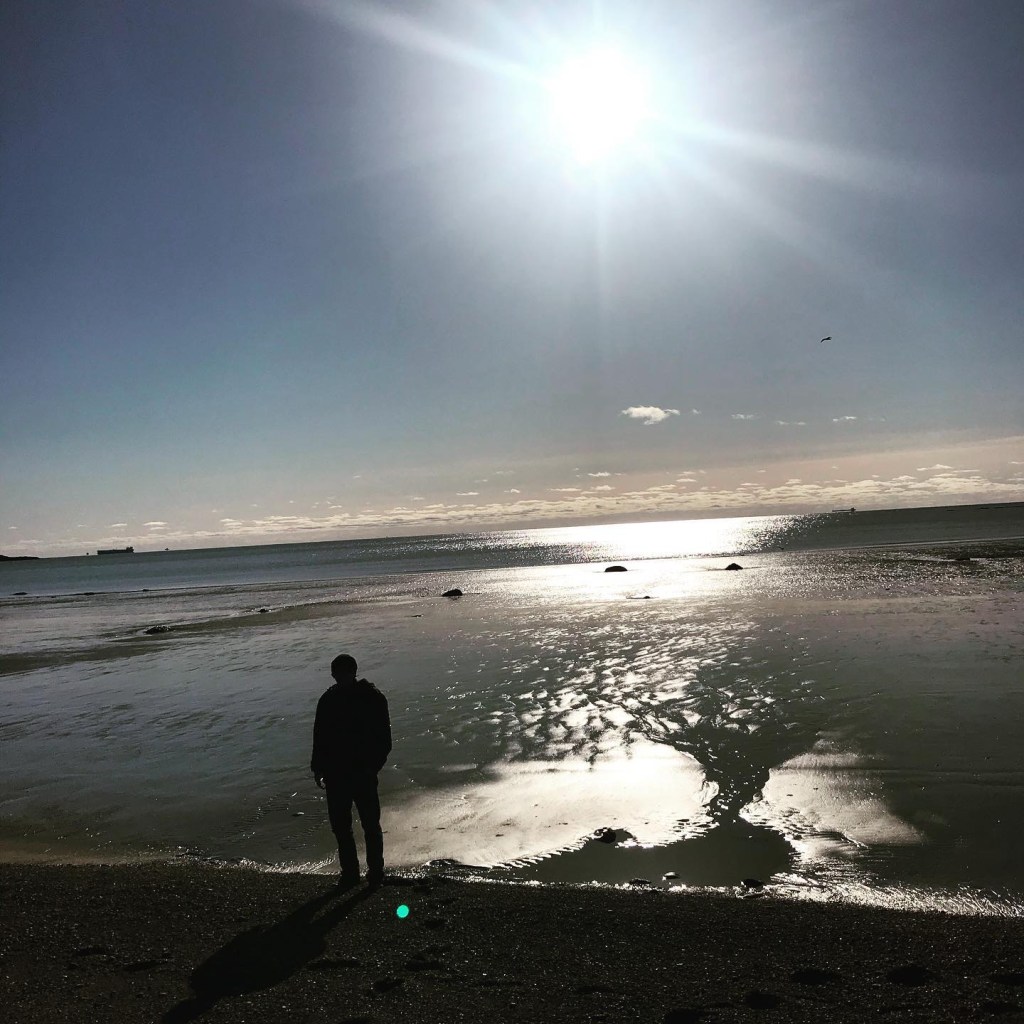
“I believe that when death closes our eyes we shall awaken to a light, of which our sunlight is but the shadow.”
Albert Schopenhauer
“Life and death are one thread, the same line viewed from different sides.”
Lao Tzu
I shall not commit the fashionable stupidity of viewing everything I can not explain as a fraud.”
Carl Jung
The Old Irish say that the sea is a ‘thin space’, a place where the curtain drawn between this world and the next is porous with peepholes, where we might speak again with our dead. I walk the seacoast often with my dog and listen intently for the hushed voices of lost loved ones in the sea wet wind and crashing waves, but none have returned or spoken plainly to me, once removed from this world, having “shuffled off this mortal coil”. Where we travel to after death, if indeed we go anywhere, remains life’s penultimate mystery, the “last unprinted snow.” It’s easy enough to discount the ancient stories in an age of science that demands, peer-reviewed empirical evidence, but such an approach seems a bit rigid with so little real data available to analyze. For this LOLIW all afterlife narratives are on the examination table, until we ourselves open Schrodinger’s cat box, or coffin as it were, and discover what lies within…an endless abyss, death’s dark sea, oblivion, or a portal to an uncharted realm…perhaps a paradise.
Whether you’re a materialist who believes consciousness dies when the brain dies, or a Dualist who understands consciousness as more than mere matter, leaving room for some notion of life after death, the unfortunate truth is that there is no real verifiable proof of either claim. While dualists might cite recurring patterns in cross-cultural qualitative studies of near death experiences, with its compelling veridical perception (reported accurate perception of events after clinical death), neuroscientists argue that oxygen deprivation and neurochemical surges are responsible for any consistency in the near-death literature. Similarly, in the case of children who report memories of previous lives, qualitative studies reveal detailed, verifiable memories, names, places and life events matching individuals unknown to these children or their families. Skeptics cite memory contamination, and investigative confirmation bias as possible explanations, but of all the stories I have read that speak to the possibility of an afterlife, I find these interviews (thousands of cases documented over decades) exceedingly interesting reading.
Where do we go for answers to questions that science cannot resolve? To story, and philosophy of course. The Ancient Greeks believed that after death we journey to an underworld called Hades. They placed coins in the mouths of their dead so they could pay passage to the Ferryman, a character called Charon, who sailed their souls across the River Styx. There, they were met by a three headed hell-hound named Cerberus…a gracious host to the newly arrived dead, but a savage assassin to any insipid soul who tried to return home to the land of the living. Maybe that’s why we never hear from anyone again then, after they pass over.
Of course, the newly bereaved with their senses keened with grief will sometimes experience the odd electrical anomaly, or maybe they come upon an errant yellow balloon in the deepest wood, or some other place it has no earthly right to be…or perhaps a new birdsong on a path they’ve walked a thousand times before. Would you believe me if I told you that when editing this essay, I closed my document to find, underneath, a dictionary look-up for the word “brother“… a word I know well…a word I have never had occasion to look up? Maybe the dead do speak to us, after a fashion, and we pass on by, unhearing.
The Greeks also tell of a place called Asphodel Fields, where the dead are relieved of all their living memories. I hate that part of the story, the idea of forgetting everyone I love. The final destination for the Greeks is a sort of five-star resort called Elysium or, behind door number 2, for the less than virtuous, a stint in a place called Tartarus, which I cannot recommend. Hard labour on tap breakfast, lunch, and dinner…Myth of Sisyphus stuff. Not wholly bad I guess…just a quick jaunt up and down Everest say, with a giant boulder strapped to you back…day in and day out ad infinitum. You’re going to be well fit after a few decades on that plan.
Jumping ahead a few millennium, honourable mention must go to Nietzsche’s Theory of Eternal Recurrence. Think Groundhog Day (Bill Murray film) where you’re destined to repeat every scene of your life in the exact same sequence over and over again in a perpetual loop. Hell of an incentive to make good life choices, isn’t it? Oatmeal or waffles… Italy or the investment portfolio…a brave life filled with great joy and heartbreak or a forever of just…alright?
I am drawn to the notion of reincarnation. Endless chances to get it right. I wonder how many lives it will take me? I’m guessing a thousand or two at least. All the Eastern religions have it that we’re born back into this world to begin again the work of climbing a sort of spiritual ladder. Eventually we reach a certain celestial plateau called “Nirvana.” For Christians, imagine St. Peter finally opens the Pearly Gates and says, “Welcome home old bean…took you long enough!
If Heaven is invite-only, then I imagine Purgatory ( a Catholic intermediary world ) must be a pretty packed pre-party… standing room only…non-redeemable sinners not welcome. I envision impromptu break out self-help rooms…’Gossipers are us’, or all those with Fear and Self-Loathing please line up here. But I guess that only tracks if you buy into a heaven and hell dialectic…right? For my part, I believe we make our own heaven and hell right here on Earth. A state of mind really, isn’t it, with your own conscience acting as judge and jury.
I mean ‘with our thoughts we make the world’. That’s what Buddha says anyway. And if I have to jump on anyone’s spiritual soapbox, it’s always going to be the Buddhist’s …they had me at karma…all that radical acceptance of what is, mastery of the self, end of suffering stuff. Of course there is no real escape from suffering. Buddhism just helps you accept it as an indispensable part of the life package. And maybe, if we endure our slice of suffering with a bit of grace, we get to skip a few grades in the school for misfit souls… who knows?
But for my money, the best book on death and the afterlife is The Upanishads, a collection of ancient wisdom teachings dating back to the 2th century BC. The title is Sanskrit for, “sit down closely.” It’s basically a user’s manual on how to get to the next level of the spiritual plain. Coles notes, it says we each arrive with a little spark of the divine inside us and our job while we’re here is to figure out our duty or dharma and to perform it with good intention. Dickens said it best, ‘mankind was my business’. Anyway, if we get it right, it’s rumoured we can liberate ourselves from the endless cycle of death and rebirth.
Sounds simple enough…right? The key to it all is embedded in an ancient Sanskrit mantra, ‘Tat tram asi’. It means ‘Thou art that.’ It’s a call to remember who we truly are…ancient, sacred, luminous beings, connected to the divine and to each other, like a string of lights on a Christmas tree. Collectively capable of conjuring a breathtaking light…unspeakable beauty.
Essentially the life we think we’re living is really just a dream…underneath we’re all actually these sacred spiritual luminous beings…indescribably beautiful, and unbreakably bound, never alone, each of us an essential piece of an endless intricate, forgotten web far grander than ourselves alone. I mean, how do you forget a thing like that? Are we all just sleepwalking through our lives …plugged in to the Matrix?
But don’t worry, legend has it that you can wake up from the dream any time you wish to Sleeping Beauty. Meditation is the best wake-up pill I’ve found so far. I mean trauma and personal tragedy work too, but I can’t recommend them. Memory can only be rekindled from within, and only when you’re ready but ideally it comes in time for you to summit the proverbial seven story mountain… to ascend the spritual spiral staircase.
I know what you’re thinking…what I’d really like, if I’m honest… is just a teeny, tiny, little smidgen of irrefutable proof…before I start the chanting, or maybe just a bit more detail on what actually happens to us after we breathe our last breath. You want the science. I get it. I’m convinced science will get there in the end…of that I have great faith. I mean we already have proof that we come from the stars, and that every single atom we interact with, including each other was forged in the stars. We’re stardust you and I.
Who knows…maybe we don’t actually go anywhere, when the lights go out… maybe we stay right here. Einstein said E=mc2…matter becomes energy and vice-versa and when you add up all the energy available at any given second, the sum of that energy remains constant. Nothing is ever really created or destroyed, only transformed.
Or consider String Theory. Essentially it proposes that the basic particles that make up our universe are little loops of vibrating strings. When scientists look at these loops at the subatomic level, it seems the number of directions to travel in may be well beyond the 3D movie we’ve been watching all our lives. What if in the unseen world of quantum mechanics there are multiple dimensions operating all at once… multiverses? Maybe when we die the end of the tunnel isn’t heaven or hell, but an alternate universe remarkably similar to the one we just left. I mean, that would go a long way to explaining the sensation of déjà vu, and precognition…that feeling when you meet someone for the first time, or enter a room you’ve never visited, coupled with a strong sense of having met or been in that place before.
To say nothing of quantum entanglement. The fascinating phenomenon where scientists can show that two subatomic particles, us, in our smallest selves, are linked somehow, even if separated by billions of light years of space. That means a mere flutter of your eyelashes can make a molecule inside a star at the edge of the universe quiver in response. What does it prove? It means we have reach…it means we can talk to the stars across the universe…it means “there are more things in Heaven and Earth Horatio, than are dreamt of in your philosophy.“
What do I choose to believe? Where do we go when we die? I’m not convinced we die at all, only our bodies, our temporary meat suits, not our real selves, the part of us that has no name. Perhaps our dead are here with us still…it’s only that they ‘walk invisible’ for a time. Thich Nhat Hahn calls it Inter-being, the idea that everything is connected, dependent and interwoven. Rather than imagining the afterlife as a location, Hahn suggests your life is like a ripple in a pond, even after the individual drop disappears beneath the surface, the ripples continue to spread. “Death is a transformation, not annihilation.”
It comforts me to think of my loved ones as only waiting for me somewhere…just a string’s length away, but the fact that I’m comforted by such a story, does not necessarily disqualify it. I cannot tell you how the light comes for us, only that I believe that it does…that it will. If we were forged in the same star, you and me, my dear family and friends, then I believe we are entangled for all time. When I leave this place, I hope to become part of the light that arrives at some appointed time for you when you awake from your dream, and until that day, I’ll be waiting patiently somewhere not too far way, to welcome you home.

 Little Old Lady … in Waiting