Tag: social connection

  • The Meaning of Life

    “To stand at the edge of the sea, to sense the ebb and flow of the tides, to feel the breadth of a mist moving over a great salt marsh, to watch the flight of snowbirds that have swept up and down the surf lines of the continents for untold thousands of years.”

    Rachel Louise Carson

    I’ve been thinking about the way, when you walk
    down a crowded aisle, people pull in their legs
    to let you by. Or how strangers still say “bless you”
    when someone sneezes, a leftover
    from the Bubonic plague. “Don’t die,” we are saying.
    And sometimes, when you spill lemons
    from your grocery bag, someone else will help you
    pick them up. Mostly, we don’t want to harm each other.
    We want to be handed our cup of coffee hot,
    and to say thank you to the person handing it. To smile
    at them and for them to smile back. For the waitress
    to call us honey when she sets down the bowl of clam chowder, and for the driver in the red pick-up truck to let us pass.We have so little of each other, now. So far
    from tribe and fire. Only these brief moments of exchange.
    What if they are the true dwelling of the holy, these
    fleeting temples we make together when we say, “Here,
    have my seat,” “Go ahead—you first,” “I like your hat.

    Danusha Lameris

    150 odd days shy of turning 60, I’ll admit, a blog post titled “The Meaning of Life” seems a little ambitious, even arrogant… utter hubris really.  Shouldn’t I be a bit closer to posthumous before attempting such a feat.  Still, it’s a dark, rainy, January day as I write this, and on rainy days when the lights glow orange, and the rain patters against the windowpanes, “no one…not even the rain has such small hands” (Cummings), I find myself incapsulated in liminal space, a portal between what has been and what will be.  It feels like the clocks have stopped and the kettle is whistling shrill, and I have been gifted stolen hours to decipher secret things, adrift in a liminal sea. I have some notes… and as the house settles around me, if I’m honest, I find myself engaged in a full-on discourse with my dear, departed brother.  If that lends the following any weight, I’m glad of it…most days I think all my thoughts are his alone anyway, truly, and I, but the scribe.

    Greater minds than ours have contemplated this age-old riddle a time or two, certainly, but, of late, I’m all the time wondering about meaning, a penchant of little old ladies in waiting, especially as we begin to lose loved ones. What are we meant to be doing, do you think, with the time we have left to us?  What’s the meaning of life?

    Maybe every soul is charged with solving this particular puzzle to their own satisfaction. But standing on the shoulders of giants, Victor Frankl, a beautiful mind if ever there was one, is as near a perfect starting point as possible. Frankl wrote that our greatest task in this life is to find meaning, and maybe what meaning we find, he suggests, depends on who we are, inside, or the eye glass we peep through for a look at the world around us. It’s important work, this search for meaning, and I’m sorry to say that a great many of us are asleep at the wheel.  Kierkegaard believed that we’re all too busy focusing on the ‘minutiae of life’. We ‘tranquilize ourselves with the trivial’, he wrote.  He called these poor souls, ‘immediate men,’ men engaged in the mundane, lost in a life of endless, repetitive deck swabbing, and never looking out to sea.

    Still others among us get so weary in their search for meaning, they convince themselves that there is no meaning to be found at all.  Even wise old Uncle Bill wrote that, “Life is a tale, told by an idiot, full of sound and fury, signifying nothing.” A beautiful line, but complete blather of course.  Shakespeare isn’t alone either.  Douglas Adams’ answer to “life, the universe, and everything” is just a number, 42 to be exact. Literary critics have worked themselves into a frenzy of deconstructive contortion, mining for meaning in Adams’ enigmatic answer but, it’s just a random number. Adams is suggesting, ever so smartly, that the universe is, in fact, random, morally neutral, an accident, and that there is no actual meaning to be found at all. I confess, a much younger version of myself took some shelter here for a time, but nihilism is a lonely planet, and not the one I intend to die on.

    Adams is a fine fellow, I concede, but my brother taught me to start with the poets when looking for the truth, or at least something to be getting on with, a figurative foothold, if you will, as we hang by our fingernails, over the vast existential abyss. It’s Whitman’s lines about life’s meaning that come to me now, “Answer: That you are here, that life exists, and identity; that the powerful play goes on, and you may contribute a verse.” So, perhaps, it’s finding purpose, or a life of service or some combination of the two that makes for a meaningful life.  Picasso wraps it up pretty, “the meaning of life” he said, “is to find your gift, and its purpose is to give it away.” Bleck…sugar spike…I promise that’s as greeting card, sickly sweet derivative as I’ll get…do read on dear friends.

    Cultivating your passions, and finding purpose, are, without doubt, excellent cards to play in the boardgame of life. It’s important to find work that you love to do… daily, if only as an antidote for boredom and disenchantment…it’s like a get out of jail free card that you can play anytime, a ticket to the ferris wheel of full engagement. Of course by this calculation, a meaningful life might equate to making a lot less money, and living without many of the material comforts we hold dear in this country… a home… a car…a Sunday pot roast. Still, I’ve always found soulless work to be the greater poverty, a cost far more dear than a slender pocketbook. Finding meaning may come at a price, but it’s a fair trade I believe, just not for the faint of heart.  Maybe meaning is best mined by the brave.   Certainly such a virtue can only help. 

    It takes a bit of courage to start you on the road less travelled, but on the plus side, any quest for meaning is also, where you’ll meet your people…the ones that you’ll carry in your heart, that you’ve somehow always known, but never met before…they’re waiting for you there…on your chosen path…and such fellowship, when you find it, is like a cheat code for unlocking lasting meaning.   Thomas Merton wrote, “we do not find meaning by ourselves alone, we find it with each other.”  I’ll add to this a little venerable Vonnegut, a wise man if ever there was one, ‘the purpose of life,” he wrote, “no matter who is controlling it, is to love whoever is around to be loved’.” That certainly has the resounding sound of truth, to my ear at least.

    Fellowship, a sense of belonging or kinship, is like a keystone, the puzzle piece that opens up a blue sky horizon or the gate to a secret garden in full bloom, each piece unique, all connected, waves moving in tandem on a wild primordial sea. Albert Schweitzer wrote that “life becomes harder when we have love for others, but it also becomes richer and happier,” and, with apologies to our learned German friend, more meaningful. “The full measure of a man,” he wrote, “is not to be found in the man himself, but in the colours and textures that come alive in others because of him.”

    Above all, when I am finished with my days, wrote Schweitzer, “may those who knew me say, ‘He was so kind.’” Hell of an epitaph, that, and maybe the best and truest route to real and lasting meaning in this life, and further still perhaps. It’s the sort of thing people said about my brother, and the kind of person I’m working hard to become, as a little old lady…in waiting (some of us are slow learners).

    That old high school dropout, Einstein, told us that “although we experience ourselves as separate from each other and the universe as a whole, it’s actually a mass optical delusion, and that the delusion is a kind of prison.” Our job, he said, is to free ourselves from that prison and widen our circle of compassion to include all living creatures and the whole of nature.

    The natural world is a multifocal Mecca for encountering meaning. It’s encrypted in the birdsong, falling leaves and snowflakes like so many clues, and the perfume that hangs in the quiet wooded trails and winding coastal paths wakes us from our slumber, like an ancient wind that whispers the wisdom of our ancestors, and lets us walk alongside them awhile. John Muir, the renowned Scottish naturalist, wrote that, “the sun shines not on us, but in us,” and “the river flows not past us but through us.”  Muir believed that going into the woods is like going home. “Into the forest I go,” he wrote, “to lose my mind and find my soul.

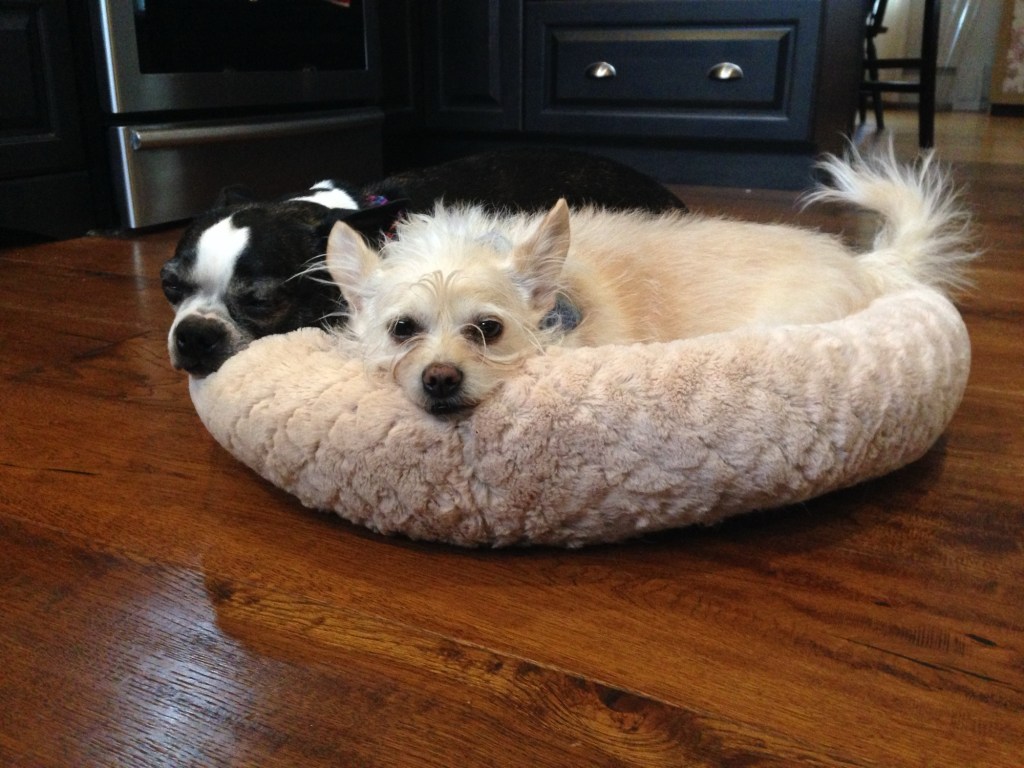
    My brother tells me that meaning is all around us, but you can only see it if you nurture a sense of wonderment.  “We need to watch things” he says, “as though they were worth watching…and not just the fireworks, and the bonfires, and the birthday cake candles, mind, but all the little beauties…everywhere.  I mean the dog napping, and everyday early morning bird chatter, the laundry lines alight like kites on windy days, or the chorus that echoes from a stand of trees. It’s the rough decaled edge of an old leather bound book with a secret inside, or a kettle boiled, the first lick of frosting on a cake made with love, and the last; it’s a letter penned, a pillowed plumped, a perfectly paired sock drawer, or the glow of a lamp lit at dusk that envelopes a common room with a golden Rembrandt hue.  Even the remembering of such moments takes my breath,” he tells me.

    Is that it then…we need just look at everything with a sense of wonder…that’s where life’s meaning is found, I ask? “That’s always been enough for me,” he replies, a knowing familiar smile on his face, “and maybe one thing more.  You see, I think we’re meant to learn something while we’re here, and if we’re good students, well…then the lessons get a little harder.  The ultimate lesson of course is unconditional love. I mean, all the best people we know have experienced defeat, and struggle and loss, haven’t they, and they found their way back out of the dark, and with an even brighter light inside themselves; the sort of light that tends to ignite a spark in everyone they meet.  It’s a light that others can warm themselves by, isn’t it?”

    “Maybe we don’t need to search for meaning at all.  Maybe if we just watch closely enough, we catch glimmers of it here and there, as we swirl past.  Life is like that isn’t it, just a waltz around the room really.  There is nowhere to go, or be, nothing that must be done…maybe let go of all that sister, and just fall into step when you hear the music.”
  • Embracing the Crone

    “The crone must become pregnant with herself, at last she must bear herself, her third self, her old age, with travail and alone. Not many will help her with that birth.” (No Time to Spare – Ursula K. Le Guin)

    “When howling gale is rattling doors, or call of lonely wolf is heard, or cry of raven on the wing, or crack of frost upon the ground, tis she, tis she, tis she. (Calleach – Siobhan Mac Mahon)

    Less than a week before Christmas, when family matriarchs are customarily exiled to Santa’s sweatshops, wrapping gifts like Edward Scissorhands, and frosting shortbreads until our collective glycemic index reads “critical,” I decided to take a night off from the Christmas chain gang. I ventured out on a dark and stormy night, in the company of a close friend of comparable vintage, to attend a workshop that promised to introduce, depict, and interpret the power and majesty of the Crone, a feminine archetype, traditionally the last in a triad, after maiden and mother.  The Crone, often portrayed in our culture as a warty hag, complete with kerchief and shawl, is cast as the most powerful as well.   A sage, a witch, a guardian, a memory keeper, a storyteller…these are just a few of the crone synonyms we might try on for fit, as we move into this last, magical, and mysterious phase of feminine folklore.

    The workshop was led by a woman who called herself a ceremonialist, a Cailleach, or “veiled one” in Gaelic mythology, who helps people transition through significant life events.  Like so many formative moments in a woman’s life,  it began with a fairy tale and the promise of a little-old-lady felted doll of our own making by night’s end, so we charged our tenuous social batteries, did battle with our homebody hearts, discussed whose eyesight was least perilous for an after dark adventure, packed a journal and a sacred object, as directed (Jesus …will there be sharing), and set off on our quest to Encounter the Crone.

    Sat close to the sea in a small conference room, the wind outside serenaded us like a siren call, a slow whistling sea shanty, and the doors rattled loudly, heralding the night’s import, like the ghost of Christmas past. We were offered tea and invited to sit around a makeshift altar decorated with bones and stones and candlelight.  We added our own holy relics: jewelry passed down from our mothers, artwork, a pinecone, a bird, a doll, the shell of a sea urchin, a heritage Christmas angel, and a witch stone, known for its magical protective properties. We were 12 women together, artists and academics, nurses, and teachers, travelling in the dark, a winter’s walk to honour our experiences, mine for meaning, and navigate together a transformation to feminine elderhood, a privileged freehold of wisdom and authenticity, sovereignty and self-possession. The magic in the room was a palpable thing…not enough to levitate… first time out mind, but strong enough to elevate us all.  I’m certain it surprised no one in the room when the lights went out and we were forced to close our circle prematurely, but not before we built something true and lasting together.

    The fairy tale recited so beautifully by our host was the story of Vasilisa the Beautiful, a kind of hybrid Cinderella and Hansel and Gretel.  Our heroine, Vasilisa, is gifted a tiny doll with magical properties from her dying mother, that protects her throughout a perilous journey to safety.  Spoiler alert she lives a full life and eventually returns to her origin story, living out her days as an elder in the forest.   The tale is simple but rich in imagery and metaphor.  We were asked to share the images that lingered in our mind’s eye.  The death scene between mother and daughter and the gift of legacy, chicken legged furniture, the impossible task of finding poppy seeds in dirt, a metaphor for discernment, and a fire torch crafted from a skull, the instrument that leads to the story’s denoument, all had honourable mention.

    For me, the lasting power of the story was not an image but an incantation.  Vasilisa called upon the power of the doll reciting, “Little doll, little doll, drink your milk my dear, and I will pour all my troubles in your ear, in your ear.” The notion of a talisman for the storms of life, a mother’s magic, an enchantment to conjure a place of safety in our darkest hour, when we’re not sure our own strength will hold; to call on the inherited love of our ancestors and open a portal of protection, or peace abiding….definately worth the price of admission. Were we leaving the workshop later that night with such a prize in our possession, a felted doll infused with magic, a protective cloak spun from our collective sacred offerings? What sorcery was this?  I started thinking maybe I should leave the house more often, even as a tempest raged outside, and Christmas at ours, still only half conjured.

    Properly incentivized we turned our attention to working with archetypes.  We chose a role from the alter at the center of our circle. Interestingly no one chose the same archetype.  There were so many wonderful choices.  I passed on Hag, and Old One, Elder and Witch.  Hearth Keeper and Herb Wife didn’t quite fit either.  We had a Weaver and a Word Witch, I remember. My friend, selected Sage.  A new grandmother, she is interested in legacy building and passing down family tradition and wisdom.  I picked Storyteller.  I’ve always been addicted to story.  It’s my preferred way to learn.  For me it’s high art, allowing us to live a thousand lives in one, a talisman against loneliness, a cure for myopia and polarization.

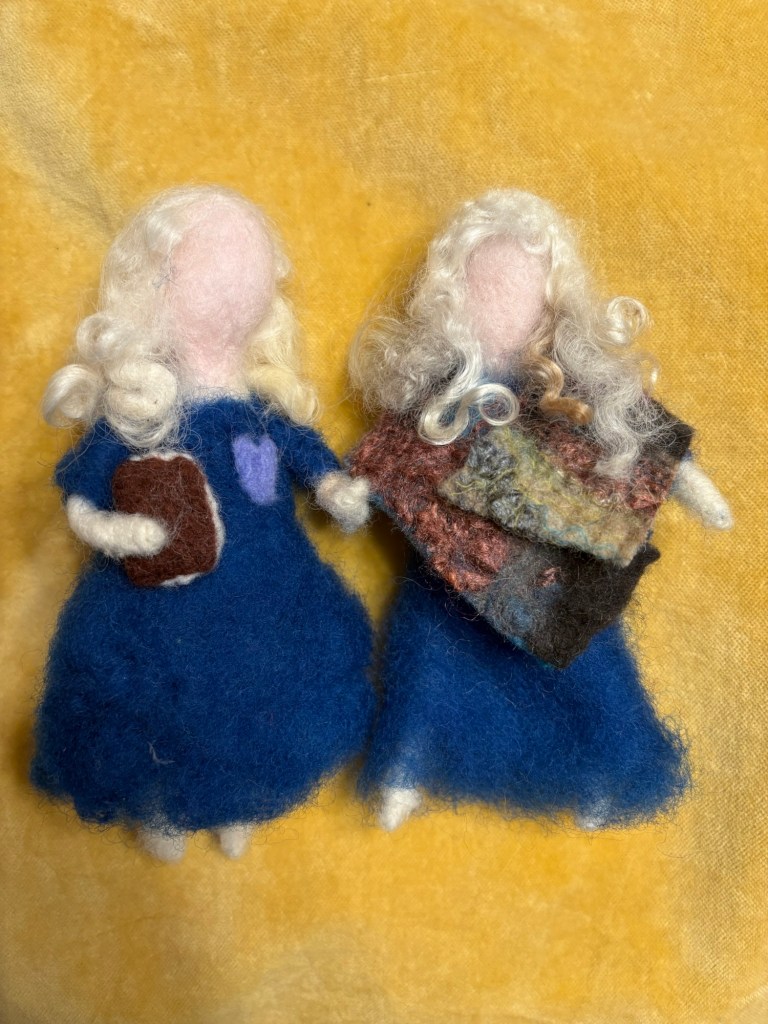
    After sharing our selections and thoughts around the archetype alter, we moved, some of us more tentatively than others, to worktables set up for needle felting, a dangerous, dexterous art, that comes with small sharp stabbing needles and raw wool to be shaped and prodded into small objets d’art, a felted little old lady…in waiting.  I wish I could tell you there was no blood lost but I’m sure I wasn’t the only hag there to stifle a silent scream that night as the needle pieced my presumably pre-loved stabbing pillow, and caught the delicate skin beneath my fingernail.  Maybe the bloodletting is part of the spell, maybe human sacrifice is the elixir that makes the doll magical.  All I know is that I stabbed my doll a thousand times or more before she came to life in my hands and the stabbing was oddly therapeutic (“psycho -killer…qu’est-ce que c’est”). I plan to continue my felt making education and have already created a companion for my doll, but maybe I’ve shared too much. Still, friends are important…even felted friends.

    The power went out when I was attempting to style my doll’s hair.  Every woman will understand the import of such a moment.  Our felting mentors came to the rescue and held cell phone flashlights for us to finish this crucial phase in the work. Suffice to say, I was never so happy to own such unruly, unkept tresses. It was the work of a moment to complete the effect and even in the dark I recognized the crone I held in my hands as my own, a story keeper and maker, a sovereign in the final decades of her reign, confidant in her unique gifts, generous in her attention to those she held dear, and determined to live intentionally, according to her values and passions until her last moments in this realm. 

    I was afraid the storm raging outside would prevent our eclectic circle from sharing our thoughts on the dolls we created. Insatiably curious, I had an almost visceral need to know how the others would answer the last question on the agenda for the  night, “If your inner doll could speak to you tonight, what would she say?”  One doll spoke of cultivating more trickster energy, to seek opportunities to laugh and have fun, another counselled that there was always something new to learn and explore, others said to ask for help and not to imagine we can do it all ourselves, that it’s ok to be messy, to rest, to be steadfast, to practice unconditional self-love, to keep moving, to offer guidance, to stand in the wind, to practice childlike wonder, and to embrace and celebrate all the beauty within.

    I know the doll is just a small, symbolic, hand-built ornament, but it feels so much bigger than that to me. I know we make our own magic, but I also know that there was a wisdom teaching waiting for us in the dark that wintry night, an introduction to “crone-ology,” a threshold for letting go of all that no longer serves us and a turning point in the pages of our story.  You may cackle, but I have plans to build my doll a small house with a door that opens with ease, so whenever I need to hold her close and feel my mother’s magic near, I’ll find her waiting for me there, her spell unbroken, a warm cloak of protection against the storms of life.

  • In Conversation with Jan Lucy

    I wasn’t looking for a new friend when I met this captivating woman.  She was waiting for me in what we now refer to as the ‘therapy pool,’ the LOLIW early morning aquacise class at the local YMCA.  A large part of me believes she was sent to me by someone who now ‘walks invisible.’ Jan’s scientific rationalist core would smile at the notion, but there are days when I believe I have her half convinced in the power of a good God Box.  Exquisitely kind, intelligent, politically progressive, community minded, and sea-loving, Jan moved to Saint John from Ontario with her husband, Don, three years ago to be close to the water in retirement. 

    Graduating with a degree in English from the University of Guelph, a proud Guelph ‘Griffin’, excelling in competitive swimming, Jan lived and worked for much of her career as a campus administrator at a satellite campus of Nipissing University in a small Ontario town called Bracebridge, cottage country for the rich and famous including such stars as Stephen Spielberg, Goldie Hawn and Martin Short.  ‘I bumped into Kurt Russell at a bar once,’ she laughs. 

    Born in Picton, Ontario, her early childhood was spent in Germany as her father was a meteorologist seconded to the military. She grew up in Ottawa and met her husband by putting an ad in the Toronto Star classifieds. ‘Where are all the Alan Aldas in the world?’ she wrote.  ‘He was a feminist, he was a humorist, and he was political,’ she explains. She received 44 responses. ‘Don was in my ‘no’ pile,’ she laughs.  ‘It was my girlfriend who pulled out Don’s letter and said, ‘What’s wrong with this guy?‘  So, I wrote to him, and he wrote back and the rest, as they say, is history.’

    After a series of unsuccessful pregnancies and adoption attempts, Jan eventually privately adopted her first child, Vincent, from Brazil.  ‘It was my labour,’ she remembers, describing the painful journey that eventually led to the great joy of bringing home their first son.  ‘When he was 4, I knew I really wanted another child and so it was back to Children’s Aid to begin again. This time it was different. Now we were considered a ‘black family,’ and so it was more a case of how many do you want?  We went to the front of the line and through a progressive adoption process we eventually welcomed our second son, Omar.  I was 39 by the time he arrived, and he was like a kitten climbing the drapes.’

    Since arriving in Saint John three years ago, Jan, socially dexterous, with charming old-world manners, and an earnest desire to connect and give back, has worked with new Canadians helping them navigate and acclimate, she has become an active member of the Saint John Naturalist Society, engaging in  ‘citizen science’. and data collection, and is a member of the Lift Community Choir, singing and supporting local causes. Most days she can be found hiking or bird watching in our beautiful province in the company of her husband, Don, and her LOL dog, Siskin.

    Tell me your life story in seven sentences or less? 

    I grew up the youngest of 3 children in a loving home. I lost my father at aged 14, when he died in a British-European plane crash…no survivors.  I went to the University of Guelph and received a degree in English where I was also a Guelph Griffin, a synchronized swimmer.  I have been married to my husband Don for 38 years, after meeting him through the Toronto Star’s Companions Wanted section. I have 4 children, two stepdaughters and two adopted boys…I like to say they were all born in my heart.  I worked for 20 years as a campus administrator for Nipissing University’s Muskoka campus where I had the best students and faculty to grow along with.  I moved to Saint John three years ago at the age of 64, buying my house online, not knowing what would come next or who I would meet.

    What is the best thing about getting older?

    The best thing…is that I’ve had the opportunity to get older.  So many people don’t. Whether it’s disease or accidents or suicide…and I think maybe it’s because of Vincent (son) being ill… and family member struggles with mental health…this idea that it could end for any of us.  So just to make it this far has been great…I hope I still have many more years, but you don’t know.

    What is the worst thing about getting older?

    Feeling like I’m running out of time…and again maybe it’s because my dad died so suddenly…he was only 46, that I worry about my life being taken away from me before I’m finished doing the things I want to do.  I’ve always been a big list maker and I like to accomplish many things in a day. What’s that old expression, “I want to arrive at the graveside all dishevelled, skid in and say, ‘Wow, what a ride!’ I don’t want to sit in a lazy boy…that’s not my thing.

    If you could retain or retrieve one quality from your youth, what would it be?

    Being more playful, I think.  I grew up with this ‘What will the neighbours think?’ mentality.  So not worrying so much about what’s expected, not worrying if your socks match.  I almost didn’t give my husband a second date because he didn’t put his cutlery together on his plate.  Or when someone is coming over…are there dust balls?  I was more playful as a younger woman.  We stayed outside and played until the streetlights went out.  So, I find if I’m given an opportunity now, I try to be more spontaneous, less wary.

    What’s the most important lesson you’ve learned so far?

    I don’t know who said it to me about your impact on your environment or on the world…that a single drop of water can overflow a cistern or a well… so not to underestimate what your small gesture or your small action can do, positively. So, I try to lift others up…I need to listen more…I know that…but by listening… if others want my advice, to try and provide what is needed. I also know I need that too. So…we all struggle in life, and I guess that’s why I love the pool so much…and why we call it the ‘therapy pool.’ It’s sharing those struggles that helps us remain optimistic and hopeful. And celebrating the high notes too, like when your son asks to speak to your friend on the phone, because he knows she is important to you.

    Do you have a favourite quote?

    “Don’t tell me not to worry, the things I worry about never happen.” (Unknown author). The other thing that my mother used to say all the time that kind of ties in to that is…’this too shall pass.’  And the whole idea that anxiety happens in the past or in the future but not when you are truly here, in the present.

    Do you have a favourite word?

    I do. It’s a made-up word, it’s ‘snigg.” So my mom and my grandmom were very progressive with their use of technology…I think they were probably emailing before I was.  My mom meant to type, after a very sentimental message, the word ‘sniff’…like after a sad story, ‘sniff’.  But typed ‘snigg’ instead.  So we’ve all taken on this accidental word whenever we come across anything sentimental or that touches our heart, we’ll always write ‘snigg,’  And what’s kind of cool is that my son does it now too, so it’s a three generational thing now.

    Describe your perfect day.

    This one was a little more challenging for me, but it has to do with water…being near water, being on it, being in it…that’s where the day starts…with water.  And then learning, I’d like to learn something and whether that’s something I’ve read, something I’ve researched, gone to a lecture or a play, but something that I’ve learned.  And lastly sharing thoughts and time with friends. 

    If you could have tea with anyone, real or fictional, dead, or alive, who would it be and what would you talk about?

    So… I thought about this one and I think it would be my mom’s mom, my grandmother. She was born in 1894. I just thought she was amazing.  She was an equal partner in her marriage to my grandfather who was Professor Emeritus of Botany at the University of Alberta.  She always felt it was important to be an intellectual equal with him and provide him with companionship.  She was pretty educated for her era as well.  She attended Alma College, a liberal arts college, but she also helped my grandfather type and illustrate his work for his PhD. And she raised two amazing, strong women, my aunt and my mother.  One of the stories that sort of exemplifies her is that on her 100th birthday there was a big reunion of family and she remembered everyone’s name, what they did, what their partners did, and asked wonderful questions.  Also, that same year, she was in a nursing home at that time, and she played the Virgin Mary and was on the front page of the Victoria paper wearing her blue scarf and holding a live baby, a little brown baby.  Before she died, there was a picture of her in the pageant by her bed, and her last words to my mother were, ‘I like to look at that picture and imagine I’m holding baby Vincent.’ Snigg.

    Another story is that when she first learned that I was moving in with Don, my grandmother’s response was, ‘Does she have a prenup?’ And then, I have a gay older brother, and it was just at the peak of the AIDS epidemic when he came out and he didn’t know how she would respond, and he went to her apartment and said, ‘am I allowed to come in?’ and she just reached out her arms to him.  So, I would like to have a discussion with her around how she became so wise, beyond her years, when there was homophobia, there was racism, and women were subservient in society…what drew her to be more? What was her thought process?

    Tell me three things that bring you joy.

    Taking some risk..like joining a choir…I mean, not bungee jumping, but I guess maybe moving to New Brunswick. I think sometimes life can be too comfortable. Do you know the story about the lobster?  The whole thing about how a lobster grows…how it has to shed its shell because it’s getting too tight, and becomes very vulnerable because it doesn’t have its hard exoskeleton. It could be dashed against the rocks…but to grow it  has to shed its shell. I always loved that story.

    The other is obviously learning new things. I never thought I would be a bird watcher until I moved here.  I love the fact that we are so multicultural here too because where I used to live it was very white…boring…one dimensional.

    And then helping others…which is a big part of my experience in Africa. It started with my sister probably fifteen years ago or more when she went on her dream vacation to Tanzania, and she met a young safari guide who had dreams of owning his own safari vehicle. She befriended him and helped with a website and referring some clients and creating itineraries for guests.  The guide’s wife was a schoolteacher, but she donated her salary back to their community.  They are incredibly lovely people and wanted to do more for their village. The guide eventually became a village elder and reached out to my sister for some help, initially for water, and then for a school.  They started very small… educating the village children and then as time progressed and climate change was affecting their livestock and food, our family became more involved.

    We ended up doing a sibling safari and as part of that, my brother who is a huge permaculture believer, suggested we might bring in a specialist from Kenya who had some success there, to see if there were possibilities for the village. We thought if they could start a small farm, then they could harvest the fruits and vegetables to feed the school.  They started teaching farming skills in the school and the kids began working with the permaculture and redirecting water runoff, and within 3 months they were feeding the kids at the school. After that some of the mammas started planting as well and the school expanded, and we were able to fund kids who couldn’t afford school fees through the ones who could, and the garden was expanded to 7 acres, and they sold the extra produce.  This all happened over the course of many years but we still talk to the village the first Friday of every month. I asked them once if I could ever be a Maasai chief.  Women don’t traditionally have much position, but I was told, not long ago by that same guide who my sister befriended, ‘Jan, you’ll be happy to know, I have three women on my advisory board now.’ Helping others brings me joy…we’re a ripple in the pond.

    Name a guilty pleasure.

    I try not to feel guilty…but I do. It’s around sweet things, specifically chocolate…really good chocolate. I never feel guilt over a kitkat…I mean going out and spending a fortune on high end truffles, because it’s money for sugar.  I feel like it’s a drug and it seems so silly and petty and something I should just let go of but at the same time, as it provides me with pleasure, why should I feel guilty about it…why don’t I deserve it?

    Do you believe in life after death? What does it look like?

    Ahh…I wish I did. I believe energy leaves me when I pass.  I want to hope there is something … maybe it’s living with a scientist. I don’t think there is, but I’ve also had these things happen…and I can’t explain it …so maybe there is something beyond what we know…but I don’t know what it is.  Is it the pearly gates…I don’t think so.  When I went on my sibling safari with my brother and sister…we were in Kenya and we were sitting at a resort and this man was wandering around singing, and all of a sudden he started singing ‘You Lift Me Up’ by Josh Groban  which was my mother’s funeral song and my brother and sister and I all looked at each other…I mean…in the middle of Africa…a song so meaningful to us all.  So, it’s those kind of things, but at the same time…I don’t know.

    What would you like your eulogy to say?

    I think I would like it to say…and this is a big task but…’She left the world a little better than when she arrived.’

  • A Curated Life

    “If you want a golden rule that will fit everything, this is it: Have nothing in your house that you do not know to be useful or believe to be beautiful.” – William Morris

    “Those who commit to nothing are distracted by everything.” – Bhagavad Gita

    I’m twelve weeks into a “down to the studs” reno of my basement. We are getting there…almost ready for paint and wallpaper …yes…that’s right…I said wallpaper. I happen to like wallpaper…just not the 50 year old striped job that lined the stairwell leading from my kitchen to the lower level of our home. I’ve hated that patterned stairwell since we moved into the house almost fifteen years ago. That’s a long time to abide an abhorent passage in your home. So…ankle deep into quasi-retirement, and my baby moving out to a beautiful space of her own; it’s got me thinking about embracing a less lackadaisical, more curated life. I refer here not only to my immediate setting, and decor choices in my home, but also to a more bespoke aproach to everything I allow entry into my mental and physical space. How we spend our time and who we choose to spend it with are weighty considerations indeed, particularly as the sands of time accelerate through the LOLIW hourglass.

    I am a woman who has always known what she loves. I’m never at a loss for how to spend my time. My baseline is reading in bed, followed closely by reading upright in well lit rooms, rooms with doors to discourage the detritus of day to day discourse. Toss in a daily walk, a few writing hours, and few games of pickleball (a smattering …mind), and maybe a sprinkling of meaningful communication with friends and family and you have the basic components of my perfectly appointed life.

    It won’t surprise you to learn that with respect to decor I like to sit in spaces that smell and feel like 19th century reading rooms. Jane Austen meets functional, animal-friendly, old-world elegance and comfort, with Rembrandt lighting in the shade of expensive cognac and furniture made to last let us say, longer than me. I like plain lines…nothing busy…smalls piles of books in every conceivable nook, and walls overfilled with art that makes me think and feel.

    Approaching 60 it seems long past time to take charge of my decor and embrace a more curated lifestyle. With more time at home to play and ponder and be, its important to invest in our space and make it conform to our notion of how to live well. Out with the acquired furniture that found its way into every corner of the basement (granny’s telephone table, the uni trunks, the side tables the dogs used as chew toys, the wedding art, the chairs I reupholstered one time too many…gone). What would your space look like if you started from scratch… what gets to stay, what gets dumpstered in the night?

    To curate is to carefully gather sift, choose and organize so that everything is handpicked, assembled, and edited by you. This might mean the dedication of an old bedroom to a fly tying workshop or a yoga studio or a writing room. The downstairs grand room might be reworked as a cozy british bar, or a working library, or a music or pottery studio. Adult spaces like day nap chaise-lounges in light colours might be positioned near full window walls for stargazing with telescopes or simply to watch the dancing autumnal leaves or the spring rains pelting your garden seedlings to life, or the magical snow that falls on Christmas eve.

    Of course lighting is everything… my mother taught me that. She liked rose tinted bulbs for evening ambiance, strong enough to read by in the after dinner hours but not so bright you can see the skin wrinkles on your LOL hands as you turn the pages…its a delicate balance ladies. A comfortable seat by the fire built for you and yours is essential for the long Canadian winters, perhaps a dartboard, a drinks cabinet… you get the idea. It’s time to focus less on containment of mess and sticky fingered childrearing chaos, and more on zones of comfort and joy for the soft bellied adults who remain. Don’t forget a posh pillow for the geriatric dog.

    Take your time visioning how to create yout LOL space.. explore your options…think about what you want your home to provide now, and build it from the inside out. There are no design rules that can’t be broken except one, namely, abandoning your own ideas on beauty and functionality. This is your home we’re speaking of, you have only yourself to please so if you want to string eddison lights from the rafters, share space with too many plants or cats or books, create an industial feel by painting the piping black or steel coloured… do it. If you want to showcase some macabre collection of antique surgical instuments or early century pharmaceutical elixirs (weirdo), now is the time to make your space into a reflecting pool for all your darlings. An invitation to your home should always feel like an invitation to you.

    Outside your home it’s equally important to curate the spaces you decide to inhabit. In rertirement if you don’t decide how you’ll spend your time, others, well meaning friends and colleagues, will ensnare you in their version of a life well lived. The siren call of casual work, the escalating addictive properties of pickleball, best resticted to promote injury preention, the silent scream of the sour dough starter and its incessant demand to be fed. That little white bread baby isnt the boss of me.

    A few years ago I read a little book called “The Subtle Art of Not Giving a Fuck” which espoused a pretty basic but essential philosophy with respect to time management and boundaries. Summarily, the author suggests that in an age where we are inundated with information and competing demands on our attention, and very often incompacitated by overstimulation and endless options, its important to decide to live deliberately and in accordance with a few key individual values and interests and spend our time and ultimately, our lives, accordingly. The book advises adopting a maximum of 5 things to give a fuck about. Thats not a lot if family and healthy living are 1 and 2. If reading, writing and pickle ball are my 3,4,5 then maybe maybe pottery and painting, knitting and felting, are curated out of my daily living line up…at least this year. Every LOLIW must choose how best to spend their time. Maybe you’ll make your garden and greenhouse your second home from May to September, perhaps you’ll join a rug hooking guild or a choir or an arts collective during the long winter months. Let your interests drive your pursuits and don’t be cajoled, or convinced to spend your time in settings that don’t meet your individual criteria for comfort and joy.

    A quick comment on mental space. I live so much of my life in my mind it’s important for me to dine on a steady diet of images and words that resonate with meaning. I hold space for vetted novels and films and converations with new and old friends who know secret things. Stories and stimuli that bring comfort and joy and occasionally cast out to higher things. While I have just as much of an unseemly fascination with Ed Gein and his skin suit pursuits and niche decorating vibe, I’m not sure I need to absorb the 8 episode narritive of the man who was the inspiration for Psycho, The Chain Saw Massacre and Buffal Bill. I mean I guess he didnt eat anyone …so thats good…right? My point is that curating that series out of my mental space and protecting my inner sanctum and sleep hygiene is probably for the best. I don’t need a visit from Gein in my dreams at night. But if real crime horror is your LOL jam, maybe Ed Gein gets a pass.

    You are the gatekeeper of your mental and physical space. Guard your boundaries, with knitting needles if need be. Allow entry only to what you decide to give a fuck about. Design a space and a life dedicated to your passions… an art room…a dream kitchen…a library…a pocast studio… a music room. It’s waiting for you beneath the debris of a lifetime of collecting the residue of other people’s idea of how to live well. So if you’ve been neglecting your mental and physical space like I have, begin an inventory of everything that you find beauty and comfort in, then drag the rest to the curb and begin again, consulting no one but your own inner curator. I believe you’ll find her taste is unerring.

  • The Art of Happiness

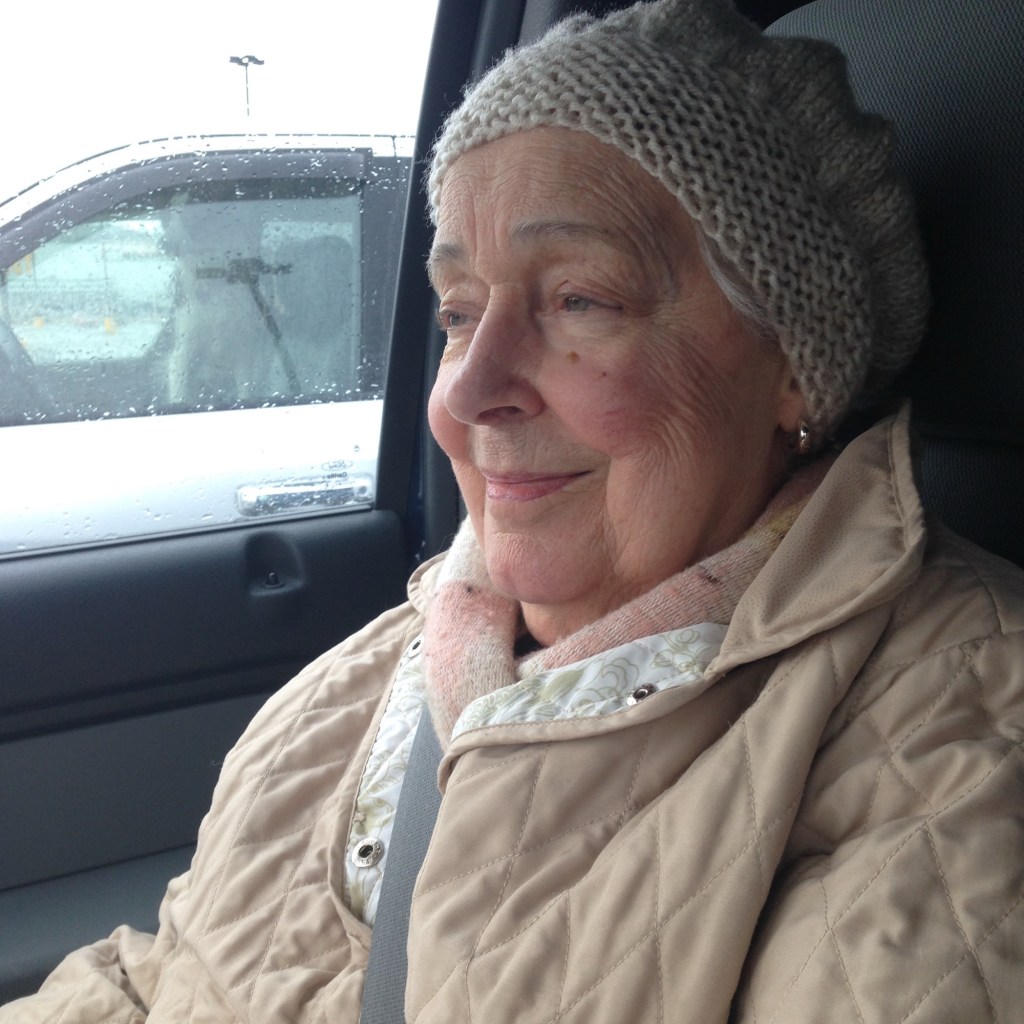
    My mother, Mary Eileen (Bunny) Lewis caught in a moment of everyday happiness

    “I must learn to be content with being happier than I deserve.” – Jane Austen

    “Letting go takes a lot of courage. But once you let go, happiness comes very quickly” – Thich Nhat Hahn

    Happiness is a slippery state of being, an elusive, inconstant companion. Like a feckless lover or an indifferent cat, it’s never near at hand when you need it most. It’s approach is often unheralded, it’s visit, never long enough, it resists all enticements to stay. It cannot be captured…it will not be held…we cannot keep it. It is as impermanent as an ice cream on a hot summer afternoon, as fleeting as a first kiss, or a glass of fine wine, it lingers briefly, and disappears into the realm of memory. The art of happiness sits haplessly in the space between our first world sense of entitlement, and our readiness to cultivate a sense of wonder, that magnifies the trace elements of happiness drawn from everyday dealings. Little things like the dog’s yawn, the carol of the wind in the trees, the smell of freshly brewed coffee, or the uncalled-for-kindness of a stranger can, with practice, conjure a sensation of peace, an ‘invisible cloak’ of contentment, protection against the certain storms of life. There are glimmers everywhere if we learn to spy them, and they can sustain us, even on our darkest days, if we apprentice in the art of happiness.

    First lesson – kill all expectation of happiness. It’s Buddhism 101, the first noble truth, ‘Life is suffering.’ Happiness is not our baseline or our birthright. We don’t deserve it, and we can’t earn it. We are not on some episode of Friends with a laugh track running every 30 seconds. Chandler Bing died of drug use disorder, and Rachel’s husband left her for Angelina Jolie. We’re in the ‘real’ people, and to quote the venerable Monty Python, ‘Life’s a piece of shit…just remember it.’ (It works better if you sing it). My kids would say that that’s a bit dark or defeatist, but I’m with Schopenhauer and the Pessimists, you need a sense of humour to get through the tragicomedy we call life, and ‘the safest way of not being very miserable is not to expect to be very happy.

    Buddha’s second noble truth is that we’re the problem…we are the root of all our suffering…we build our own hell. The art of happiness is to desire less…stop trying to make the world conform to our preferred narrative…that way lies madness. Relax…we control nothing… and anyway, sometimes bad news is good news in disguise, if we wait long enough. It is a mighty thing to slay your expectations and lay yourself open to your share of frustrations, disappointments, and loss. My mother always told me that ‘acceptance is liberation.’ She was a very wise woman, a gift earned from enduring her measured cup of sorrows.

    William James wrote ‘We need to stop deciding how we want things to be and then getting ourselves upset when things don’t turn out that way.” Easier said than done Willie, especially when you discover the last piece of cake gone, or the poop your geriatric dog deposits on the dining room floor every night.  Still, I say give it a try next time you’re provoked by an uncapped toothpaste, a Sunday driver when you’re running late, a rainy day when you wanted it fine.  Start there and when you’re ready you can move on to little old lady sized stuff, like chronic pain, or learning about a friend’s new cancer diagnosis, or loosing someone you loved very deeply…someone you thought you could keep forever…a loss that feels like the sky’s gone out and taken all the stars away. It gets a little harder to wash down then, even with a good red.

    James would say, ‘If you believe feeling bad, or working long enough will change a past or future event, then you are living on a different planet, with a different reality system.’ He’s right of course. we can’t get so mired in the shitty pieces of our story that we miss the good bits…the glimmers.

    We can’t be ‘shiny, happy people’ all the time and I guess we shouldn’t even try. Don’t we need a certain measure of malcontent to get anything done? It’s only unhappiness, disappointment and disenchantment that puts our clay feet on the floor every morning, isn’t it, that fuels our pursuit of wisdom…some magic beans to make the daily grind a bit more palatable? If we were happy all the time, we’d stay at home all day and roll around in it, wouldn’t we, hedonists supping on donuts and Netflix until our brains and our bodies turned to mush.  That’s Hotel California my friends…’and you can never leave.” (Again, much better if you sing it with me)

    If we can’t capture happiness and keep it caged, as we might like best, then we can cultivate habits and practices that invite happiness in, offer her tea and something sweet to encourage a long and robust relationship.  Gratitude is the first and best invitation to happiness that I’ve discovered.  It is that great looking glass that magnifies all the beauty and riches around us, large enough for us to see all that we have been allowed to keep… legs that take us walking, minds that may still read and discuss, running water still clean enough to drink, maybe even a hand to hold.  I’ll add to this the extraordinary occasion for a fine cup o’ tea and in good company.  Vonnegut suggests we recite in such moments of clarity, ‘If this isn’t nice, I don’t know what is.”

    We must fall in love with the beauty that is all around us.  Cast our eye about ourselves each morning and count our blessings.  Oscar Wilde wrote that ‘most of us are living in the gutter, but some of us are looking at the stars.’  We need to look for the glimmers.  They’re everywhere once you start practicing: the dance of late summer leaves, the first line of a new book, or that feeling of being understood…an easy, effortless fellowship that lets us know we’re not alone.

    Friendship is the second essential pillar in my study of happiness.  Friends come in many shapes and sizes.  They can be fictional, or four-legged, they can be blood, and people we grew up with, or choose to grow old with, but more often than not you’ll find them out roving on some adventure.  They arrive unexpectedly, a happy surprise, and their company can feel like coming home after a long time away, or a gift you didn’t know to ask for, but have wanted your whole life. ‘The secret Alice, is to surround yourself with people who make your heart smile, it’s then, only then, that you’ll find wonderland.’

    If you’ve not yet landed in Wonderland, then I suggest you take a break from your own troubles and concerns and look around you for a way to help others with theirs.  Service is chapter 3 in the little old lady book of happiness.  My brother was in love with Emily Dickinson, she was a dear friend of his.  She wrote, “If I can ease one life the aching, or cool one pain, I shall not die in vain.”  I say do harm to no man and never miss an opportunity to do a kindness. Be a light for others.  I love the old Indian proverb, ‘Blessed is he who plants a tree under whose shade he will never sit.’ To my mind there is no better way to cultivate your own happiness than to contribute to the happiness of others, unseen, unacknowledged and with great humility. If we’re all made of the same stuff in the great fabric of being, then watching out for a dropped stitch here and there only makes good sense…keeps us all from unravelling. 

    If we can stay with the knitting analogy for a minute, then I suggest that the fourth practice in this little old lady’s guide to a happiness, is to keep to your knitting every day.  The work we choose to do is key to practicing good happiness hygiene. If you love your work, then every day is a delight and you’ll be a success, no matter the weight of your wallet. That’s not to say you won’t have to find some job to keep you in beer and bread and a roof over your head.  But you must never let those necessary hours detract from your real work, the work you recognize as your own. And if you haven’t yet found this work then, to quote Ms. Dickenson once more, you must be ‘out with lanterns, looking for yourself.’ 

    John Muir the great naturalist counsels that ‘nothing dollerable is safe.’  That’s the way, he implies, to Thoreau’s ‘life of quiet desperation.’ I say be curious, go adventuring, stretch yourself beyond your imagined limits, investigate, take yourself away, let yourself go quiet.  Your work will find you…artist, teacher, carer, baker, candlestick maker…it matters not.  Trust only that which speaks to your soul, that engages you wholly, that causes you to lose time and that you can’t wait to get back to again each day on rising. ‘It’s foolish for people to want to be happy,’ wrote Georgia O’keeffe, ‘our interests are the most important thing in life.’ ‘Happiness,’ she said, ‘is only temporary, but our interests are continuous.’

    Lastly, and maybe most importantly, happiness lives principally in the present moment.  We need to slow down and stay grounded here in the now, and as the Stoics suggest, ‘do every act of our lives as though it was the very last act of our lives.’ All the greats say the same. To quote my favourite Buddhist, Thich Nhat Hahn, we must ‘drink our tea reverently, as if it is the axis on which the world revolves.’ ‘Eternal life’ wrote Wittgenstein, ‘belongs to those who live in the moment.’  But the poets say it best, To see a world in a blade of grass…heaven in a wildflower.’  It’s that moment when the musician understands that he is not only the strings of the instrument he plays on, but also the music that fills the room and touches the heart strings of everyone who hears.  There can be no higher experience of happiness to my mind then being fully present and awake to your surroundings.

    If you asked me the raw ingredients of my own happiness, I would quote Tolstoy, ‘Rest, nature, books, music, such is my idea of happiness.’ I also try to practice what my brother taught me… to live in a state of radical amazement.  E. B. White urged us to ‘always be on the lookout for wonder.’ So, I get up each morning and try to look at the world in a way that takes nothing for granted. The art of happiness lies in extracting it from commonplace things and as a little old lady in waiting, I’ll give the last word to that old sage, Socrates, ‘Let’s enjoy ourselves,’ now, ‘It’s later than we think.’

  • On Pickleball – An Addiction, a Meditation, a Playground for Graybeards and Dowagers

    Photo Credit – Joanie Lawrence

    “And though we are not now that strength which in old days moved earth and heaven, that which we are, we are. One equal temper of heroic hearts, made weak by time and fate, but stong in will, to seek, to find, and not to yield.”

    Alfred Lord Tennyson

    Hello. I am a little old lady in waiting, and I am … addicted to Pickleball. It started innocently enough…it was between the early morning Aquacise and the Active Aging strength training class that I first spied them, the Pickleballers (contemporaries, mostly retired, not exactly sportswear models…maybe for the vintage lines), slamming the hell out of a whiffle ball with what looked like oversized ping pong paddles. I stood there transfixed, my nose to the gym windows, mesmerized by the speed of the play and the unique center court positioning, which I later came to refer to as a ‘kitchen party.’ I could hear what sounded like actual whooping and wailing, ‘ooo’s’ and ‘ahhh’s,’ yelps of triumph and elation, and grunts of exertion and defeat.  It was a far cry from the mantras and abiding calm of the yoga studio, or the punishing routines practiced by the contortionists who lift and press and strain in the weight room, teeth clenched. So, when an old friend, I’ll call him ‘Dark Larry’ to protect his identity, invited me to play one day, I ‘screwed my courage to the sticking point’ and grabbed a racquet. I mean how hard could it be…right?

    Half an hour later…ok…20 minutes, I was drenched in sweat and red faced from sprinting and, well… shame and mortification.  I made my excuses and hobbled out. Full disclosure I’m not exactly ‘sporty spice’ unless you count reading outdoors or strolling with my geriatric dog. I couldn’t even return the ball unless it landed on my paddle by some stroke of luck, my eye-hand coordination was… shall we say, non-existent.  It felt like I had a learning disability. My synapses were firing fine but, not fast enough for my body to translate into something approaching athleticism. I sucked. We got pickled…twice, which means we failed to score a single point against our opponents. They say they didn’t know it was my first time, but I’m not sure I believe them.  I’ll never forgive those mean girl grannies.

    Two years later, including an 8-month hiatus for a back injury and surgical repair, I’m still playing pickleball.  My doctor said if I continued to play it was ‘at my peril’, given the number of injuries associated with the game, but when my surgeon, a sports enthusiast, gave me the all clear, I was back at it before the stitches melted away. Today, on a good day, I self-identify as an intermediate level player. I won’t bore you with the metrics, suffice to say, I feel like a badass when playing novices, and cannon fodder when flanked by advanced players, predators of placement, magicians who wave their hand back and forth at the kitchen line, a subtle roll of their paddle and its done; an unreturnable serve to your backhand, a ball that makes no bounce, a paced shot to your dominant shoulder that requires the reflexes of a teenager to return.

    Advanced players drill more than they play, they do battle with ball propellers until they perfect each shot, while intermediates, “the middle children” of the pickleball world,  mostly play each other, shrieking in satisfaction or allowing ourselves small knowing smiles of quiet delight when we land a 5.0 serve, or execute a perfect kill shot that ends a long dynamic rally.  A new favourite partner with the gift of the gab, let’s call him, ‘the Winemaker’‘, always says, “that one’s going on the fridge,‘ in those prized moments of unexpected glory.

    While those adrenaline fueled 10 second highs are satisfying in the extreme, I’m not convinced that’s sufficient reward to tempt a recluse like me to expend the energy required for  my daily pickleball fix. We’re out there for hours most days.  I like people fine, but I find them lovelier from a distance.  My social battery is three times too small, a birth defect I believe.  I have a decided preference for the “usual suspects” of long acquaintance, and well-trod social settings.  I do like the structure of organized play, however, and the fact that very little conversation is required during play. 

    Pickleball has its own vernacular: we speak of drives, and drops, the dink, the lob and my new favourite reset strategy, the drive-drop.  There is the infamous kitchen, or non-volley zone, the seat of power in pickleball, much like the center quad in a game of chess.  She who reaches the kitchen first controls the play, it is where all kill shots (overhead slams or smashes that end a rally) are born. There is the postage stamp at each corner of the court where all good serves hope to land.  Then there are the basic strategies like serve and stay, the deep return, the third shot drop, or the party pieces like ATP, the Ernie, the Houdini, and of course things to avoid, the double hit, the double bounce the foot faults, the net balls and the lets (rallies that must be replayed for any reason).  We won’t even start in on the unique scoring articulation that includes the score and server position, to be announced before each serve. It takes a moment to master, and in the end, no one can remember who is serving anyway, let alone the score. As a friend said only last week, “Sometimes I’m holding the ball and I still don’t know who is serving.”  I usually defer to the youngest player on court, rather than waste precious play time arguing with peers in the early stages of cognitive decline…no one wins those debates.

    Once you’ve learned the basics, and the lingo, then the task is to learn the players.  The lefties who encroach on the center court shots from the right, the lobbers who take advantage of the mobility compromised, the ball hogs, the blind men whose line calls are questionable at best, the players who like to call their opponents’ line calls, your basic complainers, and whiners, the cheaters and liars, those prone to unsolicited advice, those who intentionally misrepresent the score to their advantage  a second before serving, the unkind casual remarkers, passive aggressive mind fuckers….and those are just my friends. Just kidding…I adore my squad…truly. There are vexations of course, any pickleball club is a microcosm of society at large, complete with social miscreants, but for the most part the community, at the intermediate rec level at least, is honourable, inviting, observant of established etiquette, and focused on good solid play.  You win some, you lose some, and most everyone lands a shining moment, even if it never ‘makes the fridge.

    While I’ve met some amazing people playing pickleball, artists, musicians, landscape designers, neuro-surgeons, businessmen, accountants, IT types (all mostly retired); and acknowledge that for many the soft, social side of pickleball, ‘a place where everyone knows your name‘ is a big draw, I can honestly say that for an introvert like me (masquerading as an ambivert because it sounds cooler), the sweaty social petri dish of court society is most definitely not the source or even a triggering  factor of my pickleball addiction.

    So, what is the allure?  If it’s not the thrill of blood sport, or the social networking, what exactly is driving my pickleball predilection? Why do I routinely leave the house, against my better judgement most days, to play a sport that I am only arguably competent in, flailing about with quick furtive movements that can’t be considered optimal exercise for my crumbling spine, and osteoarthritic joints, and that often overwhelms my inner agoraphobic (I mean…I could be home, reading)? 

    Something is driving my need to hit that perforated, neon yellow, plastic chew toy of a ball, and I think it has more to do with my relationship to the ball itself than to any of the dear friends I count myself lucky to have met on the courts. When the ball is in play I am hyper focused, almost as though I was encapsulated in a speed game of Atari pong.  My brain likes the readiness position, awaiting the ball’s rapid-fire approach and the subsequent response signal it sends to my unruly body to return the volley. It likes to look for openings for ball placement and opportunities to dink or lob or drive as it draws me to the kitchen as if by a magnetic force. While my brain is engaged and my body, the recalcitrant slave to its unreasonable demands, I experience a heightened sense of relaxation. At play I am immersed in a thought-less slumber, I’m cocooned in an unconscious whiskeyesque oblivion.  I go animal.  Playing pickleball is a reprieve from the constant flow of thoughts that plague the modern mind.  It is a meditation, a place to rest from the narrative that has no end in the curious mind of this little old lady in waiting.  This emptying of cerebral space to all but the most basic objective, to hit the fast-moving ball, coupled with the therapeutic endorphin ride that accompanies the exacting physical exertion, and the dopamine high of a well played point, I believe that is the root of my pickleball addiction.

    You understand that win or lose, novice, intermediate or advanced, I’m still an introvert sloshing through a sweaty- peopled mosh pit to play pickleball.  Why do I do it? I do it for the dopamine.  Don’t get me wrong, I love  to win, but win or lose, the best games for me are those that are over in a flash, equally matched or playing slightly above your natural abilities, surrounded by the ‘usual suspects’, the squad that invite you out to play each day, the partner that taps your paddle after a missed shot in a show of support, the victories, the defeats, relentless humanity in all its splendour.   In the early morning hours, I tentatively open my car door in the crowded car park of the pickleball courts and am assailed by a chorus of laughter and comradery coming from a cohort who have worked hard all their lives, old enough to have earned their place in the playground, and still young enough to understand the importance of play.  It is a beautiful sound, uncommon and contagious, and sweet enough to cast a reciprocating smile on the face of even the most determined introvert. 

    Author’s Note:

    This blog post is dedicated to my very first pickleball friend who I’ll call ‘Spreadsheet girl’. We started this crazy game together, and she is currently out with an injury.    I hope I’ll see her soon.