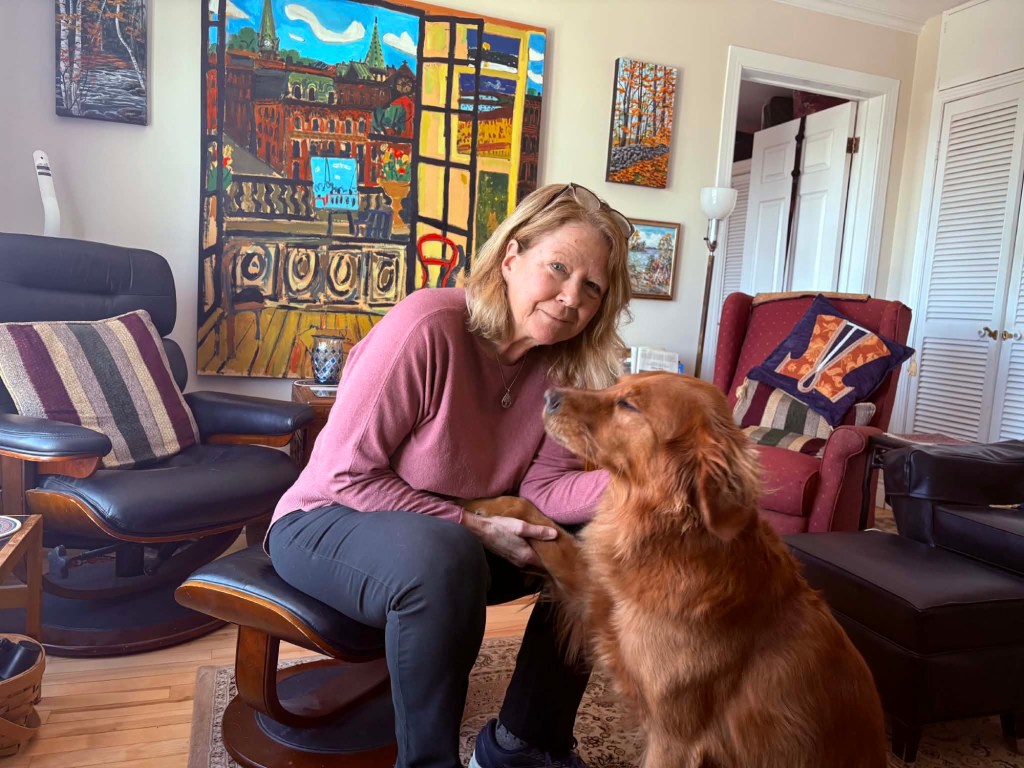
If I ever write a novel, my heroine would look and speak and live a life a lot like Nicola Carter. Think Gwyneth Paltrow in Wes Anderson’s The Royal Tannenbaums, some undisclosed number of years later. Closing in on 70, Nicola remains an uncommon beauty, with a brilliant mind, and an elegance or manner that sets her apart from her peers. She has an air of mystery…she intrigues me. It’s not that she doesn’t dive in to the deep end and discuss deeply meaningful, life altering experiences, it’s simply that you are left with the impression that she holds something in reserve, like a secret locked away, encrypted in her backstory. I must confess to a LOLIW girl crush.
During our interview Nicola serves me a cup of hibiscus tea, her current favourite, and a plate of halva, a dense, sweet middle eastern treat, both firsts for me. A tea ball in the character of a mouse, hangs precariously from the side of my hand painted cup. I am enchanted. In the home she shares with her husband, Jeff, the walls have been hollowed out to hold and frame hundreds of books, the remaining wall space is covered in an interesting, esoteric art collection gathered on her travels or inherited from ancestral homes. One small impressionist landscape in bright yellow draws my eye, a shock of sunshine from the back deck spills into the living room, and transfers my attention to a well-appointed outdoor space that transports you to a private, wooded, Narnia-like oasis, all within the city limits. Every part of her home has been utilized with intelligent design. I feel at home immediately, welcomed by the princely Leo, a well-trained and well-loved retriever, easily the greatest treasure in Nicola’s collection.
Born in Saint John, Nicola spent her early childhood in Fairvale (Rothesay). Her mother was a concert pianist and her father a well-known corporate lawyer, described as “The Giant Slayer” after fighting and winning a case in the Supreme Court against a prominent NB family empire. Her father passed away when Nicola was just 15 and her family moved from Toronto to New York where she and her brother were both accepted into the prestigious Dalton School, where many prominent and powerful U.S. leaders are educated.
While English Literature was her first love, Nicola completed an honours degree in Computer Science receiving the program medal, graduating at the top of her class in a male dominated field of study. She started a family around the same time she started her IT career with the Newfoundland Telephone Company, later working for McGill University where she was involved in building the internet in the mid 1980s, when only research institutes and the military had access to the platform. She was instrumental in building the Quebec network (RISQ). and later ran the province’s operations network for them. She describes the experience as “good fun…we we’re inventing things.” She eventually returned to New Brunswick, where she soon began work at UNB, tasked with building the internet in NB. “NBTel very quickly saw a way that they could monetize it, by installing modem banks…where people would buy email addresses and then NBTel would manage it. At this point the network was still dial up and they put me in operations where people were hands on with the Internet and where they needed the most support and experience.”
“In time I made a lateral move into engineering where I was tasked with maintaining the infrastructure and eventually moved into management. Every new technology came with problems and I enjoyed being part of the teams that solved those problems. Engineering was also where I met my husband, Jeff.” The information highway was a brave new world and Nicola was well placed with the credentials and the knowledge to take on the challenge of an exponentially accelerating and expanding field. “When it took off it took off,” she remembers.
Today, retired for more than ten years, Nicola maintains an active lifestyle, as an avid outdoorswoman, a passionate chef, a cryptic crossword aficionado, an art lover, a grandmother and more recently a great grandmother. She is well travelled and well-read and enjoys what I would describe as an aristocratic lifestyle. Her days are her own, she maps her own course, and although she has known great loss in her life , she found her way out of the dark, a herculean task, her intellectual curiosity intact, and her joy of learning enhanced and thriving.
Tell me your life story in seven sentences or less?
I was born in Saint John, and went to school in N.B., Toronto and New York, always a bookish introvert with a passion for reading, animals, music and asking questions…annoying questions.
After graduating, I had some false starts, bailing from a pre-med program at Western, bussing tables in Vancouver, driving across the U.S. in winter in a $200 ‘62 Ford Fairlane, later landing in Newfoundland with a revised study plan at Memorial: a degree in English Literature, then a sharp turn to an Honours degree in Computer Science, acquired to gain immediate employment (I was pregnant with my first child at that point).
Over 37 years, I enjoyed a varied, challenging career in technology-based roles, beginning at Newfoundland Telephone, then McGill (early heady days of building the Internet), UNB (more technology builds as the Internet evolved including some teaching consulting and development in other areas such as multi-media), and finally at NBTel in Engineering and Operations technical and management roles until retirement in 2015. My favourite roles? Solving complex technical problems.
Since 1979, I have enjoyed parenting my sons Ben and David, born in Newfoundland, and since 1994, step-parenting Jennifer and Jessica, daughters of my husband, Jeff. The challenges were many, and the rewards, great.
What is the best thing about getting older?
Self-knowledge of my physical and mental strengths and weaknesses. This helps me better understand what I need to do to thrive in my body and my mind. I confess to not always acting on this knowledge but it keeps me from trying unnecessarily hard. I can generally relax and accept more than I used to.
What is the worst thing about getting older?
Loosing people I love.
What would you title this chapter of your life?
I have a different one every day but I’ve settled on “Riding the Waves: Aging Gracefully and Gratefully”
Describe Your Perfect Day
A day which starts as a blank slate with no appointments holds the promise of a perfect day.
The day would flow with a balance of exercise, reading, music, time with a friend, learning something new (probably from CBC, overnight radio, or a podcast), a long dog walk and, if it’s not winter, kayaking, swimming, dock-sitting, and ending with a really good meal.
If you could retain or retrieve one quality from your youth, what would it be?
I don’t think I have lost many qualities of my youth, except perhaps overwhelming anxiety which I’m glad to have tossed, mostly. I am glad to have retained an abiding sense of wonder, hope, and optimism, a walking “Maggie Muggins” inside. I retain my childhood thirst for knowledge and ceaseless curiosity. Lucky me.
What’s the most important lesson you’ve learned so far?
Hmmm…I have really experienced and learned a lot. The most important lesson I have learned is that control is an illusion. I humbly accept how little control we mortals have over much on our lives. This is profoundly freeing. The seeds of this knowledge were planted early, with the unexpected suicide of my father when I was 15. Untimely deaths have been a recurring tragedy in my life. In 1994, my youngest brother, Erskine, succumbed to a long-term illness, aged 24. In 2023, my oldest son, Ben, died unexpectedly in Egypt, where he had lived and taught for 10 years. That same year, my dear younger brother/best friend, Cyrus, died, aged 65 in Istanbul, where he made his home as a teacher for over 30 years. I am still reeling from these last two losses but will say that the profound knowledge that I can control so little, and that I should not try, brings me some peace. Maybe we can only really start letting go when things have gone.
The lesson is not all bound to negative outcomes. I have had some surprising experiences which have happened around me, circumstances not in my control, that have reinforced the lesson in a positive way. Back in 1984, my partner and our two sons were in Montreal during the Labour Day Central station bomb blast. We were actually at the station when the bomb erupted with noise and smoke and screams. It’s a crazy story …we made our way out of the carnage and by some strange circumstance ended up chatting with a man who reassured us that the bomb had not been on my brother’s departing train. That evening the man’s photo appeared on the TV. He was the perpetrator. We then became involved in the subsequent inquest and trial.
Another time I was able to rescue two little boys from drowning at a local lake, just by sheer luck…I spotted something. I was just in the right place at the right time.
Finally, and perhaps most extraordinarily, I brought Jeff (husband) back from near death…also by sheer luck, when I found him unresponsive and not breathing in time to bring him back to life. How fortunate I was in time.
In short, I placidly accept my relative insignificance, and do what I can do to deal with situations…good, bad, or frightening, and accept the surprise of unexpected adventures.
Do you have a favourite quote?
A quote that frequently comes to mind is “Would it help?” This came from the film, A Bridge of Spies, when a spy is about to be sent to his probable death in East Berlin. His captor notes that he seem svery calm and asks if he is afraid, to which he responds, “Would it help?” I think of these words when faced with situations which could drive anxiety, or fear or anger. It gives me space to temper my reaction.
Can I have another? In a recent interview, Bob Rae mentioned that he read aloud Shakespeare Sonnet # 25 as he migrated from one political role to another. The quote contrasts temporary “proud titles” with the enduring joy found in true love I think that sentiment brings a valuable humbling perspective to some of the trappings we might boast That resonates with me.
The two quotes Rae highlighted from the Sonnet were:
“The painful warrior famoused for fight, / After a thousand victories once foiled, is from the book of honour razed quite, / And all the rest forget for which he toiled;”
“Then happy I, that love and am beloved, / Where I may not remove nor be removed.”
Do you have a favourite word?
My favourite word is an acronym, F.A.E. (fundamental attribution error) I use the word often at home as I did at work, to remind myself and others that we should not ascribe someone’s behavior to our ill- formed impression of their character, when the bad behavior could result instead from circumstances of which we are not aware. We should not immediately presume to know what’s going on in another’s head. We should take a breath and seek to understand. FAE has a been a good tool in de-escalating conflict. I can cry out, ‘Hey, FAE!’ at home and we all pause to reset.
If you could have tea with anyone, real or fictional, dead or alive, who would ir be and what would you talk about?
My brother, Cyrus, whom I would call my longest, precious friend. We never judged each other, shared so many interests, were both avid readers, and curious learners. I want to pick up where we left off in 2023, when he was still well, share some tears and many hearty laughs. Sublime and the ridiculous. My internal conversations with him still go on.
Tell me three things that bring you joy.
Witnessing the next generation evolving. I have loved watching my sons and step-daughters making their way. Now I enjoy seeing my grandchildren, who are all different and special in their own ways, growing. Grandparenting is such a rich role. A great grandchild was born into our clan last year. Another person to witness in their evolution.
Walking in nature or just walking – especially with my dog.
In summer sitting on the verandah at the camp looking out at the lake and listening, and often reading. Doing nothing is not really doing nothing.
Name a guilty pleasure.
So many pleasures and so little guilt. Is that wrong? I assume that guilt might arise if one felt judged for these pursuits. I happily admit to seeking solace in true crime podcasts, and doing word puzzles pretty much every day.
Do you believe in life after death?
If there were life after death, I don’t believe it involves a corporeal existence nor anything we currently understand. Perhaps we live on in the memories kept by friends and family and our energy is drawn back into the universe.
What would you like you r eulogy to say?
I’ll come to this answer indirectly. At my son’s celebration of life ceremony, five of us spoke: myself, Ben’s father, Arthur; Ben’s brother, David; Ben’s lifelong friend, Matt; and Ben’s close friend in Cairo, Jim. We did not discuss in advance what we planned to say. What emerged organically was a remarkable and moving tribute, with little overlap between the 5 speeches, each one recalling different aspects of Ben. It was clear that we all had different relationships with Ben, largely dependent upon our roles. In total, we together painted the complete picture of Ben and learned how he had touched each one of us.
I would like to be remembered similarly, in eulogy or privately, by those I have loved or touched, for what we have shared and what they have valued about our relationship. Actually, I’d like to know these things before I die.
 Little Old Lady … in Waiting