Tag: poetry

  • On Grief and Loss and other Incurable Conditions of the Heart

    “Why is it that words like these seem to me so dull and cold? Is it because there is no word tender enough to be your name?” 
    ― James Joyce, (The Dead)

    “Before you know kindness as the deepest thing inside, You must know sorrow as the other deepest thing. You must wake up with sorrow. You must speak to it till your voice catches the thread of all sorrows and you see the size of the cloth. Then it is only kindness that makes sense anymore, only kindness that ties your shoes and sends you out into the day to gaze at bread, only kindness that raises it’s head from the crowd of the world to say ‘It is I you have been looking for,’ and then goes with you everywhere like a shadow or a friend.

    -Naomi Shihab Nye (Kindness)

    My brother, Kelly Blaine Joseph Jude Lewis or KBJJ, as he signed all our written correspondence, was 90 percent angel and only 10 percent human…always…not just in death like some knighted memory where all our flaws are conveniently forgotten. Even as a child, the middle child to be exact, he was everyone’s favourite, a good son, a sweet man, a comic, a sage, a poet, a most excellent companion, a loyal and honest friend, and a beloved brother. He was a quiet, thinking man…he noticed the little things…he was careful with other people’s hearts.

    A fit, 58 year old vegan, my brother died of a massive hemorrhagic stroke on a beautiful summer day, three and half years ago now, and the sense of loss and grief I have held every day since his parting is still so close I can barely breathe when I remember him. My days are laced with little daggers that keep him alive and I am grateful for every one…the rough cut decal fore-edge of a new book, cinnamon raison toast and earl grey tea, bookstores, and coffee shops, an Irish lilt or a Scottish burr, nature walks, and the sea…always the sea, or the tang of the sea scented streets of this dirty old town he so loved, never more so than on a crisp autumn afternoon. He was all of my favourite things … “my talk, my song,” and “everywhere he walked was holy ground” to me.

    My brother lived alone, a singleton, and it was only the kindness of a concerned co-worker that alerted us to what was to be the last day of his life. He was rushed by ambulance to hospital where neuro-surgeons explained that there was nothing to be done. So, we sat in shocky silence by his deathbed and held his still warm hands. When death came close, I lay my head on his chest and listened while his heart stopped beating and his lungs swelled with his last breath. To the woman who gave our family those last few hours with my brother, to sit with him as he left this world, to say our last goodbyes, I will forever, be in your debt.

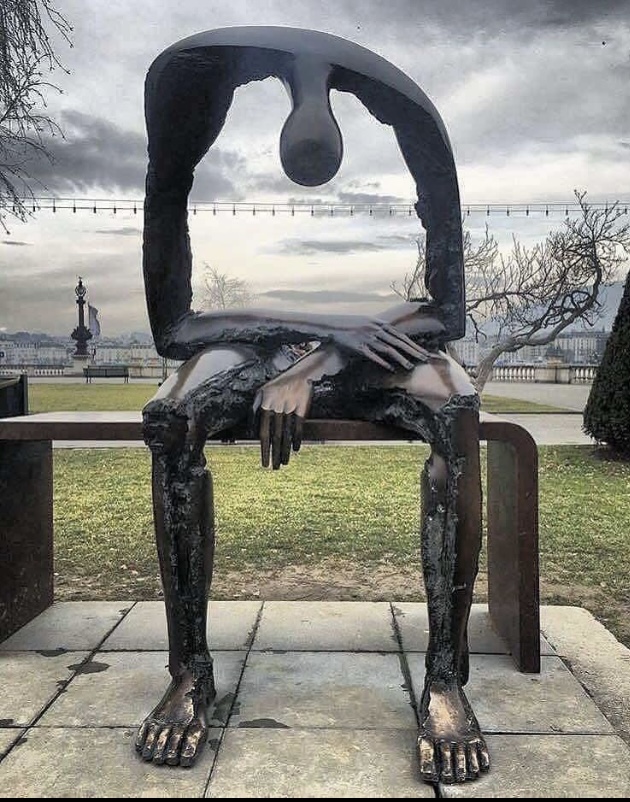
    The physical sensation of such a loss is acutely painful … a panicky breathlessness takes hold of you, the ground is swept away, and the sky goes out. There is no place to run away to, no safe space, no comfort, no medicine to alleviate the crushing weight that comes to rest squarely on the center of your chest and refuses to shift. It makes a home inside you, and though you pray for the blanket of unconsciousness, the horror and ache is still there when you wake. You wonder how your own heart can hold out… it remains a mystery to me.

    As a nurse you can imagine the cornucopia of magic beans and pharmacotherapy that arrived at my door in the days directly following my brother’s death. Although I was desperate to forget for a few hours that he was was gone, I was afraid to venture into uncharted terrain… “what dreams may come.” I settled on a steady diet of day drinking which made it possible for me to breathe in the first few months after he left us. “Grief felt four dimensional”, weighted, surreal, and still faintly familiar… I was always cold. People bring things. I remember food arriving, food I could not eat …and friends and family saying things I could not really fathom. I nodded, I let people hold me, but I couldn’t feel their warmth. I absented myself, I learned to cry quietly. I was adrift in the dark, night swimming far from shore, unreachable, inviolate… unspeakably sad. Still, I was grateful on some unconscious level…for the people…and their words…and their offerings …distant reminders that I was still here, that my own heart still beat it’s unwanted song. I let the mourners come, and my brother’s friends, such beauties, brought some solace with their stories.

    There is no medicine that I know of, no antidote, no cure for grief. No sutures to close the gaping hole in your chest. It does not heal …you bleed out slowly …you die a death as well. Our dead take a bloody big chunk of us with them, the part that only they could see, the part that they loved best, and you don’t get that part back. You learn to carry the cavity inside you, and after a time if you are very brave, you can repurpose the space as a kind of light catcher.

    Of course, the immediate shock of such a loss is nothing to what follows … the deep hollowing out, the exquisite loneliness, a yearning for everything you saw reflected in their eyes, and all you held dear in them, the staggering loss of what you thought you could keep forever. C.S Lewis in his book, A Grief Observed, originally published under the penname Dimidus (Latin meaning cut in half), writes in his opening line, “No one ever told me that grief felt so like fear.”

    After 6 weeks of staying as numb as I could manage on cheap pinot grigio, it stopped working altogether. Deep into my cups I was still stony cold, and I was terrified. I felt abandoned, alone, and inconsolable. Eventually I was desperate enough to attempt the unthinkable. I put down the bottle opener and stopped trying to hide from the full flare of the pain…I leaned into it, I stared at it’s sun. I stopped trying to outrun it, I stood my ground, and braced as the pain unfurled inside me, it intensified and it was eviscerating. Could I stand it…would it kill me, could I actually give it it’s head and let it run free inside me… was I strong enough? I’m still not sure.

    Today when it comes for me, the sadness, the memories, his voice, his heart, his poetry, his beautiful mind, I stay with him for as long as I can, I nod to the pain, like some old friend that crosses my path. I soften, I approach slowly…carefully now… I ask myself in a gentle voice, a voice I might use if speaking to a 4-year-old child…I ask where it hurts, what I’m most afraid of… and then I ask what might help a little, and the answer is always kindness.

    What is unbearable becomes bearable in time. Not because the grief goes away or gets smaller, but because we grow stronger around it, by holding space for a loved one who lives within us still. The transition is deeply unpleasant, like walking a “razor’s edge”, but befriending the pain and discovering the gift inside the grief, the gift of empathy and kindness, invokes an evolution of the spirit, a parting gift from the ghost of your lost loved one.

    Grief and all its jagged little teeth is the price for the privilege of being loved and having loved.  I know too that the size and shape and depth of grief is in direct proportion to the quality and breadth of that love. People ask if I’m better now. I always say ‘yes’ because it’s easier than explaining that the ache never leaves you…it’s only that I made friends with it.

    How do I keep him with me… the man called Parker Stephenson in my phone contacts, named after a tv sleuth of our youth, because he looked at life like a great mystery and always smiled like a boy pretending to be a detective, in the moment before he solves the case. I sit by the sea, I haunt the poetry section, I practice silence until I get a sense of his nearness and hear his voice, my own personal guardian angel. I look for every opportunity to practice kindness towards myself and all those I meet. Kindness ideally unobserved and undisclosed. I acknowledge daily what a grand thing it is to live a life and to know such love.

    If I could tell him one last secret, boil the kettle for tea just once more, or read a single line of poetry to him, I’d whisper

    ” …here is the deepest secret nobody knows

    (here is the root of the root and the bud of the bud

    and the sky of the sky of a tree called life;

    which grows higher than soul can hope or mind can hide)

    and this is the wonder that keeps the stars apart

    i carry your heart (i carry it in my heart)” (Cummings)
  • The Meaning of Life

    “To stand at the edge of the sea, to sense the ebb and flow of the tides, to feel the breadth of a mist moving over a great salt marsh, to watch the flight of snowbirds that have swept up and down the surf lines of the continents for untold thousands of years.”

    Rachel Louise Carson

    I’ve been thinking about the way, when you walk
    down a crowded aisle, people pull in their legs
    to let you by. Or how strangers still say “bless you”
    when someone sneezes, a leftover
    from the Bubonic plague. “Don’t die,” we are saying.
    And sometimes, when you spill lemons
    from your grocery bag, someone else will help you
    pick them up. Mostly, we don’t want to harm each other.
    We want to be handed our cup of coffee hot,
    and to say thank you to the person handing it. To smile
    at them and for them to smile back. For the waitress
    to call us honey when she sets down the bowl of clam chowder, and for the driver in the red pick-up truck to let us pass.We have so little of each other, now. So far
    from tribe and fire. Only these brief moments of exchange.
    What if they are the true dwelling of the holy, these
    fleeting temples we make together when we say, “Here,
    have my seat,” “Go ahead—you first,” “I like your hat.

    Danusha Lameris

    150 odd days shy of turning 60, I’ll admit, a blog post titled “The Meaning of Life” seems a little ambitious, even arrogant… utter hubris really.  Shouldn’t I be a bit closer to posthumous before attempting such a feat.  Still, it’s a dark, rainy, January day as I write this, and on rainy days when the lights glow orange, and the rain patters against the windowpanes, “no one…not even the rain has such small hands” (Cummings), I find myself incapsulated in liminal space, a portal between what has been and what will be.  It feels like the clocks have stopped and the kettle is whistling shrill, and I have been gifted stolen hours to decipher secret things, adrift in a liminal sea. I have some notes… and as the house settles around me, if I’m honest, I find myself engaged in a full-on discourse with my dear, departed brother.  If that lends the following any weight, I’m glad of it…most days I think all my thoughts are his alone anyway, truly, and I, but the scribe.

    Greater minds than ours have contemplated this age-old riddle a time or two, certainly, but, of late, I’m all the time wondering about meaning, a penchant of little old ladies in waiting, especially as we begin to lose loved ones. What are we meant to be doing, do you think, with the time we have left to us?  What’s the meaning of life?

    Maybe every soul is charged with solving this particular puzzle to their own satisfaction. But standing on the shoulders of giants, Victor Frankl, a beautiful mind if ever there was one, is as near a perfect starting point as possible. Frankl wrote that our greatest task in this life is to find meaning, and maybe what meaning we find, he suggests, depends on who we are, inside, or the eye glass we peep through for a look at the world around us. It’s important work, this search for meaning, and I’m sorry to say that a great many of us are asleep at the wheel.  Kierkegaard believed that we’re all too busy focusing on the ‘minutiae of life’. We ‘tranquilize ourselves with the trivial’, he wrote.  He called these poor souls, ‘immediate men,’ men engaged in the mundane, lost in a life of endless, repetitive deck swabbing, and never looking out to sea.

    Still others among us get so weary in their search for meaning, they convince themselves that there is no meaning to be found at all.  Even wise old Uncle Bill wrote that, “Life is a tale, told by an idiot, full of sound and fury, signifying nothing.” A beautiful line, but complete blather of course.  Shakespeare isn’t alone either.  Douglas Adams’ answer to “life, the universe, and everything” is just a number, 42 to be exact. Literary critics have worked themselves into a frenzy of deconstructive contortion, mining for meaning in Adams’ enigmatic answer but, it’s just a random number. Adams is suggesting, ever so smartly, that the universe is, in fact, random, morally neutral, an accident, and that there is no actual meaning to be found at all. I confess, a much younger version of myself took some shelter here for a time, but nihilism is a lonely planet, and not the one I intend to die on.

    Adams is a fine fellow, I concede, but my brother taught me to start with the poets when looking for the truth, or at least something to be getting on with, a figurative foothold, if you will, as we hang by our fingernails, over the vast existential abyss. It’s Whitman’s lines about life’s meaning that come to me now, “Answer: That you are here, that life exists, and identity; that the powerful play goes on, and you may contribute a verse.” So, perhaps, it’s finding purpose, or a life of service or some combination of the two that makes for a meaningful life.  Picasso wraps it up pretty, “the meaning of life” he said, “is to find your gift, and its purpose is to give it away.” Bleck…sugar spike…I promise that’s as greeting card, sickly sweet derivative as I’ll get…do read on dear friends.

    Cultivating your passions, and finding purpose, are, without doubt, excellent cards to play in the boardgame of life. It’s important to find work that you love to do… daily, if only as an antidote for boredom and disenchantment…it’s like a get out of jail free card that you can play anytime, a ticket to the ferris wheel of full engagement. Of course by this calculation, a meaningful life might equate to making a lot less money, and living without many of the material comforts we hold dear in this country… a home… a car…a Sunday pot roast. Still, I’ve always found soulless work to be the greater poverty, a cost far more dear than a slender pocketbook. Finding meaning may come at a price, but it’s a fair trade I believe, just not for the faint of heart.  Maybe meaning is best mined by the brave.   Certainly such a virtue can only help. 

    It takes a bit of courage to start you on the road less travelled, but on the plus side, any quest for meaning is also, where you’ll meet your people…the ones that you’ll carry in your heart, that you’ve somehow always known, but never met before…they’re waiting for you there…on your chosen path…and such fellowship, when you find it, is like a cheat code for unlocking lasting meaning.   Thomas Merton wrote, “we do not find meaning by ourselves alone, we find it with each other.”  I’ll add to this a little venerable Vonnegut, a wise man if ever there was one, ‘the purpose of life,” he wrote, “no matter who is controlling it, is to love whoever is around to be loved’.” That certainly has the resounding sound of truth, to my ear at least.

    Fellowship, a sense of belonging or kinship, is like a keystone, the puzzle piece that opens up a blue sky horizon or the gate to a secret garden in full bloom, each piece unique, all connected, waves moving in tandem on a wild primordial sea. Albert Schweitzer wrote that “life becomes harder when we have love for others, but it also becomes richer and happier,” and, with apologies to our learned German friend, more meaningful. “The full measure of a man,” he wrote, “is not to be found in the man himself, but in the colours and textures that come alive in others because of him.”

    Above all, when I am finished with my days, wrote Schweitzer, “may those who knew me say, ‘He was so kind.’” Hell of an epitaph, that, and maybe the best and truest route to real and lasting meaning in this life, and further still perhaps. It’s the sort of thing people said about my brother, and the kind of person I’m working hard to become, as a little old lady…in waiting (some of us are slow learners).

    That old high school dropout, Einstein, told us that “although we experience ourselves as separate from each other and the universe as a whole, it’s actually a mass optical delusion, and that the delusion is a kind of prison.” Our job, he said, is to free ourselves from that prison and widen our circle of compassion to include all living creatures and the whole of nature.

    The natural world is a multifocal Mecca for encountering meaning. It’s encrypted in the birdsong, falling leaves and snowflakes like so many clues, and the perfume that hangs in the quiet wooded trails and winding coastal paths wakes us from our slumber, like an ancient wind that whispers the wisdom of our ancestors, and lets us walk alongside them awhile. John Muir, the renowned Scottish naturalist, wrote that, “the sun shines not on us, but in us,” and “the river flows not past us but through us.”  Muir believed that going into the woods is like going home. “Into the forest I go,” he wrote, “to lose my mind and find my soul.

    My brother tells me that meaning is all around us, but you can only see it if you nurture a sense of wonderment.  “We need to watch things” he says, “as though they were worth watching…and not just the fireworks, and the bonfires, and the birthday cake candles, mind, but all the little beauties…everywhere.  I mean the dog napping, and everyday early morning bird chatter, the laundry lines alight like kites on windy days, or the chorus that echoes from a stand of trees. It’s the rough decaled edge of an old leather bound book with a secret inside, or a kettle boiled, the first lick of frosting on a cake made with love, and the last; it’s a letter penned, a pillowed plumped, a perfectly paired sock drawer, or the glow of a lamp lit at dusk that envelopes a common room with a golden Rembrandt hue.  Even the remembering of such moments takes my breath,” he tells me.

    Is that it then…we need just look at everything with a sense of wonder…that’s where life’s meaning is found, I ask? “That’s always been enough for me,” he replies, a knowing familiar smile on his face, “and maybe one thing more.  You see, I think we’re meant to learn something while we’re here, and if we’re good students, well…then the lessons get a little harder.  The ultimate lesson of course is unconditional love. I mean, all the best people we know have experienced defeat, and struggle and loss, haven’t they, and they found their way back out of the dark, and with an even brighter light inside themselves; the sort of light that tends to ignite a spark in everyone they meet.  It’s a light that others can warm themselves by, isn’t it?”

    “Maybe we don’t need to search for meaning at all.  Maybe if we just watch closely enough, we catch glimmers of it here and there, as we swirl past.  Life is like that isn’t it, just a waltz around the room really.  There is nowhere to go, or be, nothing that must be done…maybe let go of all that sister, and just fall into step when you hear the music.”

  • Embracing the Crone

    “The crone must become pregnant with herself, at last she must bear herself, her third self, her old age, with travail and alone. Not many will help her with that birth.” (No Time to Spare – Ursula K. Le Guin)

    “When howling gale is rattling doors, or call of lonely wolf is heard, or cry of raven on the wing, or crack of frost upon the ground, tis she, tis she, tis she. (Calleach – Siobhan Mac Mahon)

    Less than a week before Christmas, when family matriarchs are customarily exiled to Santa’s sweatshops, wrapping gifts like Edward Scissorhands, and frosting shortbreads until our collective glycemic index reads “critical,” I decided to take a night off from the Christmas chain gang. I ventured out on a dark and stormy night, in the company of a close friend of comparable vintage, to attend a workshop that promised to introduce, depict, and interpret the power and majesty of the Crone, a feminine archetype, traditionally the last in a triad, after maiden and mother.  The Crone, often portrayed in our culture as a warty hag, complete with kerchief and shawl, is cast as the most powerful as well.   A sage, a witch, a guardian, a memory keeper, a storyteller…these are just a few of the crone synonyms we might try on for fit, as we move into this last, magical, and mysterious phase of feminine folklore.

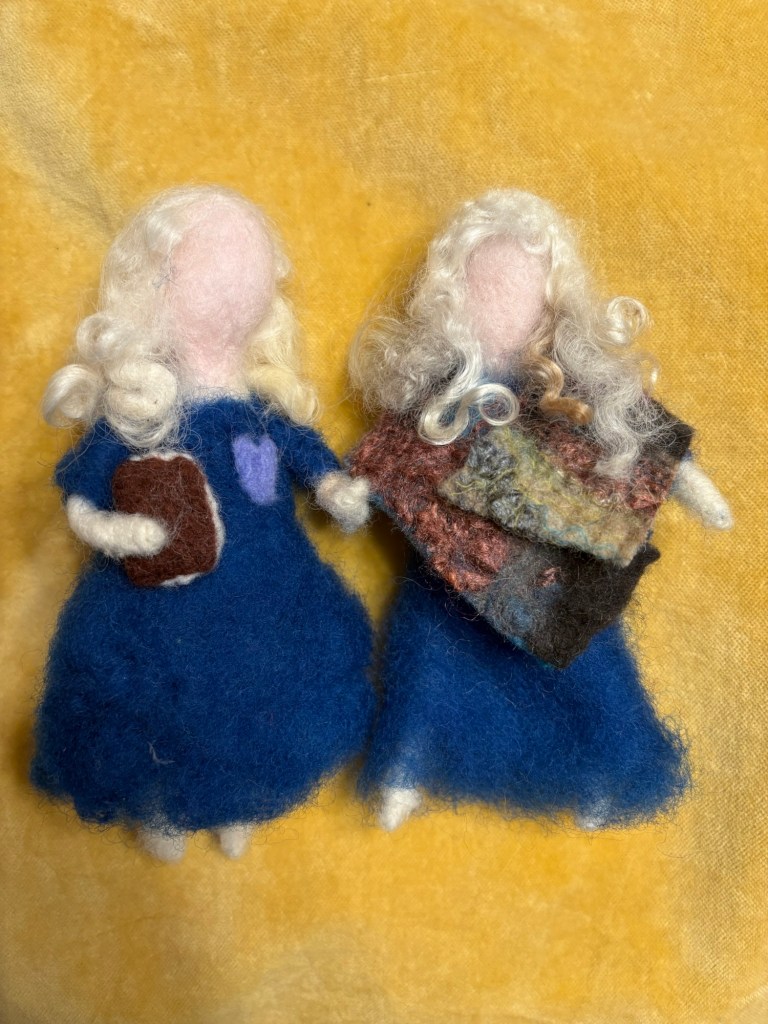
    The workshop was led by a woman who called herself a ceremonialist, a Cailleach, or “veiled one” in Gaelic mythology, who helps people transition through significant life events.  Like so many formative moments in a woman’s life,  it began with a fairy tale and the promise of a little-old-lady felted doll of our own making by night’s end, so we charged our tenuous social batteries, did battle with our homebody hearts, discussed whose eyesight was least perilous for an after dark adventure, packed a journal and a sacred object, as directed (Jesus …will there be sharing), and set off on our quest to Encounter the Crone.

    Sat close to the sea in a small conference room, the wind outside serenaded us like a siren call, a slow whistling sea shanty, and the doors rattled loudly, heralding the night’s import, like the ghost of Christmas past. We were offered tea and invited to sit around a makeshift altar decorated with bones and stones and candlelight.  We added our own holy relics: jewelry passed down from our mothers, artwork, a pinecone, a bird, a doll, the shell of a sea urchin, a heritage Christmas angel, and a witch stone, known for its magical protective properties. We were 12 women together, artists and academics, nurses, and teachers, travelling in the dark, a winter’s walk to honour our experiences, mine for meaning, and navigate together a transformation to feminine elderhood, a privileged freehold of wisdom and authenticity, sovereignty and self-possession. The magic in the room was a palpable thing…not enough to levitate… first time out mind, but strong enough to elevate us all.  I’m certain it surprised no one in the room when the lights went out and we were forced to close our circle prematurely, but not before we built something true and lasting together.

    The fairy tale recited so beautifully by our host was the story of Vasilisa the Beautiful, a kind of hybrid Cinderella and Hansel and Gretel.  Our heroine, Vasilisa, is gifted a tiny doll with magical properties from her dying mother, that protects her throughout a perilous journey to safety.  Spoiler alert she lives a full life and eventually returns to her origin story, living out her days as an elder in the forest.   The tale is simple but rich in imagery and metaphor.  We were asked to share the images that lingered in our mind’s eye.  The death scene between mother and daughter and the gift of legacy, chicken legged furniture, the impossible task of finding poppy seeds in dirt, a metaphor for discernment, and a fire torch crafted from a skull, the instrument that leads to the story’s denoument, all had honourable mention.

    For me, the lasting power of the story was not an image but an incantation.  Vasilisa called upon the power of the doll reciting, “Little doll, little doll, drink your milk my dear, and I will pour all my troubles in your ear, in your ear.” The notion of a talisman for the storms of life, a mother’s magic, an enchantment to conjure a place of safety in our darkest hour, when we’re not sure our own strength will hold; to call on the inherited love of our ancestors and open a portal of protection, or peace abiding….definately worth the price of admission. Were we leaving the workshop later that night with such a prize in our possession, a felted doll infused with magic, a protective cloak spun from our collective sacred offerings? What sorcery was this?  I started thinking maybe I should leave the house more often, even as a tempest raged outside, and Christmas at ours, still only half conjured.

    Properly incentivized we turned our attention to working with archetypes.  We chose a role from the alter at the center of our circle. Interestingly no one chose the same archetype.  There were so many wonderful choices.  I passed on Hag, and Old One, Elder and Witch.  Hearth Keeper and Herb Wife didn’t quite fit either.  We had a Weaver and a Word Witch, I remember. My friend, selected Sage.  A new grandmother, she is interested in legacy building and passing down family tradition and wisdom.  I picked Storyteller.  I’ve always been addicted to story.  It’s my preferred way to learn.  For me it’s high art, allowing us to live a thousand lives in one, a talisman against loneliness, a cure for myopia and polarization.

    After sharing our selections and thoughts around the archetype alter, we moved, some of us more tentatively than others, to worktables set up for needle felting, a dangerous, dexterous art, that comes with small sharp stabbing needles and raw wool to be shaped and prodded into small objets d’art, a felted little old lady…in waiting.  I wish I could tell you there was no blood lost but I’m sure I wasn’t the only hag there to stifle a silent scream that night as the needle pieced my presumably pre-loved stabbing pillow, and caught the delicate skin beneath my fingernail.  Maybe the bloodletting is part of the spell, maybe human sacrifice is the elixir that makes the doll magical.  All I know is that I stabbed my doll a thousand times or more before she came to life in my hands and the stabbing was oddly therapeutic (“psycho -killer…qu’est-ce que c’est”). I plan to continue my felt making education and have already created a companion for my doll, but maybe I’ve shared too much. Still, friends are important…even felted friends.

    The power went out when I was attempting to style my doll’s hair.  Every woman will understand the import of such a moment.  Our felting mentors came to the rescue and held cell phone flashlights for us to finish this crucial phase in the work. Suffice to say, I was never so happy to own such unruly, unkept tresses. It was the work of a moment to complete the effect and even in the dark I recognized the crone I held in my hands as my own, a story keeper and maker, a sovereign in the final decades of her reign, confidant in her unique gifts, generous in her attention to those she held dear, and determined to live intentionally, according to her values and passions until her last moments in this realm. 

    I was afraid the storm raging outside would prevent our eclectic circle from sharing our thoughts on the dolls we created. Insatiably curious, I had an almost visceral need to know how the others would answer the last question on the agenda for the  night, “If your inner doll could speak to you tonight, what would she say?”  One doll spoke of cultivating more trickster energy, to seek opportunities to laugh and have fun, another counselled that there was always something new to learn and explore, others said to ask for help and not to imagine we can do it all ourselves, that it’s ok to be messy, to rest, to be steadfast, to practice unconditional self-love, to keep moving, to offer guidance, to stand in the wind, to practice childlike wonder, and to embrace and celebrate all the beauty within.

    I know the doll is just a small, symbolic, hand-built ornament, but it feels so much bigger than that to me. I know we make our own magic, but I also know that there was a wisdom teaching waiting for us in the dark that wintry night, an introduction to “crone-ology,” a threshold for letting go of all that no longer serves us and a turning point in the pages of our story.  You may cackle, but I have plans to build my doll a small house with a door that opens with ease, so whenever I need to hold her close and feel my mother’s magic near, I’ll find her waiting for me there, her spell unbroken, a warm cloak of protection against the storms of life.

  • The Richness of Retreat

    .

    “Silence is also a conversation” – Ramana Maharshi

    “Be a loner. That gives you time to wonder, to search for the truth.” – Albert Einstein

    I have never lived alone, and at 59 and a half, I can count on one hand the number of nights I’ve spent alone in my home.  So, when my daughter announced that she was off to Australia for a fortnight, and asked if I might cat sit, I decided to embark on a private retreat of my own, a silent, mind-spa staycation, an experiment in the single life, an escape to a ‘room of one’s own’. The setting was LOLIW perfect… posh, urban, ceilings to God, a spiral staircased brownstone apartment in the heritage quarter, the dream home of a much younger version of myself.  The street was Orange, the mood, indigo, and the first song I danced to, with abandon, in far too many years, was Yellow.

    I have always shared living space with close friends or loved ones.  I have never experienced the kind of solitude and silence that singletons exalt in daily, the bliss of soundless mornings, the peace of uninterrupted afternoons, the effortless, evening meal for one, or the coveted hours spent in one’s own sweet company, time whiled away without reference to the wishes or inclinations of another living soul. To keep one’s own good counsel and consult no one else (save an agreeable cat with excellent manners and clear boundaries) on how best to spend the day…what a gift to give yourself, perhaps most especially as a little old lady in waiting. There is a magic to be mined, an enchantment, a real richness of experience to be savoured in retreat. 

    As with any adventure, I overthought and planned every minute detail down to the quick. I packed separate bags for the gym, for work, and for pickleball. I made sure to include enough loungewear and smalls to avoid even the notion of laundry, and a series of comfy sweaters and toasty wool socks, as you do, unfamiliar with the heating in my new abode, a Canadian girl down to  my bones. One can’t be too careful when it comes to creature comforts.  I prepared and packaged enough food to last me about ten days, individually portioned, so I wouldn’t be troubled with cooking or cleaning dishes during my retreat.  I planned to supplement my defrostables with a few evenings of restaurant meals, I was on vacation after all…there were friends to be met, and those naan nachos from Thandi’s are a siren call that cannot be ignored.

    My car was already packed the morning I set off to drive my daughter to the airport. I kissed my husband and hugged my son and small geriatric dog goodbye.  A little old lady herself, I had a quick word and cuddle with my last true dependent.  I let her know it was alright if she had an accident or two in my absence, as the menfolk aren’t as attuned to her bathrooming pecadillos, an easy concession as I wouldn’t be there to look after any mess.  I wished her well and promised to make it up to her.  We settled on half my breakfast bacon for a period no shorter than one year, and a promise that she could come away with me next time.  Oh yes, spoiler alert, there will be a next time.

    After imparting a steady stream of last-minute motherly advice to my savvy, world travelling daughter, advice she did not need, but tolerated as best she could, I watched my baby pass through security, before discarding whatever illusion of control I still harboured, and then, mentally slipping off my mother cape, a favourite cloak, I turned with a little tear in my eye, before going dark, the start of a full-blown smile forming on my lips. I was a stranger in a strange land, alive to the endless opportunities that waited for me. I decided on a quick stop to Costco (I mean …I was in the neighbourhood) for a few emergency supplies…ready made bacon, the Christmas fruitcake (singletons host friends too) and then it was straight back to the little uptown palace I would call home for the next two weeks, party of one.

    I made my escape in mid-November, an excellent time of year for retreat, just at the onset of the introspective months of the Canadian winter, but before the circus of Christmas pageantry that engulfs most matriarchs in December and doesn’t let go until after New Year’s day. For the first few days I sat in a kind of meditative slumber, wonderstruck by the tidied rooms, the luxurious silence, the fragrance of aloneness, the cadence of a single set of steps. I floated from room to room, I listened to the voice of a girl set free from a set of inherited instructions for living, a voice that spoke softly at first, but eventually commanded my entire attention. 

    Most of what she told me is private of course, you understand, what happens on Orange stays on Orange, and anyway it would probably be lost in translation.  I can share that I never once felt lonely during my retreat, that it took several days to miss the loved ones I live with, and if there were any monsters under the bed I slept in alone at night, they kept to their dark recesses and didn’t intrude on my peace. Suffice to say, I was away long enough to remember that there is no better counsel than your own, there is no truer friend than yourself, and if you’ve been neglecting that friendship, then it is time to take yourself away for a long overdue conversation, the kind where you listen more than you speak. Our words can physically influence the world around us, most especially the words we recite incessantly to ourselves silently, in a closed circuit.  The truth is that every cell in our body is listening to us, which makes the quality of the interior dialogue so critical. Do we settle for questions like, “what’s for dinner?” or even “where to travel next year?”  or do we ask ourselves how we might best build joy today? Or “what exactly Elliot meant when he wrote, “I grow old…I grow old…I shall wear the bottoms of my trousers rolled. Shall I part my hair behind?  Do I dare eat a peach?’

    If you, like me, prefer Elliot’s poetry to a cookbook, these are the essential rules of retreat. There must be quiet. Your mind must be calm and unleashed from the concerns and demands of those closest to you.  So much of our action in life is economically or socially determined. Even love can feel like a Chinese finger trap some days. As we get older the claims of our immediate environment, our preferred living arrangement, can be so pervasive that we can actually lose sight of ourself in the family photograph, beneath the Wifee sweatshirt, behind the sacred veil of motherhood, to the woman who waits within like a nested Russian doll. We can become so consumed with what we perceive as the requirements of daily living; nutritious meals, a tidy home, daily exercise, the social scene, that we forget ourselves and our real work, discovering and exploring the beauty and mystery that lies within.

    Finding a quiet place to stoke your inner fire is an essential and sacred ritual, an absolute necessity for every little old lady in waiting. If you can’t get away for a dedicated retreat, then lay claim to a certain hour every day, a space of time inviolate to family or friends, where the news of the world cannot reach you, and where you do not recognize or acknowledge what is owed to others.  A space where you are free to simply experience who you are, and what you might be, a place of creative incubation, a venue to challenge your everyday assumptions, to grow, to follow the winds of your own inclinations, to feel your courage, and to care for yourself, like the treasure you are.

    At first it may feel like you’re wasting time.  If that is your experience, at least initially, I would encourage you to hold fast, it is, after all, your time to waste. We have a limited lease of time apportioned to each of us, and whether you spend that time truly awake or asleep in the detritus of daily living is entirely up to you.  Life has no pause button or rewind setting.  If you read this blog post all the way to then end, each of us is 5 minutes closer to our demise than when you started.  If you can stay present to this moment, if you can be here now, and genuinely engaged in pursuits that bring you joy, then you know the secret to a beautiful life. So often we become embroiled in activities we do not relish and have not chosen for ourselves but believe are required of us.   Fresh from my retreat I have begun to question everything I habitually tell myself needs doing. I engage in small acts of rebellion as often as possible.  I eat cereal for dinner some nights, my bed often goes unmade, sometimes I skip the gym to write or read …there is a feathery owl atop my Christmas tree this year, slightly askew, and it has never looked more beautiful to me.  I hold space for myself to wonder and to consider questions outside the realm of my daily routine. “Do I dare eat a peach?”

    It’s true that to create a pleasant and harmonious environment in our lives together with loved ones we need the cooperation of all those we choose to hold close in our immediate circle, but pleasure carried within ourselves, within our own body and mind, and within that part of ourselves that has no name, that is our business alone. This dark season of early nights and twinkling lights, I wish for you a happy retreat…I invite you to cast your eyes to the wintry sky, to stand alone sometimes, to “look at the stars and see how they shine for you.”

  • Solvitur Ambulando…It Is Solved by Walking

    “Walking, I am listening to a deeper way. Suddenly all my ancestors are behind me. Be still, they say. Watch and listen. You are the result of the love of thousands.” – Linda Hogan (Native American writer )

    “‘But it isn’t easy ‘ said Pooh. ‘Poetry and hums arent things which you get, they’re things that get you. And all you can do is go where they can find you.’”- A.A. Milne

    If I’ve ever invited you on a walk then there is a fair chance you’re someone I love very much…family, and a handful of friends I keep close, like “a cloak, to mind (my) life.”(O’Donahue) I don’t walk, as our ancestors once did, to arrive at a particular destination, nor can I honestly say that I walk to safeguard my health, although, as a nurse, I know it to be powerful medicine, and an essential practice in the Little old lady in waiting’s handbook on how best to live a long and healthy life.  For me, walking is a sacred sojourn, like writing in a journal, or sitting down for a cup of tea on a busy day to savour a last bit of cake; it is a solitary ritual, a reflective exercise, a rich, sensual, fortifying experience, that grounds me in the present moment, and reveals a deeper way of looking, illuminating a world just beyond what our sedentary eyes can capture. Walking is a portal to the natural world where time may stand still, where we may even disappear for a while, as our unconscious unfurls, and insights and creative leaps lay waiting on well-trod paths like so many flowers to be gathered, an endless bouquet of ideas and dreams waiting to be revealed and rehomed.

    I have always believed a regular walking regime to be a salve for most of life’s ailments.  All those feel-good neurotransmitters dormant and eager for activation. I won’t bore you with the overly marketed health benefits…well, maybe just a quick review. Just as the doctors have always preached, walking, even a little, can significantly increase your lifespan, and reduce your biological age (marginally more appealing to the chronologically disadvantaged).  Walking also lowers your risk of cardiovascular disease, diabetes, and depression.  If that’s not enough to persuade you, there is also statistically significant evidence that walking lowers your stress level and reduces rumination and negative thinking.  Wait… I mean I’m down with the stress management, but I’m kind of trauma bonded with the rumination and negative thinking, that’s half my material.  Whatever…you get the idea…the health zealots are spot on, walking is good for you, body, and mind…but when has that ever been sufficient incentive to lace up, or drop the fork, if you see what I mean…again with the negative thinking and rumination. Let’s try again. Little old lady in waiting to little old lady in waiting, post-menopausal women who walk 4 hours a week have a 41% lower risk of hip fracture.  I like that. That’s positive…right?  I’m not sure where they get these exact numbers but I found it on my socials so it must be true. 

    Health considerations aside, here is what I know about walking from my own clinical trials, population of one.  No matter the setting for my walk: be it the sleepy, maturely tree’d, largely childless suburb that I call home, or any of the woodland parks scattered liberally in our beautiful picture province, or possibly the sea paths that wind along the miles of coastland in our stunning port city, nestled on the Bay of Fundy, or even a streetscape in the heritage block of Canada’s oldest incorporated city; a walk out of doors is a way through the wardrobe to a bountiful sensual world, where a steady stream of eye candy and auditory enchantments remind us to embrace the wild animal within, an invitation to howl for all the little old ladies in waiting, sat at home disguised  in grandma’s clothes, both figuratively, and literally some days.  We are meant to move our bodies, we our built to explore on foot, our ancestors walking ten times the distances we typically cover today. 

    Outside, in the natural world I am routinely transported by the startling beauty of the Disneyesque birds that sing in choirs on my quiet street, their sweet sad tunes in perfect pitch; or the spiral dance of autumnal leaves twirling upward as though commanded by the invisible hand of some ancient sorceress, reciting a spell to safeguard the woodland wildlife from winter on its way.  I hope she remembers to include me and mine in her magic. The animals nearby have a narrative all their own as they go about their daily errands and I nod to them when we meet: the black-sheep squirrel who lives in the tree at the front of my house, alone and happy to be so, or the family of deer who eat from my neighbours unpicked apple tree, heavy with fruit. I met, by chance, a beautiful fox not long ago, but neither of us had time to stop.

    Near the sea, I always envision I am walking with my dead relatives and even imagine I can hear their whispers in the wind and on the waves.  Walking in the woods, the air is perfumed with spruce and pine and something more elusive that smells like childhood and brings me back to a more innocent age, when the scariest monster I could imagine lived under my bed, not some beast who throws Gatsby themed balls, an evil, self-proclaimed king whose every soundbite is some variation of “let them eat cake.”  In the woods, while I’m walking at least, the king is dead…long live all the wild beings who walk this beautiful planet in peace.

    Saunter, stroll, scuttle, scale or stride,  I walk faithfully, alone, into the halcyon summer breeze of fresh cut grass and full strength sunny days, or the warm spring rain that bursts gardens into bloom, or my favourite, the crisp autumnal harvest days scented with chimney smoke and alight with golden interior tapestries of life, the window frames of  our neighbours homes in the gloaming, or out into the first snowfall of winter, a crampon crawl up and down frozen streets,  footfalls in virgin snow where I spy the tracks of smaller species, freshly awoken from a winter’s sleep.  Garlanded in cap and scarf, mittened, earmuffed, and balaclava’d, I’m adrift, a snowman flying through the air…la la la la la laaaaa.

    Outside, enveloped by ancient all-knowing trees, or surrounded by heritage architecture older than three little old ladies in waiting counted together, or stood at the thin space adjacent to the sea, there is a clarity of mind to be discovered that cannot be found in a book, or sat safely by the fireside, nor even under the tutelage of a wise seer.  There is a reverie known to the solitary walker (Rousseau), an enlightenment, an illumination, a flow of insights around every corner we turn. One foot in front of the other, there is space to think and puzzle and solve all the vexations visited upon us. Walking costs us nothing but time, no special gear required, only the capacity to listen to the resounding truth of our own intuition, a voice inside that speaks louder in silence, in the quiet found out of doors.

    A walkers’ trail is alive with imagery that invokes tangential lines of poetry and philosophical enquiry.  There is a hum when we walk…a higher frequency, a quiver of ideas and creative sparks. “What will you do with your one wild and precious life?” (Oliver) “I have measured out my life in coffee spoons.” (Elliot) And if while walking we by chance fall awake for a moment, to know this life is only a dream, how do we stay awake long enough to remember we are dreaming? (Wittgenstein). Walking is a whirlwind dance of ideas, a flow, an unconscious current in a deep primordial sea. And the story we rehearse inside ourselves, making up the parts we can’t quite recall, is a conversation I am happy to host most every day.

    I like to walk at a slower pace now, not quite the crawl my geriatric dog prefers, stopping to sniff every few feet, but I’m more interested in exercise for my mind and the quieting or distilling of my thoughts, than I am in exercising my body or protecting my cardiovascular health or even promoting longevity…still, perhaps aging backwards is something to aspire to.

    For me walking is a meditation, “with every step, I arrive.” (Thich Nhat Hahn) I practice slowing down, I come awake and allow time to stretch out before me, like clotheslines where birds gossip with their friends and freshly laundered linens flap their wings.  I see winter bared branches with captured notes and receipts, escaped from recycled bins, adrift in the wind like so many clues. I listen to the sound of my own footsteps and then deeper still to my breath, and my own heartbeat, and the hum that hangs over everything, the sound of the universe, I suspect, like an hourglass set close to a microphone recording the ever-escaping sands of time.

    I have found many treasures on my walks: old coins and worry stones, sea glass and driftwood art, lost letters and grocery lists, emblems of lives lived next to our own, and reminders that we are, none of us, alone.   I have heard the voices of lost loved ones and remembered the thoughts and images of versions of myself long since lost with them.  Walking I have found the answers to problems, big and small, I’ve found perspective, and gratitude, an abiding peace, and a strong feeling of connection with something greater than myself, something capable of conjuring the unspeakable beauty that is all around us, best viewed by foot, moving at your own pace, walking alone, in the natural world.

  • The Art of Happiness

    My mother, Mary Eileen (Bunny) Lewis caught in a moment of everyday happiness

    “I must learn to be content with being happier than I deserve.” – Jane Austen

    “Letting go takes a lot of courage. But once you let go, happiness comes very quickly” – Thich Nhat Hahn

    Happiness is a slippery state of being, an elusive, inconstant companion. Like a feckless lover or an indifferent cat, it’s never near at hand when you need it most. It’s approach is often unheralded, it’s visit, never long enough, it resists all enticements to stay. It cannot be captured…it will not be held…we cannot keep it. It is as impermanent as an ice cream on a hot summer afternoon, as fleeting as a first kiss, or a glass of fine wine, it lingers briefly, and disappears into the realm of memory. The art of happiness sits haplessly in the space between our first world sense of entitlement, and our readiness to cultivate a sense of wonder, that magnifies the trace elements of happiness drawn from everyday dealings. Little things like the dog’s yawn, the carol of the wind in the trees, the smell of freshly brewed coffee, or the uncalled-for-kindness of a stranger can, with practice, conjure a sensation of peace, an ‘invisible cloak’ of contentment, protection against the certain storms of life. There are glimmers everywhere if we learn to spy them, and they can sustain us, even on our darkest days, if we apprentice in the art of happiness.

    First lesson – kill all expectation of happiness. It’s Buddhism 101, the first noble truth, ‘Life is suffering.’ Happiness is not our baseline or our birthright. We don’t deserve it, and we can’t earn it. We are not on some episode of Friends with a laugh track running every 30 seconds. Chandler Bing died of drug use disorder, and Rachel’s husband left her for Angelina Jolie. We’re in the ‘real’ people, and to quote the venerable Monty Python, ‘Life’s a piece of shit…just remember it.’ (It works better if you sing it). My kids would say that that’s a bit dark or defeatist, but I’m with Schopenhauer and the Pessimists, you need a sense of humour to get through the tragicomedy we call life, and ‘the safest way of not being very miserable is not to expect to be very happy.

    Buddha’s second noble truth is that we’re the problem…we are the root of all our suffering…we build our own hell. The art of happiness is to desire less…stop trying to make the world conform to our preferred narrative…that way lies madness. Relax…we control nothing… and anyway, sometimes bad news is good news in disguise, if we wait long enough. It is a mighty thing to slay your expectations and lay yourself open to your share of frustrations, disappointments, and loss. My mother always told me that ‘acceptance is liberation.’ She was a very wise woman, a gift earned from enduring her measured cup of sorrows.

    William James wrote ‘We need to stop deciding how we want things to be and then getting ourselves upset when things don’t turn out that way.” Easier said than done Willie, especially when you discover the last piece of cake gone, or the poop your geriatric dog deposits on the dining room floor every night.  Still, I say give it a try next time you’re provoked by an uncapped toothpaste, a Sunday driver when you’re running late, a rainy day when you wanted it fine.  Start there and when you’re ready you can move on to little old lady sized stuff, like chronic pain, or learning about a friend’s new cancer diagnosis, or loosing someone you loved very deeply…someone you thought you could keep forever…a loss that feels like the sky’s gone out and taken all the stars away. It gets a little harder to wash down then, even with a good red.

    James would say, ‘If you believe feeling bad, or working long enough will change a past or future event, then you are living on a different planet, with a different reality system.’ He’s right of course. we can’t get so mired in the shitty pieces of our story that we miss the good bits…the glimmers.

    We can’t be ‘shiny, happy people’ all the time and I guess we shouldn’t even try. Don’t we need a certain measure of malcontent to get anything done? It’s only unhappiness, disappointment and disenchantment that puts our clay feet on the floor every morning, isn’t it, that fuels our pursuit of wisdom…some magic beans to make the daily grind a bit more palatable? If we were happy all the time, we’d stay at home all day and roll around in it, wouldn’t we, hedonists supping on donuts and Netflix until our brains and our bodies turned to mush.  That’s Hotel California my friends…’and you can never leave.” (Again, much better if you sing it with me)

    If we can’t capture happiness and keep it caged, as we might like best, then we can cultivate habits and practices that invite happiness in, offer her tea and something sweet to encourage a long and robust relationship.  Gratitude is the first and best invitation to happiness that I’ve discovered.  It is that great looking glass that magnifies all the beauty and riches around us, large enough for us to see all that we have been allowed to keep… legs that take us walking, minds that may still read and discuss, running water still clean enough to drink, maybe even a hand to hold.  I’ll add to this the extraordinary occasion for a fine cup o’ tea and in good company.  Vonnegut suggests we recite in such moments of clarity, ‘If this isn’t nice, I don’t know what is.”

    We must fall in love with the beauty that is all around us.  Cast our eye about ourselves each morning and count our blessings.  Oscar Wilde wrote that ‘most of us are living in the gutter, but some of us are looking at the stars.’  We need to look for the glimmers.  They’re everywhere once you start practicing: the dance of late summer leaves, the first line of a new book, or that feeling of being understood…an easy, effortless fellowship that lets us know we’re not alone.

    Friendship is the second essential pillar in my study of happiness.  Friends come in many shapes and sizes.  They can be fictional, or four-legged, they can be blood, and people we grew up with, or choose to grow old with, but more often than not you’ll find them out roving on some adventure.  They arrive unexpectedly, a happy surprise, and their company can feel like coming home after a long time away, or a gift you didn’t know to ask for, but have wanted your whole life. ‘The secret Alice, is to surround yourself with people who make your heart smile, it’s then, only then, that you’ll find wonderland.’

    If you’ve not yet landed in Wonderland, then I suggest you take a break from your own troubles and concerns and look around you for a way to help others with theirs.  Service is chapter 3 in the little old lady book of happiness.  My brother was in love with Emily Dickinson, she was a dear friend of his.  She wrote, “If I can ease one life the aching, or cool one pain, I shall not die in vain.”  I say do harm to no man and never miss an opportunity to do a kindness. Be a light for others.  I love the old Indian proverb, ‘Blessed is he who plants a tree under whose shade he will never sit.’ To my mind there is no better way to cultivate your own happiness than to contribute to the happiness of others, unseen, unacknowledged and with great humility. If we’re all made of the same stuff in the great fabric of being, then watching out for a dropped stitch here and there only makes good sense…keeps us all from unravelling. 

    If we can stay with the knitting analogy for a minute, then I suggest that the fourth practice in this little old lady’s guide to a happiness, is to keep to your knitting every day.  The work we choose to do is key to practicing good happiness hygiene. If you love your work, then every day is a delight and you’ll be a success, no matter the weight of your wallet. That’s not to say you won’t have to find some job to keep you in beer and bread and a roof over your head.  But you must never let those necessary hours detract from your real work, the work you recognize as your own. And if you haven’t yet found this work then, to quote Ms. Dickenson once more, you must be ‘out with lanterns, looking for yourself.’ 

    John Muir the great naturalist counsels that ‘nothing dollerable is safe.’  That’s the way, he implies, to Thoreau’s ‘life of quiet desperation.’ I say be curious, go adventuring, stretch yourself beyond your imagined limits, investigate, take yourself away, let yourself go quiet.  Your work will find you…artist, teacher, carer, baker, candlestick maker…it matters not.  Trust only that which speaks to your soul, that engages you wholly, that causes you to lose time and that you can’t wait to get back to again each day on rising. ‘It’s foolish for people to want to be happy,’ wrote Georgia O’keeffe, ‘our interests are the most important thing in life.’ ‘Happiness,’ she said, ‘is only temporary, but our interests are continuous.’

    Lastly, and maybe most importantly, happiness lives principally in the present moment.  We need to slow down and stay grounded here in the now, and as the Stoics suggest, ‘do every act of our lives as though it was the very last act of our lives.’ All the greats say the same. To quote my favourite Buddhist, Thich Nhat Hahn, we must ‘drink our tea reverently, as if it is the axis on which the world revolves.’ ‘Eternal life’ wrote Wittgenstein, ‘belongs to those who live in the moment.’  But the poets say it best, To see a world in a blade of grass…heaven in a wildflower.’  It’s that moment when the musician understands that he is not only the strings of the instrument he plays on, but also the music that fills the room and touches the heart strings of everyone who hears.  There can be no higher experience of happiness to my mind then being fully present and awake to your surroundings.

    If you asked me the raw ingredients of my own happiness, I would quote Tolstoy, ‘Rest, nature, books, music, such is my idea of happiness.’ I also try to practice what my brother taught me… to live in a state of radical amazement.  E. B. White urged us to ‘always be on the lookout for wonder.’ So, I get up each morning and try to look at the world in a way that takes nothing for granted. The art of happiness lies in extracting it from commonplace things and as a little old lady in waiting, I’ll give the last word to that old sage, Socrates, ‘Let’s enjoy ourselves,’ now, ‘It’s later than we think.’

  • In Conversation with Dr. Margaret Anne Smith

    I sat down with Margaret Anne Smith at a local coffee house with a reputation for good lattes and a spectrum of social justice projects that support many marginalized members of our community.  It seemed a fitting setting for a conversation with a woman who is, among other things, an advocate for the disenfranchised, sitting on the board of a harm reduction enterprise that supports people living with addiction.  Margaret Anne Smith holds a PhD in English Literature, specializing in 20th Century poetry, and has taught her entire career in the post-secondary setting.  She is an academic, a teacher, a poet, and a fiber artist.  She is married, a mother of two, and has the sort of old-world integrity and essential goodness that makes you believe that we are not without hope, no matter what unbelievable chicanery we witness daily on the evening news.  As I listened to her speak, I couldn’t help thinking of the power of a single individual to effect great change in the world around her, especially one armed with a sharp analytical mind trained to notice what others do not see, and gifted with a clear, insightful voice to ask the right questions.  She is currently at work on a book of poetry that celebrates local coastal beauty and lure.  It is a collection I very much look forward to reading someday.

    Tell me your life story in seven sentences or less? 

    I grew up in Saint John and…same sentence… moved back here on purpose, after spending a dozen years away.  I love my extended family and friends. I have been married to David for 36 very good years. We have two great kids. I live near the Bay of Fundy. I am a teacher. I am a reader and a writer.

    What is the best thing about getting older?

    Learning…I was going to say discovering, but it’s not like a momentary discovery, there is no switch that flips, there’s no ‘aha moment’… it’s a gradual process of learning what I care about. And the other side of it, is learning what I don’t give a fuck about, and that list has changed with time.

    What is the worst thing about getting older?

    Joint pain and not being able to see as well as I want to in my 50s. That’s the part that surprised me, the pain came so much earlier than I anticipated.  I’m on the cataract waiting list which depresses me, but I look forward to losing the heavy progressive lenses.

    If you could retain or retrieve one quality from your youth, what would it be?

    My knees and my feet to be honest.  It’s not my optimism…it’s not my hope, it’s not my energy level I’m worried about losing …it’s my joints. I had envisioned at this age, those walking trips in Europe, but there’s no chance.  I couldn’t physically do it… it’s my knees. I want to be able to hike for ten kilometers and I just can’t.

    What’s the most important lesson you’ve learned so far?

    I think it’s probably learning the difference between spending your energy on things you cannot change and spending your energy on things you can.  And that exists on several levels   So there are things that maybe I cannot change about myself,… my feet hurt, I can’t take a walking trip across Ireland. Ok…goodbye to that idea, and now what can I do instead? Because I think spending your energy on things you can’t change makes you bitter, and we don’t want to be bitter little old ladies in waiting… because it would be easy, wouldn’t it?

    So that’s personal, so now let’s take it to the next level to the people in my circle.  There are certain things I can’t change, and you can invest in those relationships but there are some things you just absolutely cannot change.  I like Glennon Doyle’s Podcast?  It’s called “We Can Do Hard Things”.  It’s American and its funny as hell, and they interview  a lot of interesting people and one of the great episodes is about  how to fortify yourself for the holiday season in terms of dealing with your family and expectations.  A great piece of advice he gives is ‘Be not surprised’ because you know Uncle Bob is going to go down the same road he took last year, so don’t be outraged and horrified by it, just adopt an attitude of ‘yeah, whatever, I still love you,’ when people behave in ways they have always behaved, ‘be not surprised.’

    Jewel has a song I really like from 1998, I’m dating myself here, it’s called Life Uncommon. She says ‘no longer lend your strength to that which you wish to be free from.”  It’s about using your voice and that  speaks to me now…where do you use your energy… where do you use your voice.

    The other part of that question is what you do about the global piece and that is much more difficult right now.  I try to be selective and pick the bite-sized things that I can do.  I joined the Board of Avenue B that operates on a harm reduction model.  I have no lived experience with addiction myself, or in my circle, but I thought I can be on the board.  I’m good at policy and procedure…and I try to make choices with some integrity. I don’t live in a tent, I’m not a drug user, but l am devastated by the inhumanity that’s everywhere in our cities and small towns now and how people are being treated so badly and left out.  We talked about water fountains at the meeting last night.  If you were thirsty and unhoused…where do you go?   

    Do you have a favourite quote?

    Yes, it’s a quote by Vaclav Havel.  I like it because he distinguishes between hope and optimism. It’s a quote from his time in prison.  His language is beautiful of course, but for me the beauty is that he isn’t saying, it will all be fine…because so often it is not fine. He takes hope from being a big cartoony rainbow thing and makes it real.

    “The kind of hope I often think about (especially in situations that are particularly hopeless, such as prison) I understand above all as a state of mind, not a state of the world. Either we have hope within us, or we don’t; it is a dimension of the soul; it’s not essentially dependent on some observation of the world or estimate of the situation. Hope is not prognostication. It is an orientation of the spirit, an orientation of the heart; it transcends the world that is immediately experienced, and is anchored somewhere beyond its horizons.

    Hope, in this deep and powerful sense, is not the same as joy that things are going well, or willingness to invest in enterprises that are obviously headed for early success, but, rather, an ability to work for something because it is good, not just because it stands a chance to succeed. The more unpropitious the situation in which we demonstrate hope, the deeper that hope is. Hope is not the same thing as optimism. It is not the conviction that something will turn out well, but the certainty that something makes sense, regardless of how it turns out. In short, I think that the deepest and most important form of hope, the only one that can keep us above water and urge us to good works, and the only true source of the breathtaking dimension of the human spirit and its efforts, is something we get, as it were, from “elsewhere.” It is also this hope, above all, which gives us the strength to live and continually to try new things, even in conditions that seem as hopeless as ours do, here and now.”

    Do you have a favourite word?

    Sea…as in the ocean. The word sea represents all kinds of things metaphorically but for me it is both a personal, and local place of refuge…it always has been …since I was old enough to ride my bike off the cliff, which I did by the way…I was a free-range kid in West Saint john.  I might edit that out for my mother.

    There is something timeless about the sea… I love the rhythm, I love the sound.  It’s also a metaphor for connection, wrapping around the globe, and it’s a measuring stick for what we are doing to the planet which is a big concern for me.  I think because we can see the trees being cut down and we can see the trees on fire on tv, it’s a little harder to ignore, but we could go to Bayshore this morning and think all is well…and it’s not.  We need to pay a bit more attention… we need to pay a lot more attention. 

    Describe your perfect day.

    Sunshine. Great coffee. The ocean.  My husband and my kids and their partners and nothing planned. 

    If you could have tea with anyone, real or fictional, dead, or alive, who would it be and what would you talk about?

    Given the state of the world, I want to sit down with Greta Thunberg.  Three reasons.  She is young and we need to listen to the younger voices, about everything. I mean look at where the power is…still in the hands of old rich white guys and that has to change.  Secondly, she is willing to make incredible sacrifices for the future. I’m interested in asking her, why, what do you see, what do you envision, what are you giving up and what are you giving it up for?  Three would be the climate crisis, it’s going to cook us and were pretending it’s not.  I want to talk about that.

    Tell me three things that bring you joy.

    Real conversations.  Real, not honest, because even honest conversations have a few lies in them.

    David, Kevin, and Maureen …from the beginning all the way to this morning.  So much joy in that little family of mine.

    Time outdoors.  Some of it goes back to the free-range childhood.  Total freedom.  It might have been an illusion, or it might have been quite real, that no one was paying any attention to us kids.   We were free, and time outdoors reminds me of my freedom.  Also, as an artist I appreciate the changing light and the shadows cast by the sun and the changing colours of the season.  My shoulders lower when I step out the door.

    Name a guilty pleasure.

    Ice cream. Too much fat, too much sugar but it hasn’t made me give it up.  It’s a favourite treat.

    Do you believe in life after death? What does it look like?

    I do believe in life after death, but I don’t know what it looks like.  And I don’t even have an assumed visual. I think when I was young, I did have an idea that was based on a religious tradition…heavenly gates…clouds. So now I think there is so much beauty and goodness, despite the horrors, and I don’t think those things can just come to an end.  There has to be something else.  My sense of what that is has changed, because I think there is something else for the right whale as well, and for the pigeon on the roof… that we’re all part of this interconnectedness that we can’t really, fully appreciate now and maybe our great joy in the afterlife is coming to understand what that interconnectedness means.   

    What would you like your eulogy to say?

    I boiled it down to two things. First, I want my children to write it, and I trust them. Second, and how’s this for a mothers’ control, I hope they would say that they saw that I remained engaged until the end of my days.  I don’t like the word engaged… maybe passionate, passionate is better, engaged is so psycho-ed, or maybe that I cared, but that’s too Hallmark.  Passionate works, and passionate about what doesn’t really matter…maybe when I’m 80 I’ll be passionate about my pansy collection.