Tag: lessons

  • In Conversation with Shova Rani Dhar

    Shova Dhar is my oldest friend. We met in third grade.  She was the smartest kid in my class, and in most rooms she enters I suspect.  Becoming her friend changed the trajectory of my life, motivating me to push myself academically in a way I might never have done had we never met.  I can still remember our Grade 3 Health project, a beautifully drawn portrait of a boy skeleton, with breakout close-up drawings for the more intricate bones.   Shova was the artist, I, the lucky bone labeller. We wrote a play together some years later, titled, ‘How do you like your murder, steamed or boiled?’ earning a solid A for our efforts in advanced English.

    Shova describes herself as a ‘gregarious introvert.’ She is, in fact, a peerless, exceptionally gifted human, a scientist and a seer, an artist and a stargazer…there is no one else in all the world like her.  She is an ageless, exotic beauty, and ‘my brilliant friend.’  A biologist by trade, an accomplished artist by nature, and an animal lover (all species), Shova exhibits the kind of charisma that only storybook heroines possess.  Fiercely loyal, generous in spirit, she is a boundless treasure to anyone lucky enough to call her friend.

    Shova earned a BSc in Biology and a Bachelor of Education from UNB. She has published research in marine biology, worked as a lab instructor at UNB, and as a Laboratory manager at the NB Department of Fisheries and Aquaculture. She has studied salmon anemia, virus tested potatoes, and worked in animal health and rabies.  She has been responsible for fish, meat and dairy inspection, food recalls and risk assessment.  For the last twenty-five years she has worked for the Canadian Food Inspection Agency, and for the last 17 years as a food safety specialist, currently residing in Halifax, N.S.  

    Of course, I asked her what she eats, and while she wasn’t comfortable discussing her food choices on the record, she did share that listeria is real, and that as we get older, we can’t fight it off as well, or if we’re too young, or don’t have enough stomach acid, or are pregnant. ‘I’ll be eating a lot of mush that’s hot or frozen as I get older,’ she laughs, ‘and I don’t eat out much as I am too leery of food handling practices that I can’t control.’

    Tell me your life story in seven sentences or less? 

    I was born with mixed heritage in the heat of the summer, the younger sister to one older brother but grew up with my Canadian extended family on my maternal side, as my father was killed in a car accident when I was only 8 months old. I grew up outside of Saint John and was formally educated at the University of New Brunswick.  I am a biologist, an educator, a Food Safety Specialist, a Reiki Master, and a Theta Healer™, with a love of artistic expression, especially the performing arts. As a strong unionist, I have always focused on championing the rights of others who cannot fight for themselves. I have married my best friend, travelled to many countries, enjoyed the company of many beings (human and other species), and have learned to work in light and energy. That’s my other side…the ‘woo-woo side’ as people would say.

    What is the best thing about getting older?

    Ahh…perspective. You can see the bigger picture and therefore there’s less drama about every little hiccup that happens.  Even though there are times I don’t do that, as we age our edges get rounded off a little and you have a better perspective of what life is … you see the span of your own life, and things you used to think were the end of the world are no longer the end of the world for you.  That’s the best thing.

    What is the worst thing about getting older?

    Coping with loss. That’s the thing that gives me anxiety.  Can I do it?  Losing the ones you love, the pets you love, your cohorts, your generation.  The feeling of gradual obsolescence.

    If you could retain or retrieve one quality from your youth, what would it be?

    I found this a very difficult question because there are so many things I would want to retrieve and some I wouldn’t want to, however, the sense of endless possibility, and the feeling of immortality, or ignorance of the finality of this temporary corporeal existence that we’re in right now, is something I would love to experience again.  As younger women we were more present in our lives, we lived more in the moment, we weren’t worried so much about what’s gonna happen when our time was limitless, we weren’t concerned if we could squeeze it all in… we never even thought about all that, we were just living, and I miss that, that spontaneity, being in the moment, a time when we were less reflective and less conscious.

    Now with perspective we’re always weighing one thing against another, whereas younger people are more present in their lives…even if you were full of angst as a young person, you were still anchored in the moment…not worrying about the quality of the experience.  People say youth is wasted on the young.  It’s not. They’re not wasting it…they’re really in it. They don’t even realize how precious it is.  That is the sad part. They don’t yet own their magic…they’re magical but they don’t know it yet.  The magic of being fully immersed in living.  If we were able to go back in time, we would be super powerful, and we could use that power for good or ill.  I would hope we would use all that energy and power of youth for good, but it depends on the trappings of the soul.  People are still flawed even armed with perspective.  Maybe that’s why we can’t go back.  God is pretty smart.

    What’s the most important lesson you’ve learned so far?

    I don’t know, I haven’t learned too many easy ones.  I have so many lessons to learn.  For me, so far, forgiveness is the big one …forgiveness and gratitude. Forgiveness of yourself and others.  It’s hard to do that. But gratitude is huge as well…to learn how to maintain gratitude…because you cannot be unhappy and feel gratitude at the same time. Those two emotions cannot exist at the same time.  That has changed my life knowing that.  So, whenever I’m terribly unhappy, I imagine a scenario, even if I have to invent one, a scenario where I feel grateful.  I’ll share my go to scenario with you.  I imagine I’m carrying a big armful of priceless china in boxes, not very well packaged, and I have to get through a door, and I can’t manage it without maybe dropping a parcel.  There is a guy on the other side of a busy street, he sees me struggling…he crosses the busy street, arrives at my side, and opens the door for me and I can enter in and I think ‘Thank you,’ and I feel gratitude washing over me…gratitude for him being so kind, and then I go through the door.  And at that moment if I’m unhappy I allow the gratitude from the scenario to wash over me and it helps…small acts of kindness, real or imagined, help a lot.  I use it all the time. The shift is immediate when you feel that gratitude wash over you and the sadness may come back but its less when you can feel gratitude.   It brings instant perspective.

    Other lessons I’m still trying to learn are trust, to trust in God, and to accept the things that I cannot change.  Those are hard lessons that I’m still trying to learn.  Forgiveness…I’ve worked hard on forgiveness… and I’m getting better at it.  I used to be full of resentful thoughts. I’m a very protective person of the people I love. I’m a grudge holder from way back.

    Do you have a favourite quote?

    I have four quotes on two themes.  I couldn’t pick.  First, ‘Whatever you can do, or dream you can, begin it; boldness has genius, power and magic in it.’ And I put in brackets…this is not part of the quote, Begin it now,’ because I’m a procrastinator.  I had it in my university dorm room, its Goethe, and it has served me for many, many years.  A second quote on the same theme is from the Ghost of Christmas Present (Dickens), ‘There is never enough time to do or say all the things that we would wish.  The thing is to try to do as much as you can in the time that you have. Remember Scrooge, time is short and suddenly, you’re not here anymore.’  I always think, let’s not procrastinate with the important things.

    The second theme is again from Scrooge, the 1970’s soundtrack from Leslie Bricusse on happiness.  ‘Happiness is whatever you want it to be.’  I had that at my wedding as one of my songs. And finally, a quote by Kurt Vonnegut, ‘If this isn’t nice, then I don’t know what is.” It’s a quote I learned from my husband, and when I hear his voice in my mind saying it, it calms me down and gives me perspective and makes me feel gratitude.

    Do you have a favourite word?

    ‘Justice’ and ‘perseverance’. I have two, but I love justice, just the sound of it, it’s a sweet sound to my ear.  It’s a real part of who I am, and it always has been.  I’ve always been a bully fighter in school, a fierce advocate for others…and courage is there because of it.  It takes courage to fight for justice.  In tarot, the symbol for strength is a lion and, being a Leo, I’ve always felt it was just part of who I am. It takes strength to fight for justice.  And ‘perseverance’, it’s a very important word for me as well.  You have to persevere…things aren’t instant, and you have to keep fighting for the things that really count.  You have to persevere against your own weakest nature. If you want to obtain things you have to work hard and again that comes back to my quote, ‘begin it now.’ When things aren’t easy you have to persevere and if you don’t, you’re giving up on yourself.

    Describe your perfect day.

    This was harder than I thought it would be, but I experienced the perfect day not that long ago with my family…this summer actually, and I reflected on that day when I formulated my answer.  The day starts with me waking up from a restful sleep and with good energy.  There are some planned activities but nothing stressful.  A nice morning stretch…I move my joints…I have a good breakfast.  I spend time with the ones I love, and unexpected events lead to unanticipated fun.  There is the sense of surprise, camaraderie and sharing laughter.  The unexpected events put you in the present.  I don’t always want to be planning and then judging whether or not things went well…it harkens back to the youthful joy of just being alive.  And after camaraderie and laughter, then you come back to your place of peace and revisit the day’s events together with your family.  You retell the story of the day, sharing your impressions, enjoying it all a second time in the telling…and then you go to bed feeling grateful knowing you’re loved and that you’ve loved others.  That’s a perfect day. 

    If you could have tea with anyone, real or fictional, dead, or alive, who would it be and what would you talk about?

    I would want to see my father.  I would want to talk to him about his decision to agree to leave this life when he was only 38. He died in a car accident. But I believe that people talk to their creator before beginning a new life, we choose our soul family and choose the lessons that we want to learn.  Maybe my lesson this time around was learning to be a woman who grows up without a father. His absence in my life has been so huge and yet I never really got to know him. At some point he decided he would come here and be my father and leave, allowing me the space to learn the lesson I had chosen. I’d like to speak with him about his decision and ask why he left me…because I know he loved me.

    Just recently I looked at my father’s passport picture and I feel like I saw him for the first time, and I’ve looked at that picture a thousand times, and I realized that he is in many ways still here with me.

    The other person I’d like to have tea with would be Carl Sagan.  I’d like to talk to him about intelligent design.  I’d like to explore his thoughts on that.  I had the hugest crush on him, I was in love with him for so long.

    Tell me three things that bring you joy.

    Creating things… creating things for others to enjoy, and myself.  Anything from food, a good meal, making baklava, or creating a more fair, stable, and safe workplace. I do a lot of   Occupational Health and Safety (OSH)…that’s near and dear to me.  I also like making music…learning a new piano piece or improving my vocal range while I’m singing in the car.  Nobody needs to hear it, but I get great joy when I manage to expand my range and enjoy little successes.  Artwork of course, I like creating art, that gives me a lot of joy.  I don’t do it a lot anymore, but I will again… soon.  I’ve been doing some needle felting and making some 3d figures and those are fun little projects and after making art I always think that was so much fun, why don’t I do this more often.  And maybe writing too because this project and thinking about my mother’s story…I think I’d like to delve a little deeper into that.  I’d like to work more in watercolour, I have to persevere there, watercolour is unpredictable, and trust is not there, so learning to trust the process and persevering… and then revel in the outcome, whether it’s what you planned or not.

    A second source of joy for me is being the presence of or caring for animals, especially baby critters of any sort.  To have a kitten in your hand, and care for it is the most joyful thing. Looking after the young of any species I find very joyful.   We have an unofficial office cat named Spooky and I enjoy looking after her right now.  She is my therapy cat.  We do a daily session before I enter the office.

    My third joy is stargazing.  I look forward every year to watching the Perseids meteor showers that peak on my birthday in August. I usually go out to the cottage and lie on the beach or in a field near Freeman Patterson’s place at Shamper’s Bluff to watch them.  I watch as well for lunar and solar eclipses, and, of course, the aurora borealis.

    Name a guilty pleasure.

    Again, I found this question difficult because I don’t feel guilty about too many things except for maybe online shopping and surfing the internet… scrolling, that’s a guilty pleasure that I’d like to get rid of… it’s a bad habit.  It’s wasting your life.  It’s instant pleasure, but it’s a distraction from the real work that we’re here to do. I could be in a studio, where I can make messes.  That’s real pleasure. ‘Boldness is genius.’ We need to stop procrastinating.

    Do you believe in life after death? What does it look like?

    Absolutely. The basis of my belief in God and in an afterlife is from my grandmother. She…as a child had blood poisoning and died and went to another place, a beautiful garden with a man who she described as very much like Jesus, lovely white robes, a gentle man…holding her hand, walking along a path and she was so happy, she had never felt such joy and contentment in her whole life.  They walked for a long time and then he said, ‘Fern, we’ll soon be near the end of this path and when we get there I’ll have a question for you, and I want you to answer honestly. He said, ‘You can stay in the garden with me or if you want you can go and see your mother.’ At that point she looked down from a height and she could see her lifeless body and her mother bending over her, weeping.  And then she said, ‘I think I want to go see my mother,’ and she was returned to her body, and she lived a very long life.  Every day, twice a day, she was on her knees on the hard floor kneeling beside her bed, in the morning and the evening, and she would pray to God and say how grateful she was for being allowed to live.  She lived a life that showed me that what she experienced as a young girl was the truth. The rest of her life was a testament to her decision to return here. She would feed homeless people.  She never knew if that was the man in the garden coming to test her or see if she was still happy to be here. That’s how she lived her life.

    My father grew up in the Hindu tradition and although he never shared that with me, I think it worked its way into my understanding that God is there all the time. We drove across the site where he was killed every day, twice a day my whole childhood life, and we could feel him there.  My brother, a year older, as a child saw his “Daddy” standing at the accident site there once.  

    Finally, through Theta Healing …Theta uses the theta brainwave state, a very relaxed state, where you can access your subconscious beliefs. Part of my training to become a Theta healer involved accessing spirit and listening to what they have to say.  We worked in teams to access spirits we did not know, rooted in our training partner’s life, not our own.  And in your mind’s eye, images reveal themselves with qualities recognizable to the person you’re working with, and you could ask the spirits questions.  Spirit is there.  Our souls continue and come back in other forms…I think all those things are possible.  Obviously, there is continuance of our souls.  Theta experiences have helped me know that.   Sometimes you might worry, ‘am I making this up,’ but sometimes being open, things come to you that you don’t understand but when you share it with the person asking questions, they understand it.  They know what I’m talking about…I don’t…I’m just a vessel, I’m just a process.  The other person is the authenticator.  So yes, I know there is something more, and I don’t fear death.  And when we do die, I don’t think we’ll be very far away.

    What does it look like…the afterlife? A hyper reality where we are totally supported all the time…where we know we are taken care of always.  We are complete there.

    What would you like your eulogy to say?

    How I would like to be remembered…I’d hope someone would say that I was kind, and also that I was fierce, a protector, a good friend, and that I knew how to have fun, that I was fun loving… I’m self-described as a perpetual adolescent…that I was confidant, and had lots of personality.
  • The Art of Happiness

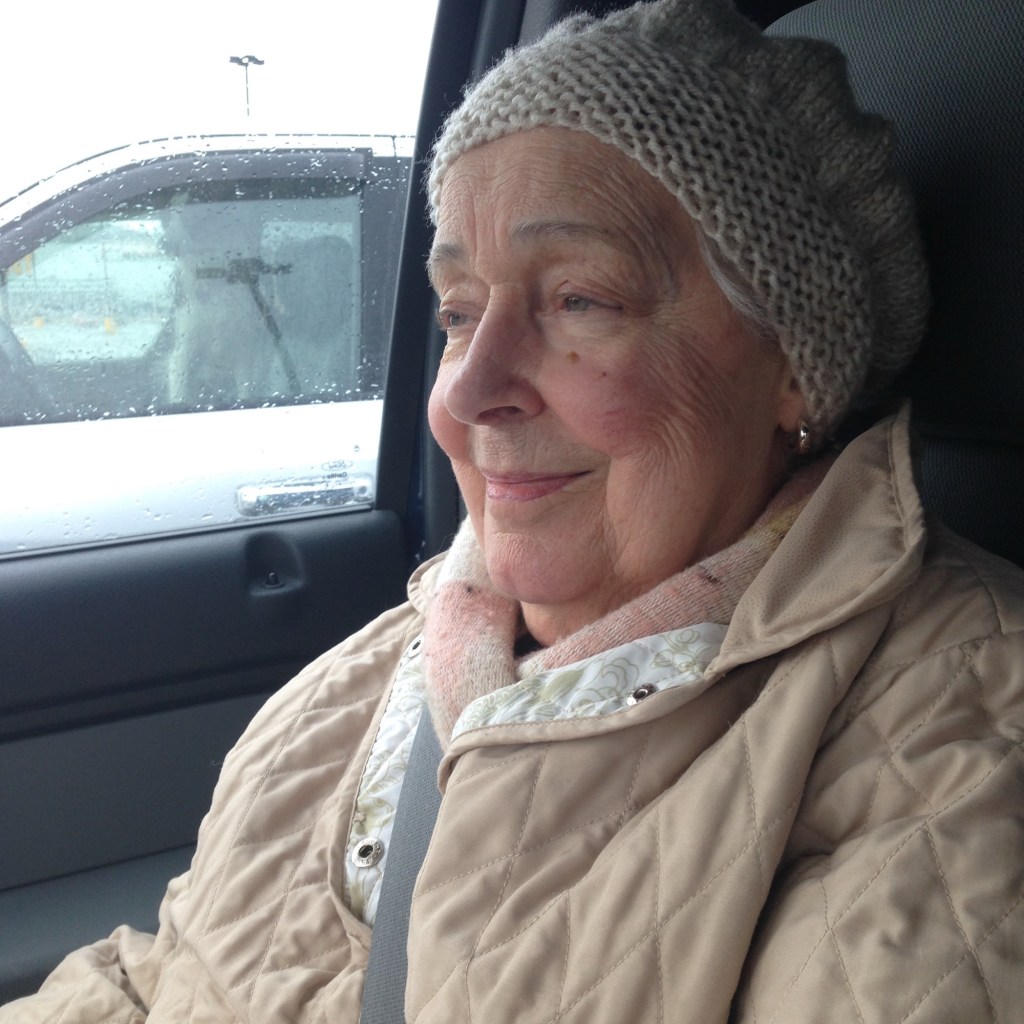
    My mother, Mary Eileen (Bunny) Lewis caught in a moment of everyday happiness

    “I must learn to be content with being happier than I deserve.” – Jane Austen

    “Letting go takes a lot of courage. But once you let go, happiness comes very quickly” – Thich Nhat Hahn

    Happiness is a slippery state of being, an elusive, inconstant companion. Like a feckless lover or an indifferent cat, it’s never near at hand when you need it most. It’s approach is often unheralded, it’s visit, never long enough, it resists all enticements to stay. It cannot be captured…it will not be held…we cannot keep it. It is as impermanent as an ice cream on a hot summer afternoon, as fleeting as a first kiss, or a glass of fine wine, it lingers briefly, and disappears into the realm of memory. The art of happiness sits haplessly in the space between our first world sense of entitlement, and our readiness to cultivate a sense of wonder, that magnifies the trace elements of happiness drawn from everyday dealings. Little things like the dog’s yawn, the carol of the wind in the trees, the smell of freshly brewed coffee, or the uncalled-for-kindness of a stranger can, with practice, conjure a sensation of peace, an ‘invisible cloak’ of contentment, protection against the certain storms of life. There are glimmers everywhere if we learn to spy them, and they can sustain us, even on our darkest days, if we apprentice in the art of happiness.

    First lesson – kill all expectation of happiness. It’s Buddhism 101, the first noble truth, ‘Life is suffering.’ Happiness is not our baseline or our birthright. We don’t deserve it, and we can’t earn it. We are not on some episode of Friends with a laugh track running every 30 seconds. Chandler Bing died of drug use disorder, and Rachel’s husband left her for Angelina Jolie. We’re in the ‘real’ people, and to quote the venerable Monty Python, ‘Life’s a piece of shit…just remember it.’ (It works better if you sing it). My kids would say that that’s a bit dark or defeatist, but I’m with Schopenhauer and the Pessimists, you need a sense of humour to get through the tragicomedy we call life, and ‘the safest way of not being very miserable is not to expect to be very happy.

    Buddha’s second noble truth is that we’re the problem…we are the root of all our suffering…we build our own hell. The art of happiness is to desire less…stop trying to make the world conform to our preferred narrative…that way lies madness. Relax…we control nothing… and anyway, sometimes bad news is good news in disguise, if we wait long enough. It is a mighty thing to slay your expectations and lay yourself open to your share of frustrations, disappointments, and loss. My mother always told me that ‘acceptance is liberation.’ She was a very wise woman, a gift earned from enduring her measured cup of sorrows.

    William James wrote ‘We need to stop deciding how we want things to be and then getting ourselves upset when things don’t turn out that way.” Easier said than done Willie, especially when you discover the last piece of cake gone, or the poop your geriatric dog deposits on the dining room floor every night.  Still, I say give it a try next time you’re provoked by an uncapped toothpaste, a Sunday driver when you’re running late, a rainy day when you wanted it fine.  Start there and when you’re ready you can move on to little old lady sized stuff, like chronic pain, or learning about a friend’s new cancer diagnosis, or loosing someone you loved very deeply…someone you thought you could keep forever…a loss that feels like the sky’s gone out and taken all the stars away. It gets a little harder to wash down then, even with a good red.

    James would say, ‘If you believe feeling bad, or working long enough will change a past or future event, then you are living on a different planet, with a different reality system.’ He’s right of course. we can’t get so mired in the shitty pieces of our story that we miss the good bits…the glimmers.

    We can’t be ‘shiny, happy people’ all the time and I guess we shouldn’t even try. Don’t we need a certain measure of malcontent to get anything done? It’s only unhappiness, disappointment and disenchantment that puts our clay feet on the floor every morning, isn’t it, that fuels our pursuit of wisdom…some magic beans to make the daily grind a bit more palatable? If we were happy all the time, we’d stay at home all day and roll around in it, wouldn’t we, hedonists supping on donuts and Netflix until our brains and our bodies turned to mush.  That’s Hotel California my friends…’and you can never leave.” (Again, much better if you sing it with me)

    If we can’t capture happiness and keep it caged, as we might like best, then we can cultivate habits and practices that invite happiness in, offer her tea and something sweet to encourage a long and robust relationship.  Gratitude is the first and best invitation to happiness that I’ve discovered.  It is that great looking glass that magnifies all the beauty and riches around us, large enough for us to see all that we have been allowed to keep… legs that take us walking, minds that may still read and discuss, running water still clean enough to drink, maybe even a hand to hold.  I’ll add to this the extraordinary occasion for a fine cup o’ tea and in good company.  Vonnegut suggests we recite in such moments of clarity, ‘If this isn’t nice, I don’t know what is.”

    We must fall in love with the beauty that is all around us.  Cast our eye about ourselves each morning and count our blessings.  Oscar Wilde wrote that ‘most of us are living in the gutter, but some of us are looking at the stars.’  We need to look for the glimmers.  They’re everywhere once you start practicing: the dance of late summer leaves, the first line of a new book, or that feeling of being understood…an easy, effortless fellowship that lets us know we’re not alone.

    Friendship is the second essential pillar in my study of happiness.  Friends come in many shapes and sizes.  They can be fictional, or four-legged, they can be blood, and people we grew up with, or choose to grow old with, but more often than not you’ll find them out roving on some adventure.  They arrive unexpectedly, a happy surprise, and their company can feel like coming home after a long time away, or a gift you didn’t know to ask for, but have wanted your whole life. ‘The secret Alice, is to surround yourself with people who make your heart smile, it’s then, only then, that you’ll find wonderland.’

    If you’ve not yet landed in Wonderland, then I suggest you take a break from your own troubles and concerns and look around you for a way to help others with theirs.  Service is chapter 3 in the little old lady book of happiness.  My brother was in love with Emily Dickinson, she was a dear friend of his.  She wrote, “If I can ease one life the aching, or cool one pain, I shall not die in vain.”  I say do harm to no man and never miss an opportunity to do a kindness. Be a light for others.  I love the old Indian proverb, ‘Blessed is he who plants a tree under whose shade he will never sit.’ To my mind there is no better way to cultivate your own happiness than to contribute to the happiness of others, unseen, unacknowledged and with great humility. If we’re all made of the same stuff in the great fabric of being, then watching out for a dropped stitch here and there only makes good sense…keeps us all from unravelling. 

    If we can stay with the knitting analogy for a minute, then I suggest that the fourth practice in this little old lady’s guide to a happiness, is to keep to your knitting every day.  The work we choose to do is key to practicing good happiness hygiene. If you love your work, then every day is a delight and you’ll be a success, no matter the weight of your wallet. That’s not to say you won’t have to find some job to keep you in beer and bread and a roof over your head.  But you must never let those necessary hours detract from your real work, the work you recognize as your own. And if you haven’t yet found this work then, to quote Ms. Dickenson once more, you must be ‘out with lanterns, looking for yourself.’ 

    John Muir the great naturalist counsels that ‘nothing dollerable is safe.’  That’s the way, he implies, to Thoreau’s ‘life of quiet desperation.’ I say be curious, go adventuring, stretch yourself beyond your imagined limits, investigate, take yourself away, let yourself go quiet.  Your work will find you…artist, teacher, carer, baker, candlestick maker…it matters not.  Trust only that which speaks to your soul, that engages you wholly, that causes you to lose time and that you can’t wait to get back to again each day on rising. ‘It’s foolish for people to want to be happy,’ wrote Georgia O’keeffe, ‘our interests are the most important thing in life.’ ‘Happiness,’ she said, ‘is only temporary, but our interests are continuous.’

    Lastly, and maybe most importantly, happiness lives principally in the present moment.  We need to slow down and stay grounded here in the now, and as the Stoics suggest, ‘do every act of our lives as though it was the very last act of our lives.’ All the greats say the same. To quote my favourite Buddhist, Thich Nhat Hahn, we must ‘drink our tea reverently, as if it is the axis on which the world revolves.’ ‘Eternal life’ wrote Wittgenstein, ‘belongs to those who live in the moment.’  But the poets say it best, To see a world in a blade of grass…heaven in a wildflower.’  It’s that moment when the musician understands that he is not only the strings of the instrument he plays on, but also the music that fills the room and touches the heart strings of everyone who hears.  There can be no higher experience of happiness to my mind then being fully present and awake to your surroundings.

    If you asked me the raw ingredients of my own happiness, I would quote Tolstoy, ‘Rest, nature, books, music, such is my idea of happiness.’ I also try to practice what my brother taught me… to live in a state of radical amazement.  E. B. White urged us to ‘always be on the lookout for wonder.’ So, I get up each morning and try to look at the world in a way that takes nothing for granted. The art of happiness lies in extracting it from commonplace things and as a little old lady in waiting, I’ll give the last word to that old sage, Socrates, ‘Let’s enjoy ourselves,’ now, ‘It’s later than we think.’

  • In Conversation with (Iwona) Maria Kubacki

    I first met Maria Kubacki when we were still teenagers.  She was a friend of my brother’s… think artsy, intellectual, an outsider, by choice or design. Recently arrived home to Saint John from a Toronto private school, she was the iconic, underground campus ‘it’ girl, a ‘Lit chick’- all cat’s eye eyeliner, black tights, and arthouse lipstick.  She was clever and cool, straight out of a Sally Rooney novel, this quixotic mix of edge and vulnerability that was foreign and familiar all at once.  Her style acumen was just the pretty wing man for her real talent, an unpretentious academic mind, a well-spoken confidence, and a reverence for the written word.

    Fast forward 40 years, Maria, a fellow little old lady in waiting (possibly in denial) forwarded her initial remarks with a disclaimer: “I’m a little embarrassed and intimidated by this. I don’t want people to think, ‘who does she think she is?’ I have no particular accomplishments. I’m just answering these questions as a fellow little old lady in waiting who is in the thick of middle age and thinking about how to make the most of the last third of life.” This same little old lady in waiting, earned a Master of Arts degree in English Literature and has worked as a book reviewer and freelance writer as well as an associate editor, and editor.  Currently she lives and works in Ottawa as a communications manager for the federal government. She took up writing fiction a few years ago and has published her short stories.  She is married to a lovely man named Ken and has two twenty-something children, Jane, and Mike. She sidesteps the 7-sentence limit of the first interview question so adeptly, using a series of semi-colons, dashes, and ellipses, that I had to allow it. Maria Kubacki is still very clever…and cool, maybe even more so as a little old lady…in waiting.

    Tell me your life story in seven sentences or less? 

    I was born in Warsaw, came to Canada when I was 4 ½, lived in Quebec City briefly and grew up in Bathurst in the 70s, where we were one of the few immigrant families, but it was pretty idyllic …double-dutch in the street with my friends, summers at Youghall Beach. I went to high school at a girls’ boarding school in Toronto where I was more focused on smoking, drinking and New Wave music and fashion than on my education, and where I started going by my middle name, Maria, instead of Iwona (my actual first name, pronounced Ee-vohn-ah and mangled by nearly everyone because of the “w”), or Yvonne (what everyone called me in Bathurst because it’s the French version of Iwona) – it was fairly common back then for immigrants to change their names to something easier for Canadians to pronounce, but it was weird and embarrassing to me to have all these names, and sometimes still is, as my parents, Polish family and friends still call me Iwona (or Iwcia, the diminutive, pronounced Eef-cha)…Bathurst friends and some cousins call me Yvonne, and everyone else calls me Maria.

    I never knew what I wanted to be when I grew up, but I loved reading – my parents were and still are big readers so we always had lots of books in the house, and also I learned English the summer I turned 9 from a British family from the Isle of Man who had all kinds of children’s classics all over their house, the Narnia series and that sort of thing – so I ended up getting a BA and then MA in English at UNB.

    I was quite lost in my twenties and dragged my MA on for many more years than I care to admit, but during that time I started doing freelance writing as a way to earn a bit of money and avoid my thesis – art reviews for a magazine called Arts Atlantic, and book reviews for the Telegraph Journal, which eventually led to a job as associate editor and then editor of the New Brunswick Reader, the Telegraph’s weekend magazine.

    I got married and had my two kids in Saint John before moving to Ottawa where we have lived for 22 years and where I wrote for the Ottawa Citizen and worked as a writer/editor at what was then Canwest News service (now Postmedia).

    For the last 16 years I have been working as a communications manager for the federal government and recently I started writing and publishing fiction, which I had never even thought about doing until I turned 50.

    What is the best thing about getting older?

    People always say things like not caring what others think anymore, or not sweating the small stuff. Sadly, I still sweat the small, medium, and large stuff – I sweat all of it. I haven’t yet reached the part of getting older where you’re relaxed and just flowing and enjoying life. I’m still in the thick of it – middle age, work, responsibilities. I think the “best thing about getting older” hasn’t come yet, or maybe I’m just doing it all wrong.

    What is the worst thing about getting older?

    Becoming set in your ways and more reluctant to try new things, acting and thinking like you are even older than you are. You’re drunk and high a lot more when you’re young, maybe that’s why you’re more open to new experiences then.  Children are like that naturally…they’ll be friends with anyone, they’ll try new things, and as we age, we tend to stick to what’s familiar, what we know we will like, people like us etc. Our world can get smaller and smaller.

    If you could retain or retrieve one quality from your youth, what would it be?

    Being open to life, people, and experiences.

    What’s the most important lesson you’ve learned so far?

    Children and dogs have it all figured out – be in the moment, and enjoy every little thing, every day. Our beloved golden doodle, Tippy, who we had to put down a few years ago, was still chasing rabbits, making new friends, and wagging her tail the night she died.

    Do you have a favourite quote?

    Does anyone actually have a favourite quote or do they just Google “famous quotes” when asked? I don’t have one off the top of my head, but whenever I see one from the Stoics, it resonates – like the Marcus Aurelius one at the top of your blog, which I love and need to meditate on every day, because I don’t think I am living my life this way now: “Think of yourself as dead. You have lived your life. Now, take what’s left and live it properly.”  I have lived a pretty cautious, small life. My anxiety, a lifelong affliction, has always held me back in life, even when I was younger. I would like to become a more fearless or at least less fearful person. Do more, see more, travel more. One of the reasons that it’s fun to read and write is that we all only have one life to live, and we have to make choices, and for some of us fear holds us back, but through writing and reading we can vicariously live many lives. 

    Do you have a favourite word?

    ‘Actually‘ – with index finger held up, because I’m a bit of a know-it-all, as my family and friends will tell you. One anecdote: on a family trip to Florida we took a drive through a ritzy area in St. Petersburg where there were big mansions…so we’re driving around  and all having a nice time, and we drive by this house that has these ornate pillars and my sister-in-law says ‘oh look, there are statues of dolphins on them’ and I was trying to fight the reflex and telling myself, ‘don’t do it’  and then it just came out, ‘Actually, I think they’re manatees.’ Everyone just rolled their eyes at me but they actually were manatees! It’s become part of the family narrative. 

    Describe your perfect day.

    Any day when I’m on a beach anywhere, in almost any weather, or just somewhere near the ocean or near water. It could be Venice, or Seven Mile Beach in Grand Cayman, or Bar Harbor, Maine. Or Brackley Beach in PEI, Sandbanks Provincial Park, Saints Rest in Saint John.  I think it connects back to happy memories of growing up in the Maritimes, spending a lot of time at Youghall Beach in Bathurst every summer throughout childhood and my teen years, and then living in Saint John for many years going to places like Cape Spencer, the Irving Nature Park, St. Martin’s.  I guess to me water also feels very open to possibility.  I think I like imagining what’s on the other side of the ocean. I also love the feeling of being on the water, I love kayaking… it’s just very freeing. 

    If you could have tea with anyone, real or fictional, dead or alive, who would it be and what would you talk about?

    I know people often say Jane Austen, Shakespeare, or Churchill but I can read them, no need to have tea with them. I love Jane Austen, but I think she would be really catty and judgmental in real life – I would be afraid of her. Maybe hanging out with Churchill while he sat around in his pink satin undies and robe while drinking and trying to figure out how to defeat Hitler might have been cool. But I think what I would really like is to have tea with both my grandmothers, although separately. I would ask them about their lives in Poland. My mother’s mother had a farm outside Warsaw and raised 5 children during the Second World War. She was not educated but was very smart, wise, funny, kind, and resourceful. She was milking the cows at like 4 am, made all the kids’ clothes by hand…during the war, German soldiers took over their farm and the kids all had scarlet fever as well …and somehow, she managed to keep everyone alive. And found time to make beautiful hand-embroidered tablecloths.

    My father’s mother was very ahead of her time.  She went to medical school in the 1920s when there was a “numerus clausus” – a quota that only allowed 10 % of the students to be women, and she was smart and tough enough to be one of the 10%. She did a PhD and was a specialist in internal medicine. She also loved to travel and trying new foods and was sporty and adventurous – she would rent scooters for her, my dad and his brother and they would all go adventuring together.

    Tell me three things that bring you joy.

    My family and friends. Walking/hiking/kayaking. Travelling almost anywhere, whether it’s a day trip near Ottawa, a road trip to New York or New England, or Europe. I’m going to cheat and list way more things because many things bring me joy. Going to museums, big or small, almost anywhere. Cappuccinos and spritzes. Chocolate. Music. Going to movies at the Bytowne, our local rep cinema. Conversations about life with my kids, Jane, and Mike. Family dinners with the kids and my parents. Rewatching favourite movies and TV shows with my husband, Ken – Remains of the Day being the movie we rewatch most often, because it’s perfect in almost every way – from the writing and the acting to the period costumes and interiors and the incredibly sad but beautiful score.  Ken and I also like making up our own words to songs and making ourselves laugh. Sometimes we also meow songs – we don’t remember why we started doing that, but I think it was when our kids were little, but anyway it makes us laugh. It’s not possible to list just 3 things.

    Name a guilty pleasure.

    Taking a day off just for myself to do whatever I want. Or years ago, when my kids were little, Ken and I would sometimes take an afternoon off work to go to a movie just the two of us.

    Do you believe in life after death? What does it look like?

    I don’t really think about it. It’s probably just oblivion – we probably just get reabsorbed into whatever the universe is made of…ashes to ashes, dust to dust. But if there was some kind of life after death, it would be nice if it were an eternal sleep where we dream forever and get to be with everyone we loved and experience everything we ever wanted to but did not get to experience in life. In this eternal dreamworld I hope I get to fly, and look down over the earth, like Google Street view, but better.

    What would you like your eulogy to say?

    I guess my kids would be writing my eulogy. I hope they say I was a decent human being who taught them to be decent people. I think they might say that I gave unsolicited advice very freely, but I hope they feel that sometimes it was good advice. I hope they also remember our Amazing Race-style family trips where I made them see and do everything, even if we were exhausted and our feet were sore from walking 20,000 steps a day.

  • In Conversation with Dr. Margaret Anne Smith

    I sat down with Margaret Anne Smith at a local coffee house with a reputation for good lattes and a spectrum of social justice projects that support many marginalized members of our community.  It seemed a fitting setting for a conversation with a woman who is, among other things, an advocate for the disenfranchised, sitting on the board of a harm reduction enterprise that supports people living with addiction.  Margaret Anne Smith holds a PhD in English Literature, specializing in 20th Century poetry, and has taught her entire career in the post-secondary setting.  She is an academic, a teacher, a poet, and a fiber artist.  She is married, a mother of two, and has the sort of old-world integrity and essential goodness that makes you believe that we are not without hope, no matter what unbelievable chicanery we witness daily on the evening news.  As I listened to her speak, I couldn’t help thinking of the power of a single individual to effect great change in the world around her, especially one armed with a sharp analytical mind trained to notice what others do not see, and gifted with a clear, insightful voice to ask the right questions.  She is currently at work on a book of poetry that celebrates local coastal beauty and lure.  It is a collection I very much look forward to reading someday.

    Tell me your life story in seven sentences or less? 

    I grew up in Saint John and…same sentence… moved back here on purpose, after spending a dozen years away.  I love my extended family and friends. I have been married to David for 36 very good years. We have two great kids. I live near the Bay of Fundy. I am a teacher. I am a reader and a writer.

    What is the best thing about getting older?

    Learning…I was going to say discovering, but it’s not like a momentary discovery, there is no switch that flips, there’s no ‘aha moment’… it’s a gradual process of learning what I care about. And the other side of it, is learning what I don’t give a fuck about, and that list has changed with time.

    What is the worst thing about getting older?

    Joint pain and not being able to see as well as I want to in my 50s. That’s the part that surprised me, the pain came so much earlier than I anticipated.  I’m on the cataract waiting list which depresses me, but I look forward to losing the heavy progressive lenses.

    If you could retain or retrieve one quality from your youth, what would it be?

    My knees and my feet to be honest.  It’s not my optimism…it’s not my hope, it’s not my energy level I’m worried about losing …it’s my joints. I had envisioned at this age, those walking trips in Europe, but there’s no chance.  I couldn’t physically do it… it’s my knees. I want to be able to hike for ten kilometers and I just can’t.

    What’s the most important lesson you’ve learned so far?

    I think it’s probably learning the difference between spending your energy on things you cannot change and spending your energy on things you can.  And that exists on several levels   So there are things that maybe I cannot change about myself,… my feet hurt, I can’t take a walking trip across Ireland. Ok…goodbye to that idea, and now what can I do instead? Because I think spending your energy on things you can’t change makes you bitter, and we don’t want to be bitter little old ladies in waiting… because it would be easy, wouldn’t it?

    So that’s personal, so now let’s take it to the next level to the people in my circle.  There are certain things I can’t change, and you can invest in those relationships but there are some things you just absolutely cannot change.  I like Glennon Doyle’s Podcast?  It’s called “We Can Do Hard Things”.  It’s American and its funny as hell, and they interview  a lot of interesting people and one of the great episodes is about  how to fortify yourself for the holiday season in terms of dealing with your family and expectations.  A great piece of advice he gives is ‘Be not surprised’ because you know Uncle Bob is going to go down the same road he took last year, so don’t be outraged and horrified by it, just adopt an attitude of ‘yeah, whatever, I still love you,’ when people behave in ways they have always behaved, ‘be not surprised.’

    Jewel has a song I really like from 1998, I’m dating myself here, it’s called Life Uncommon. She says ‘no longer lend your strength to that which you wish to be free from.”  It’s about using your voice and that  speaks to me now…where do you use your energy… where do you use your voice.

    The other part of that question is what you do about the global piece and that is much more difficult right now.  I try to be selective and pick the bite-sized things that I can do.  I joined the Board of Avenue B that operates on a harm reduction model.  I have no lived experience with addiction myself, or in my circle, but I thought I can be on the board.  I’m good at policy and procedure…and I try to make choices with some integrity. I don’t live in a tent, I’m not a drug user, but l am devastated by the inhumanity that’s everywhere in our cities and small towns now and how people are being treated so badly and left out.  We talked about water fountains at the meeting last night.  If you were thirsty and unhoused…where do you go?   

    Do you have a favourite quote?

    Yes, it’s a quote by Vaclav Havel.  I like it because he distinguishes between hope and optimism. It’s a quote from his time in prison.  His language is beautiful of course, but for me the beauty is that he isn’t saying, it will all be fine…because so often it is not fine. He takes hope from being a big cartoony rainbow thing and makes it real.

    “The kind of hope I often think about (especially in situations that are particularly hopeless, such as prison) I understand above all as a state of mind, not a state of the world. Either we have hope within us, or we don’t; it is a dimension of the soul; it’s not essentially dependent on some observation of the world or estimate of the situation. Hope is not prognostication. It is an orientation of the spirit, an orientation of the heart; it transcends the world that is immediately experienced, and is anchored somewhere beyond its horizons.

    Hope, in this deep and powerful sense, is not the same as joy that things are going well, or willingness to invest in enterprises that are obviously headed for early success, but, rather, an ability to work for something because it is good, not just because it stands a chance to succeed. The more unpropitious the situation in which we demonstrate hope, the deeper that hope is. Hope is not the same thing as optimism. It is not the conviction that something will turn out well, but the certainty that something makes sense, regardless of how it turns out. In short, I think that the deepest and most important form of hope, the only one that can keep us above water and urge us to good works, and the only true source of the breathtaking dimension of the human spirit and its efforts, is something we get, as it were, from “elsewhere.” It is also this hope, above all, which gives us the strength to live and continually to try new things, even in conditions that seem as hopeless as ours do, here and now.”

    Do you have a favourite word?

    Sea…as in the ocean. The word sea represents all kinds of things metaphorically but for me it is both a personal, and local place of refuge…it always has been …since I was old enough to ride my bike off the cliff, which I did by the way…I was a free-range kid in West Saint john.  I might edit that out for my mother.

    There is something timeless about the sea… I love the rhythm, I love the sound.  It’s also a metaphor for connection, wrapping around the globe, and it’s a measuring stick for what we are doing to the planet which is a big concern for me.  I think because we can see the trees being cut down and we can see the trees on fire on tv, it’s a little harder to ignore, but we could go to Bayshore this morning and think all is well…and it’s not.  We need to pay a bit more attention… we need to pay a lot more attention. 

    Describe your perfect day.

    Sunshine. Great coffee. The ocean.  My husband and my kids and their partners and nothing planned. 

    If you could have tea with anyone, real or fictional, dead, or alive, who would it be and what would you talk about?

    Given the state of the world, I want to sit down with Greta Thunberg.  Three reasons.  She is young and we need to listen to the younger voices, about everything. I mean look at where the power is…still in the hands of old rich white guys and that has to change.  Secondly, she is willing to make incredible sacrifices for the future. I’m interested in asking her, why, what do you see, what do you envision, what are you giving up and what are you giving it up for?  Three would be the climate crisis, it’s going to cook us and were pretending it’s not.  I want to talk about that.

    Tell me three things that bring you joy.

    Real conversations.  Real, not honest, because even honest conversations have a few lies in them.

    David, Kevin, and Maureen …from the beginning all the way to this morning.  So much joy in that little family of mine.

    Time outdoors.  Some of it goes back to the free-range childhood.  Total freedom.  It might have been an illusion, or it might have been quite real, that no one was paying any attention to us kids.   We were free, and time outdoors reminds me of my freedom.  Also, as an artist I appreciate the changing light and the shadows cast by the sun and the changing colours of the season.  My shoulders lower when I step out the door.

    Name a guilty pleasure.

    Ice cream. Too much fat, too much sugar but it hasn’t made me give it up.  It’s a favourite treat.

    Do you believe in life after death? What does it look like?

    I do believe in life after death, but I don’t know what it looks like.  And I don’t even have an assumed visual. I think when I was young, I did have an idea that was based on a religious tradition…heavenly gates…clouds. So now I think there is so much beauty and goodness, despite the horrors, and I don’t think those things can just come to an end.  There has to be something else.  My sense of what that is has changed, because I think there is something else for the right whale as well, and for the pigeon on the roof… that we’re all part of this interconnectedness that we can’t really, fully appreciate now and maybe our great joy in the afterlife is coming to understand what that interconnectedness means.   

    What would you like your eulogy to say?

    I boiled it down to two things. First, I want my children to write it, and I trust them. Second, and how’s this for a mothers’ control, I hope they would say that they saw that I remained engaged until the end of my days.  I don’t like the word engaged… maybe passionate, passionate is better, engaged is so psycho-ed, or maybe that I cared, but that’s too Hallmark.  Passionate works, and passionate about what doesn’t really matter…maybe when I’m 80 I’ll be passionate about my pansy collection.