Tag: kindness

  • A Parting Glass

    “It takes two years to learn to speak and sixty years to learn to keep quiet.” – Ernest Hemingway

    “It is a kind of love, is it not? How the cup holds the tea…I’ve been thinking about the patience of ordinary things. How clothes wait respectfully in closets, and soap dries quietly in the dish, and towels drink the wet…and what is more generous than a window.” – Pat Scheider

    A low inward thrum seemed to pass through the garden, as though the place itself had drawn breadth and held it. The roses knew first. A faint tremor went through their stems; their leaves turned ever so slightly as if in listening…The roses said nothing. They had long ago mastered patience. But in the folded centres of their blooms they kept their knowledge.” – Thackray of England

    We don’t always get to say a proper goodbye, to intentionally take our leave of one another, to say the words that will hold meaning and then pass into memory. As my 60th birthday looms and my year of writing as a little old lady… in waiting draws to a close, I raise a “parting glass” in gratitude for your readership and your always thoughtful and thought-provoking feedback. A special thank you to the “12” wise women who gave me their trust, and opened their homes and there histories to share their earned wisdom. A curated circle, chosen for their considerable and varied life experience, they dug deep for their gold and held out their best bits so I could take a closer look, reviewing over 600 years of collective learning. These conversations proved a deeply nourishing, uniquely rich, and stimulating experience.

    The Little old Lady …in waiting blog which began as a bid to slow down time as I transitioned to a life beyond the corseted years of paid employment and the heavy-lifting decades of parenting, was developed as a space to inventory and explore the bittersweet privilege of growing older; the good, the bad and the not so pretty.

    As a writing workshop the blog proved a perfect tool for exploring and consolidating my thoughts on topics like retirement and the mother choice, death and diet, loss and heartache, the importance of rest and transformative power of travel, creative engagement, the beauty and majesty of the Crone, the everyday therapy of walking, the art of happiness, the meaning of life, and even the possibility of an afterlife. I smile a slow inscrutable smile imagining my children, one day opening these essays, perhaps in their 50’s, and hopefully wearing similar smiles, reading my thoughts on subjects they are only now beginning to consider. I will have my say!

    I have learned a great deal in this last year of writing. I learned, most importantly, that when we distill our life stories down to the essentials: education, work, love of place and people, it is always a story of family, the backbone of our lives, that sustains us, those who came before us and those who will still be here after we are gone.

    Often the quality heralded as the “best thing” about getting older is a certain imperviousness to the opinions of others, while the “worst thing” about getting older, referenced most frequently, is pain, the emotional pain of losing those we love, as well as physical pain, or the breaking down of the body. It seems while our inner women may still feel twenty-something, the body keeps its own count of the passing years.

    Important life lessons that resonated with me include the deceptively simple truth that “happiness is an inside job,” the importance of “being in the moment,” the gift of “forgiveness… of ourselves and others, the profoundly freeing understanding “that control is an illusion” and the everyday magic of “leading with kindness.”

    Favourite quotes …an impossible task to be sure, but a few stand-outs for me include:

    “Well behaved women seldom make history.”

    “Would it help?” (a question to ask when tempted to plummet into a worry spiral)

    “If this isn’t nice, then I don’t know what is.” (An intentional acknowledgement of everyday moments that bring joy)

    “Life is not difficult for those who prefer everything” (Excellent advice to accept the universe as it unfolds)

    I loved the experience of collecting favourite words, arguably my most telling interview question. Honorable mention must go to the expletives and the made-up words. “Kretzimah (soft or enjoyable, a gentle person…it describes everything delightful” and “Snigg,” an accidental emoticon. (Originally a typo denoting an emotional reaction, passed down in family correspondence, evolving to an intergenerational sentiment inspiring familial love and affection).

    Components of perfect days recounted invariably involve agendaless afternoons and time with family. Chapter headings chosen to reflect this part of our life stories were most often some variation of living intentionally, in wisdom and in grace or a kind of renaissance, or revival. Experiences that spark joy include meaningful conversation, time with close friends and family and engaging work. Guilty pleasures were for the most part verboten, discarded vestiges of younger versions of ourselves. Most everyone interviewed was open to the notion of an afterlife but most were unsure what it might look like. Some hoped we might fly, many wished to spend time with lost loved ones, but ultimately the afterlife proved impossible to imagine in any tangible way, one friend insistent on “a place of perdition if you’ve been just an absolute arsehole.” Never mess with a little old lady…in waiting.

    As to tea with real or imagined guests, many chose to invite personal heroes, and family members no longer living, with one thoughtful LOLIW choosing to come back some years hence and have tea with her grown grandchildren. What a great privilege that would be.

    As for eulogy, most women I spoke to wished to be remembered as kind, passionately engaged with their lives, a good friend, or as someone who leaves the world a bit better than when they arrived. My favourite eulogies were the succinct ones, “….and curtain“, ” I came, I was…I went, and the brilliantly comic, “That ass though…”

    I answered these questions for myself in a journal entry dated almost one calendar year ago to the day, and will attach them below as a gesture of respect and gratitude for the 12 extraordinary women who agreed to embrace social media and go public with their answers (I can be brave too), and as a legacy letter for my own children who may one day wish to know my answers. I encourage all my fellow cronies to do the same as a legacy project, as a writing exercise to distill personal meaning, and as a love letter to yourself, a guide to light your way in these last and hopefully most meaningful years of your journey.

    It was a great privilege to engage with you, my readers, in this year of writing as a Little old lady…in waiting and a real surprise to discover readers in places as far away as South Africa and Switzerland, Japan and Ireland, Greece and Australia, over 40 countries in total. I am deeply grateful for your readership and correspondence. My wish for little old ladies in waiting everywhere, is that we savour these last, unpromised chapters of our story, and if, as I have suggested many times, that “the end is where we start from,” it seems right to close where I began this journey, with Homer’s insightful invitation to mind your life in these last, most precious years.

    “Any moment might be our last. Everything is more beautiful because we are doomed. You will never be lovelier than you are now. We will never be here again.

    I raise a parting glass to you, in gratitude,

    A Little Old Lady…in Waiting


    In Conversation with Sylvie Fitzgerald

    Tell me your life story in seven sentences or less.

    I was born on the first day of Summer and was originally to be called “Summer”. My dad decided on Sylvie instead, a French name that he found in a novel by Louis Lamour. I had the great good fortune to be born into a family where I grew up feeling deeply loved, with two older brothers, one a protector, the other a soulmate…I was the only girl, and the baby so I grew up feeling like a princess.

    I’m a very high functioning introvert, happiest at home, reading, writing and, to a lesser extent, discussing, so I spent half of my 20s at university, managing to come out without any working papers, so I decided on a teaching degree first, and much later a nursing degree. No work has ever made me as happy as the work of reading, researching, ruminating, and writing. Along the way I met a lovely man named Jeff and we’ve been together now for more than 30 years… he’s probably the best decision I ever made, he and our two beautiful twenty-something children.

    Closing in on 60, I have a growing awareness that my time is finite and I would like to spend it well, cultivating, to the exclusion of all else, engagement, joy, and kindness. I’m trying to live well so that I can reconnect with people I’ve lost, people who have gone ahead of me and that I miss very much.

    What is the best thing about getting older?

    The best thing about getting older is laying down the mantle of responsibilities we assume over the course of our lives … work …, parenting, what to make for dinner, worrying about all the things beyond our control. I love the quote. “Don’t worry, nothing is in our control.” I guess for me the best thing is reclaiming my freedom, deciding how best to spend my life every day, every moment.

    What is the worst thing about getting older?

    The worst thing about getting older is losing the people you love, the people who matter most to you, people so much a part of you, you’re really not sure what’s left of you after they leave….and the aftermath of that experience…learning to live with that kind of profound loss.

    What would you title this chapter of your life?

    Beauty Everywhere.

    If you could retain or retrieve one quality from your youth, what would it be?

    I’ve let go of many things that no longer serve me…a certain arrogance that my answers are the right answers, an analytic way of thinking that is quick to classify and critique and judge, an egocentricism that casts me as the star of the story instead of a single small light on a tree set with millions of twinkling stars, or the idea that we must set goals and achieve them, that the mountain is there to be climbed instead of simply seen. I’ve let go of a lot from my youth, none of which I would wish to reclaim… maybe taut skin and a waist.

    What’s the most important lesson you’ve learned so far?

    That kindness trumps cleverness, every time. I used to think that the pursuit of knowledge was the most laudable goal and now I know that kindness is, unequivocally, and that the best training in kindness begins with kindness to yourself.

    Do you have a favourite quote?

    With our thoughts we make the world.” (Buddha) It was the first big secret I discovered and it remains a central tenet of my philosophy that I return to again and again. That we, each of us, have our own unique lens on the world, a filter that colours our perceptions. Two people can read the same book or watch the same play or experience the same family dinner and one can come away, marvelling at a moment of great beauty while another is conflicted about the experience, a witness to discord or even tragedy. We create our own reality; we see what we expect to see. Physicists even claim that when we observe a thing, we actually change its composition on a molecular level. We give form to things. If we cultivate beauty within, then we see beauty in others. If we are hard on ourselves then we have a tendency to be hard on others, if we are ourselves injured, we will sometimes choose to injure others in anger. Anais Nin says it beautifully as well, “ We don’t see things as they are, we see things as we are.” Closely related is a quote by Rumi, “Out there beyond the idea of wrong doing and right doing, there is a field. I’ll meet you there.” In reality there is nothing that is good or ill, its only our thoughts that colour in context and assign meaning.

    Do you have a favourite word?

    I love words so it’s almost impossible to choose only one. I’ll curtail myself to a few. I’ll start with “Sonder” a recent acquisition and new favourite, discovered in a book by Joe Koenig “The Dictionary of Obscure Sorrows.” It’s the realization that everyone you pass by is living a life as intricate and complex and real as your own, complete with their own dreams, troubles and foibles, a similar hero’s journey that evolves, unknown around you, like an anthill sprawling deep underground with passages to countless other lives that you will never truly know, but may still appear in for a moment, like a photobomber, perhaps only once, sipping a latte in the background, or a blurry passerby in a dimly lit window at dusk. I love the notion of interconnectedness “sonder” conjures.

    Copacetic” is another favourite. I like to say the word, the sound of it, and I like it’s meaning, that all is well. It also invites a posture of “equanimity” for me, a quality I have been in pursuit of most of my adult life, and another favourite word inspired in part by its illusiveness. Lastly, I must include, “Egad an old-fashioned exclamation that my father was fond of using. It helps me remember everything I hold dear about him, his humor and his love of language.

    Describe your perfect day.

    My perfect day starts early, maybe 6 AM, a quiet morning …coffee… it’s raining outside. I can hear the tapping of the rain on the window. panes. I love the rain because I don’t have to feel guilty about staying in on rainy days. I take my time, I write some morning pages and enjoy a second coffee with my husband, perhaps a fire, a lazy morning. Afterwards there is some physical component to the day maybe a long walk with my dog by the sea, or a swim in summer. After lunch I fall in to the pages of a perfect story, perhaps a woman in her 60’s, maybe a sonnet writer, surrounded by colourful characters that distract and delight. Later in the day my family gathers, there is slow atmospheric music playing, possibly jazz…maybe The Mercury Songbook. The lighting is orangey gold, Rembrandt tinted, I can smell seafood being prepared for dinner. Someone else is cooking, hopefully my husband, a glass of wine appears, as if by magic, just one. My kids are there and we sit down to a dinner together. We talk about our day, things that made us think or wonder, little beauties our eyes captured. There is dessert of course, because life can always be a little sweeter. Later another good story, for there can never be enough, perhaps a British mystery and then a blissful sleep.

    If you could have tea with anyone, real or fictional, dead or alive, who would it be and what would you talk about?

    I would want to sit down with my mum and dad and brother, all of whom have passed away. I would also invite my living brother, so I guess my origin family. I’d have questions, but mostly I would just want to sit in their presence, to feel their embrace in a physical way, to hold hands, to hug them and be held by them in turn for as long as I could. I’d ask where they are. I’d ask how I might find them when it was my turn to follow them, and I’d ask how we might talk sometimes now, how I might best listen for them.

    Tell me three things that bring you joy.

    My family, reading, and meaningful discussion, the kind that changes you in small important ways, that butts against your confirmation bias, the kind where you can feel your heart beating and know for sure that you’ve discovered something true.

    Name a guilty pleasure.

    I love a good period romance, think Downton Abbey, Jane Eyre, The Austen novels. You know the story, always a dark, brooding hero. Just a little healthy escapism but never before dinner. Every little old lady in waiting knows that we rescue ourselves, that we are the architects of our own fortunes, that we craft our own happy endings, but sometimes it’s fun to make believe.

    Do you believe in life after death? What does it look like?

    Yes, I do. I choose to believe in life after death, in the absence of any definitive proof one way or another. I am not so arrogant as to discount what I cannot conceptualize or understand. I don’t believe that there is an end to what we truly are, our essence. I know that our physical bodies die, but not our true or higher selves, the part of ourselves that has no name, that listens deep within us. Death, I believe is only a small speed bump between this world and the next, a door opening and closing. Blake wrote ” If the doors of perception were cleansed everything would appear to man as it is, infinite.”

    What does it look like? I hope it’s like a book I once read, What Dreams May Come. I hope it’s a place where we flow in a stream of consciousness with our thoughts and desires. If I think of my mother, then I am suddenly there with her in her kitchen watching her make molasses cookies, or I float down to the seaside for a stroll with my dad and a long overdue chat. Later a trip to the library, where I find my way to the poetry section for a cuppa with my brother where we cast away with our latest literary finds. In the afterlife of my imagining there is no fear, no scarcity, no expiration, no worry…only engagement, adventure and love.

    What would you like your eulogy to say?

    I hope it will say that she was kind, that she loved well, that she honoured her gifts, and that she left this world a slightly better place for having been here. I’d like someone I have loved well to read the poem, “Kindness.” by Naomi Shihab Nai and perhaps Ulysses by Tennyson or maybe the Desiderata or almost anything by Rilke or Rumi. I hope I get to hear your words, and carry them home with me, carefully, to keep until I see you again.

    Kindness

    Naomi Shihab Nye

    1952 – 

    Before you know what kindness really is
    you must lose things,
    feel the future dissolve in a moment
    like salt in a weakened broth.
    What you held in your hand,
    what you counted and carefully saved,
    all this must go so you know
    how desolate the landscape can be
    between the regions of kindness.
    How you ride and ride
    thinking the bus will never stop,
    the passengers eating maize and chicken
    will stare out the window forever.

    Before you learn the tender gravity of kindness
    you must travel where the Indian in a white poncho
    lies dead by the side of the road.
    You must see how this could be you,
    how he too was someone
    who journeyed through the night with plans
    and the simple breath that kept him alive.

    Before you know kindness as the deepest thing inside,
    you must know sorrow as the other deepest thing.
    You must wake up with sorrow.
    You must speak to it till your voice
    catches the thread of all sorrows
    and you see the size of the cloth.
    Then it is only kindness that makes sense anymore,
    only kindness that ties your shoes
    and sends you out into the day to mail letters and purchase bread,
    only kindness that raises its head
    from the crowd of the world to say
    It is I you have been looking for,
    and then goes with you everywhere
    like a shadow or a friend.
  • In Conversation with Dr. Cheryl Fury

    I met Cheryl Fury on the page before I met her in person. A published academic and popular history professor at UNB, I was first introduced to her irrepressible humor in a series of side-splitting social essays for The Reader, the weekend magazine of the Telegraph Journal.   Her writing was belly-laugh hilarious, whether chronicling the Pokeman world of a boy mom, or narrating a ferociously funny tale of a well-deserved weekend away with her girlfriends, her essays invited you in for a close up look at the busy, messy, unruly life of a thinking woman in her prime.  Her pieces were fresh, honest and recognizable, her voice unique, her writing capturing the unsung work and experience of a modern, educated woman in the heavy-lifting years of motherhood. Her stories were my story, and the story of a cohort of women raising children, managing careers, and working to preserve a life of the mind.  Her essays told the well-kept truth about what Irish actress, Jesse Buckley, recently called the “beautiful chaos of a mother’s heart.” She made me laugh out loud about the sticky-fingered, crayon coloured life we lead for a time, and I will always be grateful to her for that.

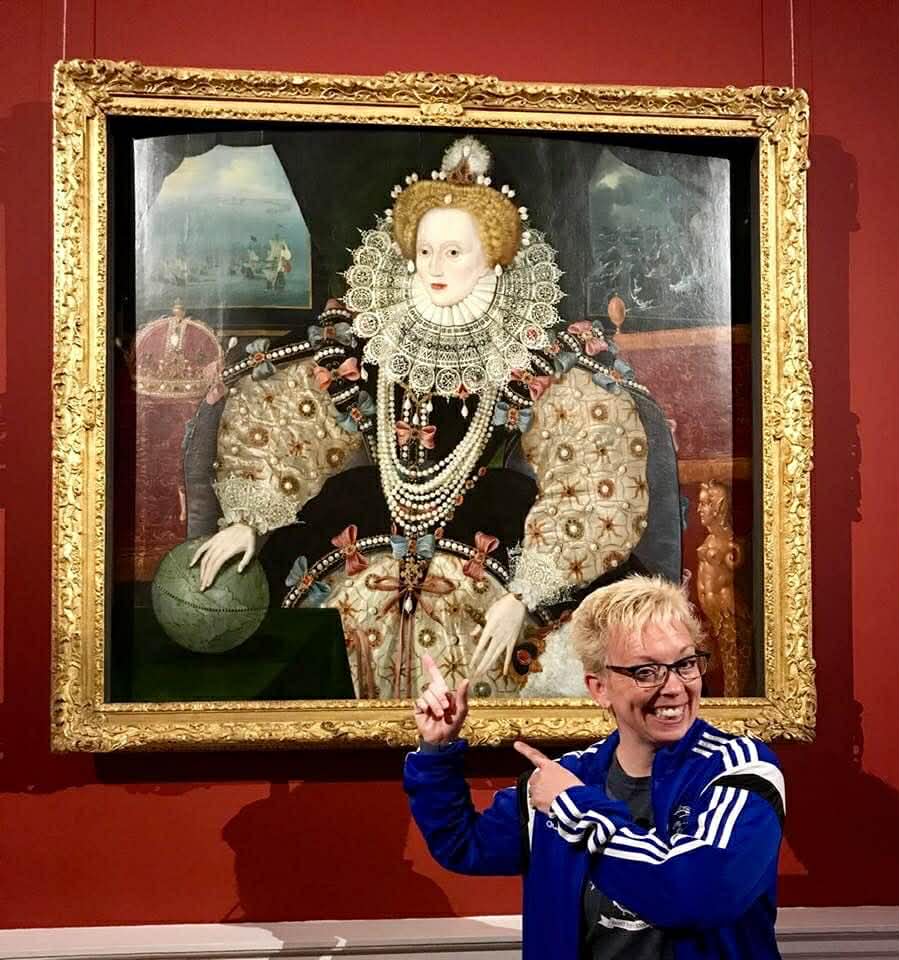
    Fast forward 20 years, Cheryl is an ageless, fit, and still very funny little old lady in waiting who runs 10 k a day, a sports enthusiast who played soccer until age 50.  Modelling a spiky, blond pixie cut and a triple-helix ear stack, her t-shirt reads, I incite this meeting to Rebellion.  She had me at hello. A tenured professor of history, and a Fellow at the Gregg Centre for War and Society, and the Royal Historical Society (UK), Cheryl grew up in Fredericton and earned her PhD at McMaster University.   She teaches courses in European and British history including early modern women and queenship, as well as modern Europe, with a special interest in the Holocaust and Fascism. Specializing in the social history of English sailors in the 16th and 17th centuries, she has published several books on seafarers, the men of the early English East India Company, and her current project examines the relationship between diet, disease and disorder on the high seas in the early 17th century. “Me and my sailors have a long, long romance,” she smiles.

    Cheryl is also a Holocaust educator who has worked as an editor on a number of research projects and a memoir with survivor Vera Schiff, who passed away a few years ago. Cheryl took part in a March of the Living Tour in Germany and Poland in 2010.  I asked her which of the concentration camps was the most horrific.  She told me that Majdanek in Poland was by far the worst. “There is a big concrete mausoleum at the back of the property that looks like a space ship…it holds seven tonnes of human ash.”  Cheryl also recalls an unsettling visit to the Wannsee Conference House where in 1942 the Final Solution of the Jewish question was first announced to the Nazi elite.  She describes a beautiful space right on the river, with people out in paddle boats waving on a sunny July day.  “It was so surreal…I had to leave…we had the lunch menus of what the Nazis dined on after the announcement.”

    I asked the history professor if she could encapsulate the lesson to be learned in the Holocaust, or a wisdom teaching that survivor, Vera Schiff, would want her to share with the world.  “Vera always quoted Edmund Burke,” she tells me. “The only thing that it takes for evil to triumph is for good men to do nothing.”

    Professor Fury’s top tags in online student assessments include, “hilarious”, “amazing lectures”, “tough grader”, and “get ready to read,” with 100 percent of respondents stating they would take her course again.  Cheryl smiles recalling one student who wrote “overrated.” She laughs and suggests that maybe that’s true too.  On her role as an academic, Cheryl has a lot to say about the blight of AI on campus.  “Chat GPT has some amazing uses but it’s not a good tool to find academic sources. It both astonishes at times and then makes stuff up – like a smart but bad, possibly drunk boyfriend.”

    “My role, I hope, is to cultivate independent thinking, writing and researching skills and now, more and more, the ability to identify what is real and not real in the age of AI. Learning how to check facts and cross reference is critical.  In the current moment, the world is so unbelievable that it makes it doubly hard to separate fact from misinformation, so the ability to check credible sources and have an interior base of knowledge is essential.”

    With no plans of retirement, Cheryl jokes that there are days when she and a fellow academic flirt with the idea of managing a convenience store or some little book nook where they can be their own bosses.  At least, I hope she is joking.  It makes me sleep better at night knowing that there is a strong, clear, and tolerant voice on campus competing with Chat GPT for the minds, hearts and souls of the next generation, entrusted to remember our history lessons.

    Tell me your life story in seven sentences or less? 

    I was born and raised in Freddy Beach. Played some soccer and some music. Had some schooling and some laughs.  Really like dead people.  Got married and became a boy mom.  Much professing.  Still love all those things.

    What is the best thing about getting older?

    Knowing who you are. You’ve figured it out. You’ve got your life partner…you’ve had your kids. You’re kind of watching them find themselves and you’re just so much more in tune with yourself… you know what makes you tick.  I know who I am in a way I was still trying to figure out when I was twenty.

    What is the worst thing about getting older?

    The lack of metabolism.  Watching various body parts expire their best before dates. Maybe in the 16th Century when we expired a little earlier…maybe that’s really what’s supposed to happen. Today whenever something starts to hurt, I don’t even hesitate, straight to physio…I’ve got coverage. I still run…I do it to run off the crazy.  I don’t even enjoy it at the time, I hate it…I run because it centers me.  I do it for how I feel afterwards.

    What would you title this chapter of your life?

    Embracing Your Inner and Outer Crone.

    If you could retain or retrieve one quality from your youth, what would it be?

    I think that I’ve retained the things that I really value.  I have a lot of  childlike joys in my life like my love of Halloween, something that I’ve carried with me from childhood, only now I have more money for animatronics. I loved playing Pokeman Go with my kids and I still play it. I am a top shelf Pokeman Go player.  I love Disney…I love The Grinch. Now I can afford like an 8 ft tall Grinch for my front yard. So, there are a lot of things that I truly loved in my childhood that I’ve carried along with me.

    I would say that I’m definitely more jaded at this point in my life.  I’m not the cock-eyed optimist of my youth.  I’m no longer thinking ‘Why can’t we all get along’ or ’surely humanity is moving in a better direction… women are getting more rights, right?’ I mean humanity is kind of losing its mind right now…its collective knowledge of things, and it may have to go and re-experience those things.  Our parents and grandparents could have told you that fascism is a bad thing… that totalitarian regimes aren’t good for the humans, but we’re seeing this resurgence of the fascist-curious, and many countries are flirting with the far right… and then hopefully pulling themselves back at the last moment because they have that collective memory.  

    What’s the most important lesson you’ve learned so far?

    Kindness.  I think kindness is the most important thing in life. That’s what makes the world go round.  Not everyone needs a lecture on the Industrial Revolution from me, but you might need a kind word, on a given day in particular.  So, leading with kindness is important to me and I would hope that my kids would get that more than anything else…to be kind to people because they need it.  We’re all going through God knows what, especially now. 

    Also, that less is more.  I’m not trying to swing for the fences anymore.  When I teach students, I’m not trying to dazzle them with every fact and statistic and every bit of my knowledge. I want to give them a basic interest and the idea that it gets more intricate the farther up they go in terms of courses and years at university, but it’s usually the simple stuff, and the basic stuff and maybe something a little funny or quirky that gets their attention, or the occasional bit of profundity if you’ve picked it up along the way…you drop that into the conversation and give them something to chew on. I always advise young academics to keep it simple, keep it entertaining, tell people a story…hook them with a good story that reveals something about humanity, and if they’re intrigued they’ll come back for more.

    Do you have a favourite quote?

    Well behaved women seldom make history.” I think you have to be a shit-stirrer, whether you’re male or female, or gay or straight, most of the time our rights are not given to us on a silver platter. Along the way you may have to get in the streets.  The first time the government tried to turn the university into a polytechnic I took my boys with me into the streets.  I was fighting for their education and the education of all their friends.  It’s not necessarily a comfortable place for most of us… to pick up a placard and get out there, but sometimes that’s what you have to do if you want to advance the ball, especially these days when we now have to defend things that we’ve held dear for years.

    Do you have a favourite word?

    Shit” That is my most frequently used word because shit can be a good thing, shit can be a bad thing, or it can be sort of a neutral thing like, “I don’t know shit,’ or ‘that’s some good shit,” and “that’s some baaaad shit.”  I mean really, it’s all shit…it’s truly one of the most versatile words.

    Describe your perfect day.

    I tend to think it would be some sort of turbo history nerd adventure. Some sort of haunted castle somewhere that I could explore, some backrooms that nobody else has seen.  Or it could just be a day outside with a bonfire and a bunch of guitars, friends and family and several bottles of prosecco. And I like my own company too, so sometimes a good day is when there is nobody in my house and I can have supper at 3 in the afternoon if it suits,  and if I want to stay up until 4 in the morning with the music going that’s fine too …I’m not disturbing anyone. 

    If you could have tea with anyone, real or fictional, dead, or alive, who would it be and what would you talk about?

    Well, I lost my mom quite a few years ago so it would be her. I want to catch up, so she would be my obvious first choice. Just a check in…I’m sure she does that anyway but it would be lovely to have a more productive two-way conversation.  But if it wasn’t her…I mean clearly, I’d like to have some conversations with Jesus but I’ll save that discussion for your afterlife question.  I would like to talk to certain historical figures to find out if we have things right.  I mean, I would really like to know for sure what caused the fall of Ann Boleyn. Those sorts of conversations would be pretty cool.

    Tell me three things that bring you joy.

    Knowing that my kids are becoming who they are, finding their vocation and jobs that have meaning for them. I also love my work. It’s so much fun to get into the archives and have a really good day there. Of course, there is a lot that is boring detective work as well but some days you find a great letter or something and it’s amazing.  I really love the old book smell too…it’s like a drug.  Just the idea of working in the same rooms as people like Karl Marx once did.  I also have a childlike fascination with Halloween.  The planning for Halloween 2026 is already underway.  You always need new gear, new animatronics, new costumes.  I love being scared…I love ghost stories. 

    Name a guilty pleasure.

    I don’t have a lot of guilt in my pleasures anymore.  In my 20’s I probably wouldn’t have admitted I liked some Abba songs but not now.  Things that might make people embarrassed like playing Pokeman Go or certain types of disposable pop music…you know what…if it’s a good song I’ll put it on my running mix and take it off when I get tired of it.  I’ll listen to it if it gives me pleasure. Micro pleasures are what help us survive.  My last sabbatical, my side quest was to source the perfect cup of coffee for me.  And, for me, its Jingle Java from Piccadilly coffee in Sussex. It’s seasonal, its only available around Christmas, so I literally get pounds of it and freeze it.  There is nothing about it that I identify as particularly ‘Jingly’…unless I’ve had six or seven of cups that is…and I flirt with other brands but Jingle Java is my preferred cup of coffee.  Its ruined me for pretty much everything else. 

    Do you believe in life after death? What does it look like?

    I absolutely believe in life after death. There has to be justice in the next life for some of the really bad actors. I mean I don’t think that hell will look like fire and brimstone and things like that, but I do think that there is some place of perdition if you’ve been just an absolute arsehole your entire life, that there is something nasty waiting for you in the afterlife.  I choose to believe that because if I think that people are going to escape all kinds of consequences in this life, that really bothers me a great deal.  You know conversely, I look at some people and, my god, they just can’t get a break in this life, and they’re the nicest most jubilant people and have all this joy and no reason to be joyful.  They are just a light to everyone around them.  They don’t have anything, and they would literally give you the shirt off their back.  There has to be a kind of payoff other than the good regard of those around them.  I tend to think there is something good waiting, and it might not look like various theologies tell us, maybe it looks a little bit different for everybody.  Like for me it will probably be going around interviewing all these historical figures and learning what really happened in the Russian Revolution, for example.   My heaven will be full of puppies and kitties and all kinds of critters.  I choose to believe, and if I’m wrong, I won’t know it.

    What would you like your eulogy to say?

    That ass though.”  It’s not original, I stole it from Facebook, but I’m taking it.


  • On Grief and Loss and other Incurable Conditions of the Heart

    “Why is it that words like these seem to me so dull and cold? Is it because there is no word tender enough to be your name?” 
    ― James Joyce, (The Dead)

    “Before you know kindness as the deepest thing inside, You must know sorrow as the other deepest thing. You must wake up with sorrow. You must speak to it till your voice catches the thread of all sorrows and you see the size of the cloth. Then it is only kindness that makes sense anymore, only kindness that ties your shoes and sends you out into the day to gaze at bread, only kindness that raises it’s head from the crowd of the world to say ‘It is I you have been looking for,’ and then goes with you everywhere like a shadow or a friend.
    -Naomi Shihab Nye (Kindness)

    My brother, Kelly Blaine Joseph Jude Lewis or KBJJ, as he signed all our written correspondence, was 90 percent angel and only 10 percent human…always…not just in death like some knighted memory where all our flaws are conveniently forgotten. Even as a child, the middle child to be exact, he was everyone’s favourite, a good son, a sweet man, a comic, a sage, a poet, a most excellent companion, a loyal and honest friend, and a beloved brother. He was a quiet, thinking man…he noticed the little things…he was careful with other people’s hearts.

    A fit, 58 year old vegan, my brother died of a massive hemorrhagic stroke on a beautiful summer day, three and half years ago now, and the sense of loss and grief I have held every day since his parting is still so close I can barely breathe when I remember him. My days are laced with little daggers that keep him alive and I am grateful for every one…the rough cut decal fore-edge of a new book, cinnamon raison toast and earl grey tea, bookstores, and coffee shops, an Irish lilt or a Scottish burr, nature walks, and the sea…always the sea, or the tang of the sea scented streets of this dirty old town he so loved, never more so than on a crisp autumn afternoon. He was all of my favourite things … “my talk, my song,” and “everywhere he walked was holy ground” to me.

    My brother lived alone, a singleton, and it was only the kindness of a concerned co-worker that alerted us to what was to be the last day of his life. He was rushed by ambulance to hospital where neuro-surgeons explained that there was nothing to be done. So, we sat in shocky silence by his deathbed and held his still warm hands. When death came close, I lay my head on his chest and listened while his heart stopped beating and his lungs swelled with his last breath. To the woman who gave our family those last few hours with my brother, to sit with him as he left this world, to say our last goodbyes, I will forever, be in your debt.

    The physical sensation of such a loss is acutely painful … a panicky breathlessness takes hold of you, the ground is swept away, and the sky goes out. There is no place to run away to, no safe space, no comfort, no medicine to alleviate the crushing weight that comes to rest squarely on the center of your chest and refuses to shift. It makes a home inside you, and though you pray for the blanket of unconsciousness, the horror and ache is still there when you wake. You wonder how your own heart can hold out… it remains a mystery to me.

    As a nurse you can imagine the cornucopia of magic beans and pharmacotherapy that arrived at my door in the days directly following my brother’s death. Although I was desperate to forget for a few hours that he was was gone, I was afraid to venture into uncharted terrain… “what dreams may come.” I settled on a steady diet of day drinking which made it possible for me to breathe in the first few months after he left us. “Grief felt four dimensional”, weighted, surreal, and still faintly familiar… I was always cold. People bring things. I remember food arriving, food I could not eat …and friends and family saying things I could not really fathom. I nodded, I let people hold me, but I couldn’t feel their warmth. I absented myself, I learned to cry quietly. I was adrift in the dark, night swimming far from shore, unreachable, inviolate… unspeakably sad. Still, I was grateful on some unconscious level…for the people…and their words…and their offerings …distant reminders that I was still here, that my own heart still beat it’s unwanted song. I let the mourners come, and my brother’s friends, such beauties, brought some solace with their stories.

    There is no medicine that I know of, no antidote, no cure for grief. No sutures to close the gaping hole in your chest. It does not heal …you bleed out slowly …you die a death as well. Our dead take a bloody big chunk of us with them, the part that only they could see, the part that they loved best, and you don’t get that part back. You learn to carry the cavity inside you, and after a time if you are very brave, you can repurpose the space as a kind of light catcher.

    Of course, the immediate shock of such a loss is nothing to what follows … the deep hollowing out, the exquisite loneliness, a yearning for everything you saw reflected in their eyes, and all you held dear in them, the staggering loss of what you thought you could keep forever. C.S Lewis in his book, A Grief Observed, originally published under the penname Dimidus (Latin meaning cut in half), writes in his opening line, “No one ever told me that grief felt so like fear.”

    After 6 weeks of staying as numb as I could manage on cheap pinot grigio, it stopped working altogether. Deep into my cups I was still stony cold, and I was terrified. I felt abandoned, alone, and inconsolable. Eventually I was desperate enough to attempt the unthinkable. I put down the bottle opener and stopped trying to hide from the full flare of the pain…I leaned into it, I stared at it’s sun. I stopped trying to outrun it, I stood my ground, and braced as the pain unfurled inside me, it intensified and it was eviscerating. Could I stand it…would it kill me, could I actually give it it’s head and let it run free inside me… was I strong enough? I’m still not sure.

    Today when it comes for me, the sadness, the memories, his voice, his heart, his poetry, his beautiful mind, I stay with him for as long as I can, I nod to the pain, like some old friend that crosses my path. I soften, I approach slowly…carefully now… I ask myself in a gentle voice, a voice I might use if speaking to a 4-year-old child…I ask where it hurts, what I’m most afraid of… and then I ask what might help a little, and the answer is always kindness.

    What is unbearable becomes bearable in time. Not because the grief goes away or gets smaller, but because we grow stronger around it, by holding space for a loved one who lives within us still. The transition is deeply unpleasant, like walking a “razor’s edge”, but befriending the pain and discovering the gift inside the grief, the gift of empathy and kindness, invokes an evolution of the spirit, a parting gift from the ghost of your lost loved one.

    Grief and all its jagged little teeth is the price for the privilege of being loved and having loved.  I know too that the size and shape and depth of grief is in direct proportion to the quality and breadth of that love. People ask if I’m better now. I always say ‘yes’ because it’s easier than explaining that the ache never leaves you…it’s only that I made friends with it.

    How do I keep him with me… the man called Parker Stephenson in my phone contacts, named after a tv sleuth of our youth, because he looked at life like a great mystery and always smiled like a boy pretending to be a detective, in the moment before he solves the case. I sit by the sea, I haunt the poetry section, I practice silence until I get a sense of his nearness and hear his voice, my own personal guardian angel. I look for every opportunity to practice kindness towards myself and all those I meet. Kindness ideally unobserved and undisclosed. I acknowledge daily what a grand thing it is to live a life and to know such love.

    If I could tell him one last secret, boil the kettle for tea just once more, or read a single line of poetry to him, I’d whisper

    ” …here is the deepest secret nobody knows

    (here is the root of the root and the bud of the bud

    and the sky of the sky of a tree called life;

    which grows higher than soul can hope or mind can hide)

    and this is the wonder that keeps the stars apart

    i carry your heart (i carry it in my heart)” (Cummings)

  • The Meaning of Life

    “To stand at the edge of the sea, to sense the ebb and flow of the tides, to feel the breadth of a mist moving over a great salt marsh, to watch the flight of snowbirds that have swept up and down the surf lines of the continents for untold thousands of years.”

    Rachel Louise Carson

    I’ve been thinking about the way, when you walk
    down a crowded aisle, people pull in their legs
    to let you by. Or how strangers still say “bless you”
    when someone sneezes, a leftover
    from the Bubonic plague. “Don’t die,” we are saying.
    And sometimes, when you spill lemons
    from your grocery bag, someone else will help you
    pick them up. Mostly, we don’t want to harm each other.
    We want to be handed our cup of coffee hot,
    and to say thank you to the person handing it. To smile
    at them and for them to smile back. For the waitress
    to call us honey when she sets down the bowl of clam chowder, and for the driver in the red pick-up truck to let us pass.We have so little of each other, now. So far
    from tribe and fire. Only these brief moments of exchange.
    What if they are the true dwelling of the holy, these
    fleeting temples we make together when we say, “Here,
    have my seat,” “Go ahead—you first,” “I like your hat.

    Danusha Lameris

    150 odd days shy of turning 60, I’ll admit, a blog post titled “The Meaning of Life” seems a little ambitious, even arrogant… utter hubris really.  Shouldn’t I be a bit closer to posthumous before attempting such a feat.  Still, it’s a dark, rainy, January day as I write this, and on rainy days when the lights glow orange, and the rain patters against the windowpanes, “no one…not even the rain has such small hands” (Cummings), I find myself incapsulated in liminal space, a portal between what has been and what will be.  It feels like the clocks have stopped and the kettle is whistling shrill, and I have been gifted stolen hours to decipher secret things, adrift in a liminal sea. I have some notes… and as the house settles around me, if I’m honest, I find myself engaged in a full-on discourse with my dear, departed brother.  If that lends the following any weight, I’m glad of it…most days I think all my thoughts are his alone anyway, truly, and I, but the scribe.

    Greater minds than ours have contemplated this age-old riddle a time or two, certainly, but, of late, I’m all the time wondering about meaning, a penchant of little old ladies in waiting, especially as we begin to lose loved ones. What are we meant to be doing, do you think, with the time we have left to us?  What’s the meaning of life?

    Maybe every soul is charged with solving this particular puzzle to their own satisfaction. But standing on the shoulders of giants, Victor Frankl, a beautiful mind if ever there was one, is as near a perfect starting point as possible. Frankl wrote that our greatest task in this life is to find meaning, and maybe what meaning we find, he suggests, depends on who we are, inside, or the eye glass we peep through for a look at the world around us. It’s important work, this search for meaning, and I’m sorry to say that a great many of us are asleep at the wheel.  Kierkegaard believed that we’re all too busy focusing on the ‘minutiae of life’. We ‘tranquilize ourselves with the trivial’, he wrote.  He called these poor souls, ‘immediate men,’ men engaged in the mundane, lost in a life of endless, repetitive deck swabbing, and never looking out to sea.

    Still others among us get so weary in their search for meaning, they convince themselves that there is no meaning to be found at all.  Even wise old Uncle Bill wrote that, “Life is a tale, told by an idiot, full of sound and fury, signifying nothing.” A beautiful line, but complete blather of course.  Shakespeare isn’t alone either.  Douglas Adams’ answer to “life, the universe, and everything” is just a number, 42 to be exact. Literary critics have worked themselves into a frenzy of deconstructive contortion, mining for meaning in Adams’ enigmatic answer but, it’s just a random number. Adams is suggesting, ever so smartly, that the universe is, in fact, random, morally neutral, an accident, and that there is no actual meaning to be found at all. I confess, a much younger version of myself took some shelter here for a time, but nihilism is a lonely planet, and not the one I intend to die on.

    Adams is a fine fellow, I concede, but my brother taught me to start with the poets when looking for the truth, or at least something to be getting on with, a figurative foothold, if you will, as we hang by our fingernails, over the vast existential abyss. It’s Whitman’s lines about life’s meaning that come to me now, “Answer: That you are here, that life exists, and identity; that the powerful play goes on, and you may contribute a verse.” So, perhaps, it’s finding purpose, or a life of service or some combination of the two that makes for a meaningful life.  Picasso wraps it up pretty, “the meaning of life” he said, “is to find your gift, and its purpose is to give it away.” Bleck…sugar spike…I promise that’s as greeting card, sickly sweet derivative as I’ll get…do read on dear friends.

    Cultivating your passions, and finding purpose, are, without doubt, excellent cards to play in the boardgame of life. It’s important to find work that you love to do… daily, if only as an antidote for boredom and disenchantment…it’s like a get out of jail free card that you can play anytime, a ticket to the ferris wheel of full engagement. Of course by this calculation, a meaningful life might equate to making a lot less money, and living without many of the material comforts we hold dear in this country… a home… a car…a Sunday pot roast. Still, I’ve always found soulless work to be the greater poverty, a cost far more dear than a slender pocketbook. Finding meaning may come at a price, but it’s a fair trade I believe, just not for the faint of heart.  Maybe meaning is best mined by the brave.   Certainly such a virtue can only help. 

    It takes a bit of courage to start you on the road less travelled, but on the plus side, any quest for meaning is also, where you’ll meet your people…the ones that you’ll carry in your heart, that you’ve somehow always known, but never met before…they’re waiting for you there…on your chosen path…and such fellowship, when you find it, is like a cheat code for unlocking lasting meaning.   Thomas Merton wrote, “we do not find meaning by ourselves alone, we find it with each other.”  I’ll add to this a little venerable Vonnegut, a wise man if ever there was one, ‘the purpose of life,” he wrote, “no matter who is controlling it, is to love whoever is around to be loved’.” That certainly has the resounding sound of truth, to my ear at least.

    Fellowship, a sense of belonging or kinship, is like a keystone, the puzzle piece that opens up a blue sky horizon or the gate to a secret garden in full bloom, each piece unique, all connected, waves moving in tandem on a wild primordial sea. Albert Schweitzer wrote that “life becomes harder when we have love for others, but it also becomes richer and happier,” and, with apologies to our learned German friend, more meaningful. “The full measure of a man,” he wrote, “is not to be found in the man himself, but in the colours and textures that come alive in others because of him.”

    Above all, when I am finished with my days, wrote Schweitzer, “may those who knew me say, ‘He was so kind.’” Hell of an epitaph, that, and maybe the best and truest route to real and lasting meaning in this life, and further still perhaps. It’s the sort of thing people said about my brother, and the kind of person I’m working hard to become, as a little old lady…in waiting (some of us are slow learners).

    That old high school dropout, Einstein, told us that “although we experience ourselves as separate from each other and the universe as a whole, it’s actually a mass optical delusion, and that the delusion is a kind of prison.” Our job, he said, is to free ourselves from that prison and widen our circle of compassion to include all living creatures and the whole of nature.

    The natural world is a multifocal Mecca for encountering meaning. It’s encrypted in the birdsong, falling leaves and snowflakes like so many clues, and the perfume that hangs in the quiet wooded trails and winding coastal paths wakes us from our slumber, like an ancient wind that whispers the wisdom of our ancestors, and lets us walk alongside them awhile. John Muir, the renowned Scottish naturalist, wrote that, “the sun shines not on us, but in us,” and “the river flows not past us but through us.”  Muir believed that going into the woods is like going home. “Into the forest I go,” he wrote, “to lose my mind and find my soul.

    My brother tells me that meaning is all around us, but you can only see it if you nurture a sense of wonderment.  “We need to watch things” he says, “as though they were worth watching…and not just the fireworks, and the bonfires, and the birthday cake candles, mind, but all the little beauties…everywhere.  I mean the dog napping, and everyday early morning bird chatter, the laundry lines alight like kites on windy days, or the chorus that echoes from a stand of trees. It’s the rough decaled edge of an old leather bound book with a secret inside, or a kettle boiled, the first lick of frosting on a cake made with love, and the last; it’s a letter penned, a pillowed plumped, a perfectly paired sock drawer, or the glow of a lamp lit at dusk that envelopes a common room with a golden Rembrandt hue.  Even the remembering of such moments takes my breath,” he tells me.

    Is that it then…we need just look at everything with a sense of wonder…that’s where life’s meaning is found, I ask? “That’s always been enough for me,” he replies, a knowing familiar smile on his face, “and maybe one thing more.  You see, I think we’re meant to learn something while we’re here, and if we’re good students, well…then the lessons get a little harder.  The ultimate lesson of course is unconditional love. I mean, all the best people we know have experienced defeat, and struggle and loss, haven’t they, and they found their way back out of the dark, and with an even brighter light inside themselves; the sort of light that tends to ignite a spark in everyone they meet.  It’s a light that others can warm themselves by, isn’t it?”

    “Maybe we don’t need to search for meaning at all.  Maybe if we just watch closely enough, we catch glimmers of it here and there, as we swirl past.  Life is like that isn’t it, just a waltz around the room really.  There is nowhere to go, or be, nothing that must be done…maybe let go of all that sister, and just fall into step when you hear the music.”

  • In Conversation with Sherry Fitzgerald

    Sherry Fitzgerald is my extraordinary sister-in-law and the youngest little old lady in waiting I will be interviewing in this series celebrating women over 50, a project devised and designed to elucidate wisdom teachings from my peers as we enter our last and ideally most intentional years. I have learned a lot from this dynamic, pocket-sized, ‘powerhouse’ wellness expert over the years, and I saved our conversation especially for January, a time when so many of us are reflecting on lifestyle changes to optimize health and wellbeing.

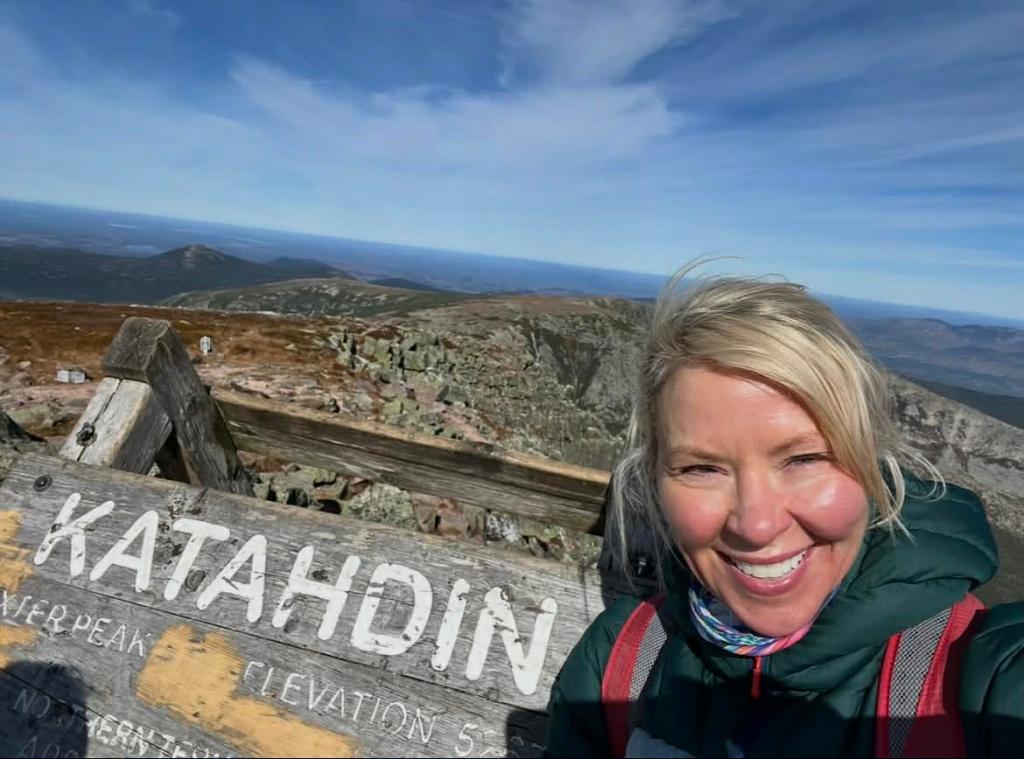
    Sherry’s life story sits unequivocally in the action-adventure category.  She rises at 4 am each day, works out twice a day, running, swimming, and biking 3 times a week, and making time to strength train 4 to 5 times each week. I often see her in Yoga class as well, she calls it her ‘treat’. In her early 50’s, Sherry has a body that most women in their 20’s would covet, and her biological age is, I strongly suspect, at least a decade younger than what her driver’s license indicates. She has run dozens of marathons in her athletic career and began training for Ironman competitions in her 40s, completing four of these grueling tests of strength and endurance to date, notably in Lake Placid and Mount Tremblant. For non-sporty types, these are triathlons starting with a 3.9-kilometer swim, followed by a 180-kilometer bike race, and for the closer, a full marathon, a 42-kilometer run. Mountain climbing was Sherry’s first physical challenge, climbing Mount Katahdin at age 18 and working as a mountaineer for a time in her younger years, spending 3 months in the fiords of Newfoundland. She is proficient at rock and ice climbing, she has jumped out of planes and bungee jumped, and was married in a hot air balloon.

    I asked her where such fire comes from, the genesis of her tremendous discipline and a lifelong devotion to fitness.  She shared with me that losing her father two weeks after her 17th birthday was a traumatic and profoundly impactful experience. “To be honest with you, I think I didn’t want to be on the earth for a while…there was a period in high school where if I knew more about suicide, I might have taken my life.  Once I figured out that wasn’t what I wanted to do, I kind of went in the opposite direction and said ‘Ok, who are the healthiest people in the world…I’m going to mirror what they’re doing’, and I did a 360 turn from there.  That’s why my fitness roots are so strong.  Every triathlon, every Ironman I complete is a little memoriam to my dad…most marathons I don’t even stop for the medal…it’s never been about that.”

    How she maintains such discipline has always been a mystery to me.  I asked her the secret. “I know our minds are very powerful, and sometimes not in our favor,” she tells me, “They’re always trying to keep us from doing anything hard, and I know that about my mind, and so now it’s the behavior that has to override that, so I just put actions first, before the feelings.  I am good at moving.  I get the endorphins, and I’m lucky in that I feel good when I’m moving.  But I also want to make sure that I move in a way that’s good for me, that includes rest and recovery and sometimes trying something new.  I’m not so good at sitting and that’s an area I’d like to explore more now.”

    No interview with a fitness expert would be complete without asking about diet, especially as the new year begins.  With respect to food, Sherry prioritizes longevity and optimizing feeling good above all. “I know instantly when I eat something whether it’s going to support my health or betray me.” Sherry eats a colorful rainbow of food, securing as many phytonutrients as she can get, and maximizing healthy fats and proteins.  Her diet is research-based but also customized to satisfy her palette.  “You have to make it your own, so you don’t feel hungry, or like you’re missing out. The food I eat leaves me feeling my best and if I didn’t feel that way, then I would still have some work to do.  I eat a plant-based diet. I don’t eat meat, or processed foods…no dairy, no wheat, no alcohol…I stay with whole foods. But there is no set formula. I’m not religious about food. I do take supplements and enjoy a pea or hemp protein smoothie daily maybe with chia and collagen and creatinine.  I do believe in fasting as well for my body to detox and clean.  During the day is my grace period. I graze and stay light during peak movement hours.  At the end of the day, I eat an enriched salad with a warm veg as well and I try to include 9 to 12 different colours on my plate.”

    Sherry has volunteered and worked contract and salaried positions at the YMCA in Saint John since she was in high school, initially as a fitness instructor and later as a personal trainer. Today she works full time as the Fitness Supervisor at the Y, where she is a well-loved and tremendously popular icon of fitness, a wellness mentor, and a stellar ambassador, exemplifying the philosophy and principles that the YMCA has long championed, embodying core values like inclusiveness, and kindness. I have on many occasions considered writing to her CEO to let them know what a magnificent asset they have in her and would have done so had we not shared the same last name. She has saved my life more than once.  After suffering great personal loss and working to overcome injury, it was often her voice that kept me moving and held me together on the hard days, and her steps I followed to find my way back to myself.  

    A wellspring of positive energy and a beacon of light, I know she has helped a great many others transition through similar periods of challenge with her characteristic humour, relentless encouragement, and deep hearted kindness. There is a small legion of little old ladies in waiting queuing up at the Y most days for the full Sherry experience, where she is leaving a legacy, fortifying a cohort of bodies, minds, and spirits, ensuring we live full and active lives, one standing abdominal curl and suitcase squat at a time. She makes movement fun, she creates a culture of safety that meets us where we are on our fitness journey, she distracts us from the hard parts, and encourages us to experience and enjoy the challenging work of staying healthy. She asks us to imagine what feels impossible some days and empowers us to find our own stride and strength, leading us in classes that build our muscles, create community, and elevate us all.

    Tell me your life story in seven sentences or less.

    I grew up fast after losing my father at a young age, and it changed the entire direction of my life. Health, movement, and taking care of my body became a priority from the beginning. That path led me to a lifelong career in fitness and wellness, helping others live the life they don’t want to lose. I built a family of my own, two children and a husband who anchor me, inspire me and remind me why every minute matters. I’ve learned to chase joy, strength, and connection with intention. I believe in living fully, honestly, and with purpose.

    What is the best thing about getting older?

    Understanding what truly deserves your energy and letting go of everything that doesn’t.  It’s a gift to grow older, as we know.  My energy and my first priority has always been my family, but especially now, after the kids moved out.  I make a point to keep up with what’s going on in their lives, checking in on a regular basis, and making connections when I can, when they let me, she laughs. I make dates with my mom, celebrating her is a priority to me as well.  But at the start of each day, I prioritize myself.  The stronger I am, the more strength I can lend to everything else.  So, it always starts with me.  I’m up early and in bed early by 8 or 9pm.  It would be a wild night for me if I didn’t get to bed until 10, there would be some mischief happening.

    What is the worst thing about getting older?

    Realizing that time moves faster than you think, and that you can’t get any of it back.  I set intentions every day and at the end of day I usually do a little recap. In my bed I’ll revisit what went well not only with respect to my goals but also regarding my personal values, so if I can be authentic and live up to the values I’ve set for myself, then I count that as a win, to have lived a good day.  I don’t wait for Friday every week to weigh in and see how I’m doing…I think we’re past that.

    What would you title this chapter of your life?

    Living with Intention and Purpose

    What’s the most important lesson you’ve learned so far?

    That living authentically and staying true to my values matters most, especially when life is going well. It’s important not to take anything for granted, to appreciate your life every day.  Every day is a gift.  Choosing to look for the brighter side and trusting that every experience, even the difficult ones, is something I am meant to learn and grow from, here to shape who I am becoming.

    If you could retain or retrieve one quality from your youth, what would it be?

    The ability to bounce back without overthinking. As a child when something happens you tend to get distracted by something else so quickly and it’s easier to just let things go; whereas as an adult, and I’m getting better at this now, but if someone looks at me a certain way or if I potentially hurt someone’s feelings, or someone hurts mine, it stays with you. We have more experiences at play and more meaning behind those experiences because of the life span, and things can become more emotional.

    Do you have a favourite quote?

    What you give out always finds its way back. I do believe in karma. I think angry people hold that inside themselves and I wouldn’t wish that for anyone.  My mom is very religious and brought us up on the ‘Do unto others as you would have them do unto you.’  So even if no one else is around when you do something bad you still internalize it, and it will come back to teach you again.

    Do you have a favourite word?

    Kindness.  It’s my number one strength.  Not only in how I treat others but also in how I treat myself.  I wasn’t kind to myself for a lot of years and it’s a fine balance between giving and not taking too much away from yourself.  I’m just getting it now.  I wasn’t as kind to myself as I was to everybody else for many years.  I practice kindness in a more balanced way now and that feels good.  A coach once told me to imagine someone you love very much and consider how you would treat them or counsel them in similar circumstances. You would want to treat them kindly, and so now hold the mirror up and take that approach with yourself.

    Describe your perfect day.

    A morning workout to set the tone, followed by time with my family, unrushed, present, connected. A long walk in nature and meaningful conversation. I have that perfect day every week with my friends and with my family.  Now whether that’s my husband’s shining moment of the week I don’t know. (Laughing) No… marrying Derek was probably the smartest thing I ever did, and I think there was a higher power that brought my husband to me.  He is pure kindness.  Meaningful conversation for me includes our speaking about our shared memories and the future, dreaming together, and listening to stories from my mother’s childhood as well. I’m at age now where I have the capacity to care and listen better.  I ask more open-ended questions to learn more from the people I care about most.

    If you could have tea with anyone, real or fictional, dead, or alive, who would it be and what would you talk about?

    My father. I’d want to tell him who I became, and introduce him to the family he never met, and I would ask him everything I never got the chance to ask. I’m very proud of the life we’ve built together.  It doesn’t just happen, as you know, it’s a lot of hard work and a lot of sweat, a lot of time and effort and sacrifice, but also lot of joy and a lot of learning.  My husband is a gift, I’d just have to present him. The same with the kids, they are just so unique. I would just send them in.  I never really got a chance to know my dad as an adult, to learn what he liked to do, what some of his favourite things are.  I would like to learn more about him, to really know him.  I was just so angry that he left, it made for some very hard teenage years.  I would love the chance to get to know him, and to like him.

    Tell me three things that bring you joy.

    Movement. Family. Helping someone discover their own strength. In my work at the Y, where I get the most joy is having those conversations with people and them speaking out loud their goals and dreams and the privilege of being that person that can help them get there.  I’ve been given so many tools throughout my education to support people and I feel so fortunate to be that person that can help them unlock their potential or rediscover their passion and joy. Those conversations…they’re a big part of my intention and my purpose, and my joy, catching people when they need a hand up.

    Name a guilty pleasure.

    Reality T.V and Kind bars.

    Do you believe in life after death? What does it look like?

    I believe our spirit continues, maybe as energy, maybe as memory, maybe as a presence that never fully leaves. I like to think that the people we love are nearby in ways we can’t see but sometimes can feel. Years ago, when I was in Newfoundland, I had hypothermia and was evacuated by helicopter to hospital, and I feel like it was my father who saved my life.  I think there was like a tap on my shoulder that kept me from falling asleep and I’ve always attributed it to my dad.  A lot of people wouldn’t have survived, but I did.

    What would you like your eulogy to say?

    She will be remembered for her warm smile, contagious laugh, and unique, spirited personality. She loved her family and friends with her whole heart and always put others first, while learning to be kind to herself as well. She had a gift for seeing the brighter side of life, supporting people when they needed it most, and making those around her feel truly cared for.