Tag: death

  • In Conversation with Dr. Alison Luke

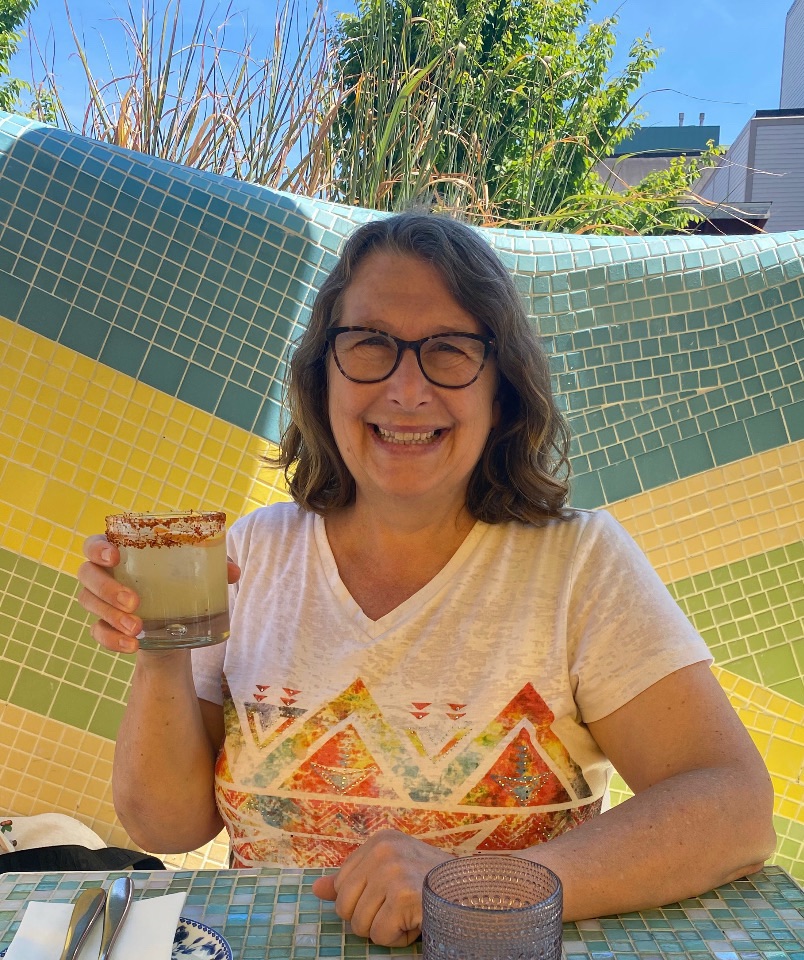
    Alison Luke is a witty, artsy intellectual who I had the great good fortune to meet in the schoolyard when our first-born darlings entered kindergarten together. A founding member of the “Coffee Mommies” collective, the setting for so many rich and sumptuous mornings of coffee and conversation, and the genesis of a great many stimulating and enduring friendships, Alison was always that triple threat friend: maker of tasty baked goods, a scintillating conversationalist and a formidable academic, well versed in a wide spectrum of subjects, always happy to engage on topics ranging from literature and art to philosophy and politics.  Her eyes shine brightest when she gets her teeth into questions of class, culture and power. 

    Perhaps the best way to describe Alison is like a character in a Woody Allen film, one of the better ones, maybe Manhattan Murder Mystery …think urban, cultured, a perfect dinner party guest.  Curious, thoughtful and ethically grounded, Alison is verbally agile, vivacious, and delightfully funny, especially when existentially alarmed.  In short, she is most excellent company and an exceptional friend to call one’s own.

    Born in Belfast, Northern Ireland, Alison’s father, a British South African engineer was in the UK doing graduate work when he met and married a small-town girl from Lincolnshire, England.  A poverty activist and social worker, Alison’s mother was instrumental in establishing the first homeless shelter for men in Fredericton, NB, calling them her ‘angels.’  Growing up in Fredericton where her father taught at the University of New Brunswick, Alison developed an early and lifelong interest in politics, excelling in debate and model parliament.  Today, she is a proud card-carrying member of the NDP, an ideologue, who votes her conscience in a well-established two-party system, and remains deeply left of center on the political spectrum when much of her cohort has crept quietly to the midlands.

    Originally planning on becoming a country doctor, but confounded by the multiple-choice format exams, Alison finished her first degree in English Literature with a drama option in theatre, and completed a PHD in Sociology in 2010, remotely from the Maritimes while raising a family. No small accomplishment. I asked her how she landed on Sociology. “Sociology is the study of society, trying to understand why we do the things we do but rooted in social structures. Marxism, Feminism, Critical Race Theory…all that comes out of Sociology.  My PhD looked at how our attitudes change over time around things like religious identities and sexual/gender identities…not as much of a political bent to it as I might have liked but at the PhD level you learn very quickly that you need to do something you can finish…and that was something I could finish,” she laughs.

    Today Alison works as Associate Research Director at the Center for Research and Integrated Care at UNB, which focuses on models of care designed to improve health care delivery. “We are working on making health care less fragmented and more integrated, so we do assessments and implement pilot projects like patient navigation or case management and then evaluate to see how it’s working. My work is all about health service delivery, and everything we do is patient oriented which means we always have patient partners or care givers or more broadly people with lived experience who sit on our research team and inform everything we do.”

    Timely work indeed.  I asked Alison if she feels her team is making any real progress within the maelstrom of the current health care crisis. “Frankly one thing that drives me nuts, working with the government who use the language of efficiency and cost-cutting, is that they always want more for less. I’m often the person in the meeting…at 58 I don’t care so much about optics now…I speak up and say maybe the answer might actually be that we need to invest more in primary care, because we don’t invest as much in primary care as say the UK.  If you’re worried about the ER overflowing with people and long wait times, and people lying in hospital beds and worried about whether they should be there, then invest more in primary care.”

    In the last few years, Alison recently took up the tuba and the euphonium or ‘little tuba’, lovingly described as “the cello of the concert band” and plays in Saint Mary’s Band as well as a lovely local ensemble called The Second Chance Band, an orchestra of enthusiastic, eclectic and quirky amateur musicians whom she affectionately likens to the “land of misfit toys.” “I have band practice three nights a week and have reclaimed a lot of joy in having music in my life again. A band is a beautiful thing.”

    Tell me your life story in seven sentences or less? 

    I grew up with a strong sense of community and a love for helping others and a strong belief that everyone should be treated with dignity and respect.  My mother was an extremely strong influence…maybe not the most nurturing person in the world, but she showed me how to be strong and passionate and to care about the world around me. My dad taught me a love of learning, to be interested and curious about the world…wanting to know about everything and I like to think I embody those qualities.  I have always been interested in debate and public speaking and politics and even theatre which I think is a way of showcasing passion. I love the whole performance aspect. I was always involved in music and theatre; it was a big part of my formative years. Later I got to travel a bit around Canada.  I think I got a pretty good education, I had two amazing children, and eventually settled in Saint John…and the rest as they say is history.

    What is the best thing about getting older?

    I think it’s not giving a fuck. I’ve heard that before, I’ve read it, but it really resonates with me. I do think there is some freedom in getting older and I don’t care so much about most things these days.  Now with that, there is the whole other thing about being a woman getting older. Invisibility, which can be freeing, is also wrapped up in all this ageism stuff. We become little old ladies and people maybe start to treat you a little differently, and that can be a bit demeaning. But overall, the freedom I think on the whole is good.

    What is the worst thing about getting older?

    It’s kind of two sides of the same coin.  I work with a lot of people who are under 40, so a lot of young people, and you do hear a lot of little jokes about the fact that maybe Alison can’t hear very well, which I can laugh about, but it is interesting to me.  Somebody at work once referred to a pair of shoes suggesting they must belong to Alison because they look like old lady shoes, so I promptly called him out.   I do find ageism very interesting.  I saw it with my mother when she became sick, people talking over her or making an assumption that she couldn’t answer for herself. And so even though I’m not yet 60, you start to see this creep in of ageism and it kind of pisses me off.  The worse part of it is imagining someday being seen as having no value at all.

    What would you title this chapter of your life?

    Autumn. The Fall is my favourite season. There is a sense of comfort and plenty in the Fall season. You’re not trying to fit into bikinis, it’s the season of comfy sweaters and layering. Back to school is my favourite time of year and it reminds me of this season of my life.

     If you could retain or retrieve one quality from your youth, what would it be?

    Sometimes I wish I was more easy-going. As we age, we maybe worry a bit more about certain things.  I wish I could just have people over and not worry so much about what my house looks like, I don’t know when that happened.  I never used to care quite so much about those things.  Maybe we become our parents a bit more as we age.  I think of us now as the accumulation of all the things we were when we were young and I don’t think those things are gone.  But as we mature, maybe we soften, and maybe some of our younger insecurities are gone now, but new worries take hold, like worrying about not being around for your kids someday.

    What’s the most important lesson you’ve learned so far?

    To focus on what’s in front of you and to live your life in the moment.  I think we spend so much time thinking about regrets or worrying about something that hasn’t happened yet, and I think it’s enough to just focus on what’s in front of you today.  And that may be a problem to solve or maybe something really awful that’s happening in the moment.  I’m not some Pollyanna saying “Don’t worry, be happy in the moment” but I’ve learned to focus on what’s right in front of me and let that be enough for now.

    Do you have a favourite quote?

    Yes, it’s a quote by Anton Chekhov.  It’s a line in the Cherry Orchard about a character being teased for being a perpetual student. It’s not a fancy quote, it’s more the idea.  “He moved through the world as a perpetual student, more interested in understanding life, than in ever mastering it.” For me it’s about having a lifelong interest in learning and staying curious.

    Do you have a favourite word?

    Melancholy. I love the word melancholy.  It’s a great sounding word.  I love it because it’s kind of that interesting place where you’re not euphoric but you’re not sad … but you’re not quite content either.  It’s this sweet place, like a Fall day, it feels kind of cloudy, or windy, maybe late in Fall, and you’re bundling up to go outside, or settling down to a good book.  I think we reflect when we’re melancholy. I think of the Romantic poets, and this idea of being in the depths of despair, like Anne Shirley in Anne of Green Gables…I guess I like getting caught up in the idea of being tragically cast sometimes.

    Describe your perfect day.

    My perfect day would be sleeping in a little bit for a start.  I don’t like to get up really early.  Working full time, I long for days when I can work from home and push the snooze till about 8 am.  After that, I would love to have a really good cup of coffee, probably two.  Then I’d like to do my New York Times puzzles. And on a perfect day with no housework or anything like that, I would want to go for a really great hike in the Fundy area with ocean views. After that, I would like to go to a pub for a nice craft beer and come home for a good dinner, listen to some music, talk politics, put the news on, maybe watch a show and I would be sure to carve out a good hour or so to read in bed, a favourite pastime.

    If you could have tea with anyone, real or fictional, dead, or alive, who would it be and what would you talk about?

    Well, if I really think about someone I’ve always wanted to sit down to tea with, it would be Karl Marx.   He believed that if people can suddenly wake up from their sleep, we can realize that our numbers mean we can change the world. Our numbers are our power and there is hope in that.  I see Marx as very hopeful, and I would just love to pick his brain. I’d love to hear his take on what’s going on now around the world. We would talk about politics, of course. I want to sit with him in some smoky old pub, drink a beer and smoke a cigarette and talk to Karl Marx about the state of the world.

    Tell me three things that bring you joy.

    Hard to narrow it down to three.  I mean there is the obvious, my children, and my children do bring me huge joy but if I was to think of just me, it would be reading.  Reading brings me great joy. Also camping in my little camper.  It was a pandemic purchase that has brought so much joy.  Our favourite place to camp and hike is Fundy National Park. We have a little heater and a functional bathroom…I love it so much, I love the Maritimes; I love everything about where we live and with the camper, we can explore it all. A third joy would be spending time with family.  My dad visits every weekend and time with family and friends means everything to me.

    Name a guilty pleasure.

    I don’t feel guilty about any pleasure.  I love wine and I love chocolate. I love to eat…I love good food… I love butter. But I try very hard to not to think of them as guilty pleasures, they’re just pleasures, they’re my pleasures. One of my favourite ways to spend an evening is to go out for a good meal or make a nice meal at home…some nibblies and wine and maybe trying a new recipe.

    Do you believe in life after death? What does it look like?

    Well, I’ve thought a lot about this one, and though I was raised going to church, I’ve never believed in the whole idea of this place called Heaven. In all of my various sociology of religion courses, I was always a big fan of the eastern traditions, like Buddhism and even Hinduism, and I’m very drawn to the idea that energy is neither created or destroyed. But also, there is a side of me as well, the existentialist, who hates the idea of living for something better after death. That sort of thinking can work to oppress people and keep people poor, ‘Oh don’t worry, at least you’ll go to heaven.’   I think people need to make the best of the life they have right now…act now, and make this life a good one.  But at the same time, I pair that with an idea that once we go, I think we’re in the trees and the birds and we may even be reincarnated.   That would be more where my thoughts might go to as a belief system, if there is anything.  My practical brain says I become good compost, and that’s also great.   I’d be eaten by worms or be food for a tree, and then become the tree or the birds. Bury me in the ground, I want a compost burial.  I hope that kind of thing is available as an option around here.

    What would you like your eulogy to say?

    I’ve thought a lot about this one as well. There is what you think you’d like people to say, what people will say, and then you’ve got the self-deprecating person who might wonder if anyone will say anything nice at all.  ‘Maybe nobody will come to my party,’ Alison laughs.  But what I’d like my eulogy to say is that I was passionate, that I cared about people, that I had a love for life and that I was compassionate.


  • Notes on an Afterlife

    KBJJ at Bayshore

    “I believe that when death closes our eyes we shall awaken to a light, of which our sunlight is but the shadow.”

    Albert Schopenhauer

    “Life and death are one thread, the same line viewed from different sides.”

    Lao Tzu

    I shall not commit the fashionable stupidity of viewing everything I can not explain as a fraud.”

    Carl Jung

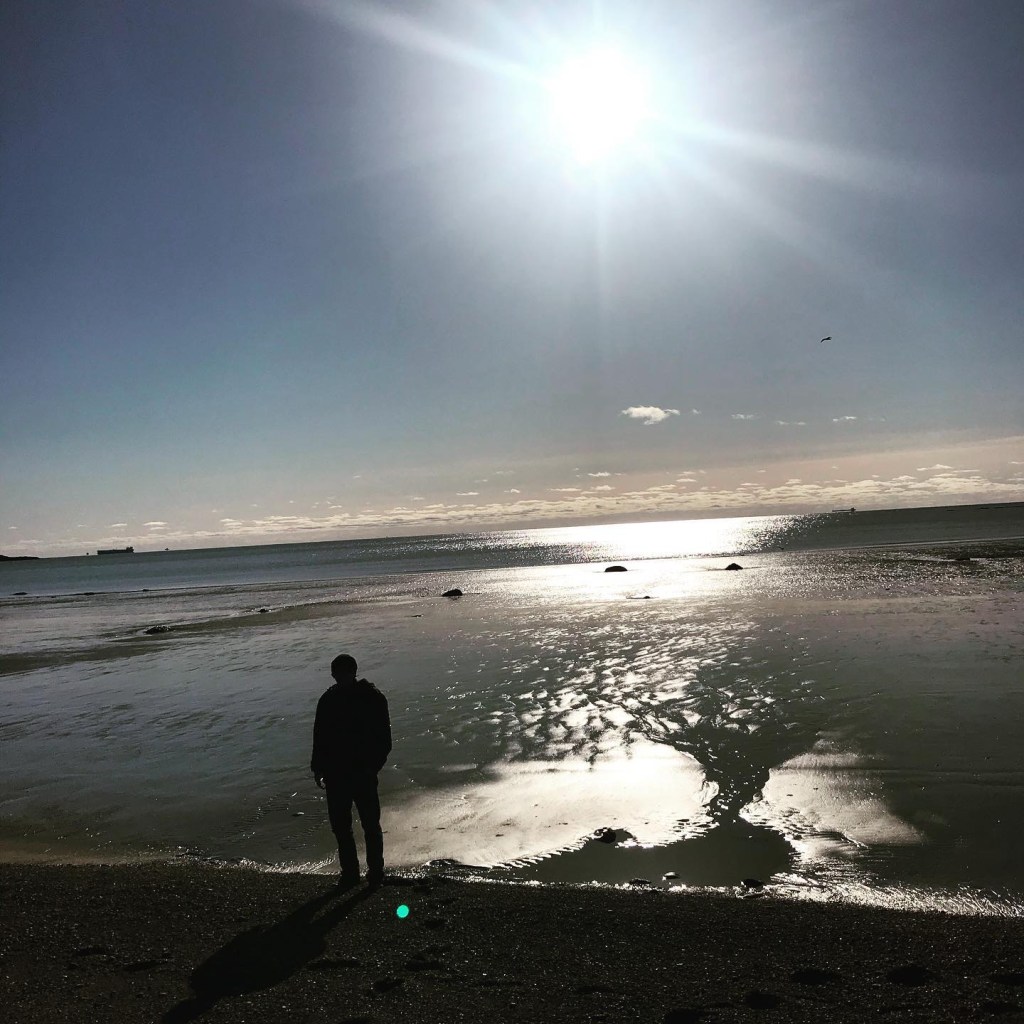
    The Old Irish say that the sea is a ‘thin space’, a place where the curtain drawn between this world and the next is porous with peepholes, where we might speak again with our dead. I walk the seacoast often with my dog and listen intently for the hushed voices of lost loved ones in the sea wet wind and crashing waves, but none have returned or spoken plainly to me, once removed from this world, having “shuffled off this mortal coil”. Where we travel to after death, if indeed we go anywhere, remains life’s penultimate mystery, the “last unprinted snow.” It’s easy enough to discount the ancient stories in an age of science that demands, peer-reviewed empirical evidence, but such an approach seems a bit rigid with so little real data available to analyze. For this LOLIW all afterlife narratives are on the examination table, until we ourselves open Schrodinger’s cat box, or coffin as it were, and discover what lies within…an endless abyss, death’s dark sea, oblivion, or a portal to an uncharted realm…perhaps a paradise.

    Whether you’re a materialist who believes consciousness dies when the brain dies, or a Dualist who understands consciousness as more than mere matter, leaving room for some notion of life after death, the unfortunate truth is that there is no real verifiable proof of either claim. While dualists might cite recurring patterns in cross-cultural qualitative studies of near death experiences, with its compelling veridical perception (reported accurate perception of events after clinical death), neuroscientists argue that oxygen deprivation and neurochemical surges are responsible for any consistency in the near-death literature. Similarly, in the case of children who report memories of previous lives, qualitative studies reveal detailed, verifiable memories, names, places and life events matching individuals unknown to these children or their families. Skeptics cite memory contamination, and investigative confirmation bias as possible explanations, but of all the stories I have read that speak to the possibility of an afterlife, I find these interviews (thousands of cases documented over decades) exceedingly interesting reading.

    Where do we go for answers to questions that science cannot resolve? To story, and philosophy of course. The Ancient Greeks believed that after death we journey to an underworld called Hades.  They placed coins in the mouths of their dead so they could pay passage to the Ferryman, a character called Charon, who sailed their souls across the River Styx. There, they were met by a three headed hell-hound named Cerberus…a gracious host to the newly arrived dead, but a savage assassin to any insipid soul who tried to return home to the land of the living. Maybe that’s why we never hear from anyone again then, after they pass over.

    Of course, the newly bereaved with their senses keened with grief will sometimes experience the odd electrical anomaly, or maybe they come upon an errant yellow balloon in the deepest wood, or some other place it has no earthly right to be…or perhaps a new birdsong on a path they’ve walked a thousand times before.  Would you believe me if I told you that when editing this essay, I closed my document to find, underneath, a dictionary look-up for the word “brother“… a word I know well…a word I have never had occasion to look up? Maybe the dead do speak to us, after a fashion, and we pass on by, unhearing. 

    The Greeks also tell of a place called Asphodel Fields, where the dead are relieved of all their living memories. I hate that part of the story, the idea of forgetting everyone I love. The final destination for the Greeks is a sort of five-star resort called Elysium or, behind door number 2, for the less than virtuous, a stint in a place called Tartarus, which I cannot recommend.  Hard labour on tap breakfast, lunch, and dinner…Myth of Sisyphus stuff.  Not wholly bad I guess…just a quick jaunt up and down Everest say, with a giant boulder strapped to you back…day in and day out ad infinitum.  You’re going to be well fit after a few decades on that plan. 

    Jumping ahead a few millennium, honourable mention must go to Nietzsche’s Theory of Eternal Recurrence. Think Groundhog Day (Bill Murray film) where you’re destined to repeat every scene of your life in the exact same sequence over and over again in a perpetual loop.  Hell of an incentive to make good life choices, isn’t it? Oatmeal or waffles… Italy or the investment portfolio…a brave life filled with great joy and heartbreak or a forever of just…alright?

    I am drawn to the notion of reincarnation.  Endless chances to get it right.  I wonder how many lives it will take me? I’m guessing a thousand or two at least. All the Eastern religions have it that we’re born back into this world to begin again the work of climbing a sort of spiritual ladder.  Eventually we reach a certain celestial plateau called “Nirvana.”  For Christians, imagine St. Peter finally opens the Pearly Gates and says, “Welcome home old bean…took you long enough!

    If Heaven is invite-only, then I imagine Purgatory ( a Catholic intermediary world ) must be a pretty packed pre-party… standing room only…non-redeemable sinners not welcome.  I envision impromptu break out self-help rooms…’Gossipers are us’, or all those with Fear and Self-Loathing please line up here.  But I guess that only tracks if you buy into a heaven and hell dialectic…right? For my part, I believe we make our own heaven and hell right here on Earth. A state of mind really, isn’t it, with your own conscience acting as judge and jury.

    I mean ‘with our thoughts we make the world’.  That’s what Buddha says anyway. And if I have to jump on anyone’s spiritual soapbox, it’s always going to be the Buddhist’s …they had me at karma…all that radical acceptance of what is, mastery of the self, end of suffering stuff. Of course there is no real escape from suffering.  Buddhism just helps you accept it as an indispensable part of the life package.  And maybe, if we endure our slice of suffering with a bit of grace, we get to skip a few grades in the school for misfit souls… who knows?

    But for my money, the best book on death and the afterlife is The Upanishads, a collection of ancient wisdom teachings dating back to the 2th century BC.   The title is Sanskrit for, “sit down closely.”  It’s basically a user’s manual on how to get to the next level of the spiritual plain.  Coles notes, it says we each arrive with a little spark of the divine inside us and our job while we’re here is to figure out our duty or dharma and to perform it with good intention.  Dickens said it best, ‘mankind was my business’.  Anyway, if we get it right, it’s rumoured we can liberate ourselves from the endless cycle of death and rebirth.

    Sounds simple enough…right? The key to it all is embedded in an ancient Sanskrit mantra, ‘Tat tram asi’.  It means ‘Thou art that.’ It’s a call to remember who we truly are…ancient, sacred, luminous beings, connected to the divine and to each other, like a string of lights on a Christmas tree.  Collectively capable of conjuring a breathtaking light…unspeakable beauty.

    Essentially the life we think we’re living is really just a dream…underneath we’re all actually these sacred spiritual luminous beings…indescribably beautiful, and unbreakably bound, never alone, each of us an essential piece of an endless intricate, forgotten web far grander than ourselves alone. I mean, how do you forget a thing like that?  Are we all just sleepwalking through our lives …plugged in to the Matrix?

    But don’t worry, legend has it that you can wake up from the dream any time you wish to Sleeping Beauty.  Meditation is the best wake-up pill I’ve found so far. I mean trauma and personal tragedy work too, but I can’t recommend them.  Memory can only be rekindled from within, and only when you’re ready but ideally it comes in time for you to summit the proverbial seven story mountain… to ascend the spritual spiral staircase.

    I know what you’re thinking…what I’d really like, if I’m honest… is just a teeny, tiny, little smidgen of irrefutable proof…before I start the chanting, or maybe just a bit more detail on what actually happens to us after we breathe our last breath. You want the science. I get it. I’m convinced science will get there in the end…of that I have great faith.  I mean we already have proof that we come from the stars, and that every single atom we interact with, including each other was forged in the stars.  We’re stardust you and I.

    Who knows…maybe we don’t actually go anywhere, when the lights go out… maybe we stay right here. Einstein said E=mc2…matter becomes energy and vice-versa and when you add up all the energy available at any given second, the sum of that energy remains constant.  Nothing is ever really created or destroyed, only transformed.

    Or consider String Theory. Essentially it proposes that the basic particles that make up our universe are little loops of vibrating strings.  When scientists look at these loops at the subatomic level, it seems the number of directions to travel in may be well beyond the 3D movie we’ve been watching all our lives.  What if in the unseen world of quantum mechanics there are multiple dimensions operating all at once… multiverses? Maybe when we die the end of the tunnel isn’t heaven or hell, but an alternate universe remarkably similar to the one we just left. I mean, that would go a long way to explaining the sensation of déjà vu, and precognition…that feeling when you meet someone for the first time, or enter a room you’ve never visited, coupled with a strong sense of having met or been in that place before.

    To say nothing of quantum entanglement. The fascinating phenomenon where scientists can show that two subatomic particles, us, in our smallest selves, are linked somehow, even if separated by billions of light years of space.  That means a mere flutter of your eyelashes can make a molecule inside a star at the edge of the universe quiver in response. What does it prove? It means we have reach…it means we can talk to the stars across the universe…it means “there are more things in Heaven and Earth Horatio, than are dreamt of in your philosophy.

    What do I choose to believe? Where do we go when we die? I’m not convinced we die at all, only our bodies, our temporary meat suits, not our real selves, the part of us that has no name. Perhaps our dead are here with us still…it’s only that they ‘walk invisible’ for a time. Thich Nhat Hahn calls it Inter-being, the idea that everything is connected, dependent and interwoven. Rather than imagining the afterlife as a location, Hahn suggests your life is like a ripple in a pond, even after the individual drop disappears beneath the surface, the ripples continue to spread. “Death is a transformation, not annihilation.”

    It comforts me to think of my loved ones as only waiting for me somewhere…just a string’s length away, but the fact that I’m comforted by such a story, does not necessarily disqualify it. I cannot tell you how the light comes for us, only that I believe that it does…that it will. If we were forged in the same star, you and me, my dear family and friends, then I believe we are entangled for all time. When I leave this place, I hope to become part of the light that arrives at some appointed time for you when you awake from your dream, and until that day, I’ll be waiting patiently somewhere not too far way, to welcome you home.

  • On Grief and Loss and other Incurable Conditions of the Heart

    “Why is it that words like these seem to me so dull and cold? Is it because there is no word tender enough to be your name?” 
    ― James Joyce, (The Dead)

    “Before you know kindness as the deepest thing inside, You must know sorrow as the other deepest thing. You must wake up with sorrow. You must speak to it till your voice catches the thread of all sorrows and you see the size of the cloth. Then it is only kindness that makes sense anymore, only kindness that ties your shoes and sends you out into the day to gaze at bread, only kindness that raises it’s head from the crowd of the world to say ‘It is I you have been looking for,’ and then goes with you everywhere like a shadow or a friend.

    -Naomi Shihab Nye (Kindness)

    My brother, Kelly Blaine Joseph Jude Lewis or KBJJ, as he signed all our written correspondence, was 90 percent angel and only 10 percent human…always…not just in death like some knighted memory where all our flaws are conveniently forgotten. Even as a child, the middle child to be exact, he was everyone’s favourite, a good son, a sweet man, a comic, a sage, a poet, a most excellent companion, a loyal and honest friend, and a beloved brother. He was a quiet, thinking man…he noticed the little things…he was careful with other people’s hearts.

    A fit, 58 year old vegan, my brother died of a massive hemorrhagic stroke on a beautiful summer day, three and half years ago now, and the sense of loss and grief I have held every day since his parting is still so close I can barely breathe when I remember him. My days are laced with little daggers that keep him alive and I am grateful for every one…the rough cut decal fore-edge of a new book, cinnamon raison toast and earl grey tea, bookstores, and coffee shops, an Irish lilt or a Scottish burr, nature walks, and the sea…always the sea, or the tang of the sea scented streets of this dirty old town he so loved, never more so than on a crisp autumn afternoon. He was all of my favourite things … “my talk, my song,” and “everywhere he walked was holy ground” to me.

    My brother lived alone, a singleton, and it was only the kindness of a concerned co-worker that alerted us to what was to be the last day of his life. He was rushed by ambulance to hospital where neuro-surgeons explained that there was nothing to be done. So, we sat in shocky silence by his deathbed and held his still warm hands. When death came close, I lay my head on his chest and listened while his heart stopped beating and his lungs swelled with his last breath. To the woman who gave our family those last few hours with my brother, to sit with him as he left this world, to say our last goodbyes, I will forever, be in your debt.

    The physical sensation of such a loss is acutely painful … a panicky breathlessness takes hold of you, the ground is swept away, and the sky goes out. There is no place to run away to, no safe space, no comfort, no medicine to alleviate the crushing weight that comes to rest squarely on the center of your chest and refuses to shift. It makes a home inside you, and though you pray for the blanket of unconsciousness, the horror and ache is still there when you wake. You wonder how your own heart can hold out… it remains a mystery to me.

    As a nurse you can imagine the cornucopia of magic beans and pharmacotherapy that arrived at my door in the days directly following my brother’s death. Although I was desperate to forget for a few hours that he was was gone, I was afraid to venture into uncharted terrain… “what dreams may come.” I settled on a steady diet of day drinking which made it possible for me to breathe in the first few months after he left us. “Grief felt four dimensional”, weighted, surreal, and still faintly familiar… I was always cold. People bring things. I remember food arriving, food I could not eat …and friends and family saying things I could not really fathom. I nodded, I let people hold me, but I couldn’t feel their warmth. I absented myself, I learned to cry quietly. I was adrift in the dark, night swimming far from shore, unreachable, inviolate… unspeakably sad. Still, I was grateful on some unconscious level…for the people…and their words…and their offerings …distant reminders that I was still here, that my own heart still beat it’s unwanted song. I let the mourners come, and my brother’s friends, such beauties, brought some solace with their stories.

    There is no medicine that I know of, no antidote, no cure for grief. No sutures to close the gaping hole in your chest. It does not heal …you bleed out slowly …you die a death as well. Our dead take a bloody big chunk of us with them, the part that only they could see, the part that they loved best, and you don’t get that part back. You learn to carry the cavity inside you, and after a time if you are very brave, you can repurpose the space as a kind of light catcher.

    Of course, the immediate shock of such a loss is nothing to what follows … the deep hollowing out, the exquisite loneliness, a yearning for everything you saw reflected in their eyes, and all you held dear in them, the staggering loss of what you thought you could keep forever. C.S Lewis in his book, A Grief Observed, originally published under the penname Dimidus (Latin meaning cut in half), writes in his opening line, “No one ever told me that grief felt so like fear.”

    After 6 weeks of staying as numb as I could manage on cheap pinot grigio, it stopped working altogether. Deep into my cups I was still stony cold, and I was terrified. I felt abandoned, alone, and inconsolable. Eventually I was desperate enough to attempt the unthinkable. I put down the bottle opener and stopped trying to hide from the full flare of the pain…I leaned into it, I stared at it’s sun. I stopped trying to outrun it, I stood my ground, and braced as the pain unfurled inside me, it intensified and it was eviscerating. Could I stand it…would it kill me, could I actually give it it’s head and let it run free inside me… was I strong enough? I’m still not sure.

    Today when it comes for me, the sadness, the memories, his voice, his heart, his poetry, his beautiful mind, I stay with him for as long as I can, I nod to the pain, like some old friend that crosses my path. I soften, I approach slowly…carefully now… I ask myself in a gentle voice, a voice I might use if speaking to a 4-year-old child…I ask where it hurts, what I’m most afraid of… and then I ask what might help a little, and the answer is always kindness.

    What is unbearable becomes bearable in time. Not because the grief goes away or gets smaller, but because we grow stronger around it, by holding space for a loved one who lives within us still. The transition is deeply unpleasant, like walking a “razor’s edge”, but befriending the pain and discovering the gift inside the grief, the gift of empathy and kindness, invokes an evolution of the spirit, a parting gift from the ghost of your lost loved one.

    Grief and all its jagged little teeth is the price for the privilege of being loved and having loved.  I know too that the size and shape and depth of grief is in direct proportion to the quality and breadth of that love. People ask if I’m better now. I always say ‘yes’ because it’s easier than explaining that the ache never leaves you…it’s only that I made friends with it.

    How do I keep him with me… the man called Parker Stephenson in my phone contacts, named after a tv sleuth of our youth, because he looked at life like a great mystery and always smiled like a boy pretending to be a detective, in the moment before he solves the case. I sit by the sea, I haunt the poetry section, I practice silence until I get a sense of his nearness and hear his voice, my own personal guardian angel. I look for every opportunity to practice kindness towards myself and all those I meet. Kindness ideally unobserved and undisclosed. I acknowledge daily what a grand thing it is to live a life and to know such love.

    If I could tell him one last secret, boil the kettle for tea just once more, or read a single line of poetry to him, I’d whisper

    ” …here is the deepest secret nobody knows

    (here is the root of the root and the bud of the bud

    and the sky of the sky of a tree called life;

    which grows higher than soul can hope or mind can hide)

    and this is the wonder that keeps the stars apart

    i carry your heart (i carry it in my heart)” (Cummings)

  • In Conversation with Shova Rani Dhar

    Shova Dhar is my oldest friend. We met in third grade.  She was the smartest kid in my class, and in most rooms she enters I suspect.  Becoming her friend changed the trajectory of my life, motivating me to push myself academically in a way I might never have done had we never met.  I can still remember our Grade 3 Health project, a beautifully drawn portrait of a boy skeleton, with breakout close-up drawings for the more intricate bones.   Shova was the artist, I, the lucky bone labeller. We wrote a play together some years later, titled, ‘How do you like your murder, steamed or boiled?’ earning a solid A for our efforts in advanced English.

    Shova describes herself as a ‘gregarious introvert.’ She is, in fact, a peerless, exceptionally gifted human, a scientist and a seer, an artist and a stargazer…there is no one else in all the world like her.  She is an ageless, exotic beauty, and ‘my brilliant friend.’  A biologist by trade, an accomplished artist by nature, and an animal lover (all species), Shova exhibits the kind of charisma that only storybook heroines possess.  Fiercely loyal, generous in spirit, she is a boundless treasure to anyone lucky enough to call her friend.

    Shova earned a BSc in Biology and a Bachelor of Education from UNB. She has published research in marine biology, worked as a lab instructor at UNB, and as a Laboratory manager at the NB Department of Fisheries and Aquaculture. She has studied salmon anemia, virus tested potatoes, and worked in animal health and rabies.  She has been responsible for fish, meat and dairy inspection, food recalls and risk assessment.  For the last twenty-five years she has worked for the Canadian Food Inspection Agency, and for the last 17 years as a food safety specialist, currently residing in Halifax, N.S.  

    Of course, I asked her what she eats, and while she wasn’t comfortable discussing her food choices on the record, she did share that listeria is real, and that as we get older, we can’t fight it off as well, or if we’re too young, or don’t have enough stomach acid, or are pregnant. ‘I’ll be eating a lot of mush that’s hot or frozen as I get older,’ she laughs, ‘and I don’t eat out much as I am too leery of food handling practices that I can’t control.’

    Tell me your life story in seven sentences or less? 

    I was born with mixed heritage in the heat of the summer, the younger sister to one older brother but grew up with my Canadian extended family on my maternal side, as my father was killed in a car accident when I was only 8 months old. I grew up outside of Saint John and was formally educated at the University of New Brunswick.  I am a biologist, an educator, a Food Safety Specialist, a Reiki Master, and a Theta Healer™, with a love of artistic expression, especially the performing arts. As a strong unionist, I have always focused on championing the rights of others who cannot fight for themselves. I have married my best friend, travelled to many countries, enjoyed the company of many beings (human and other species), and have learned to work in light and energy. That’s my other side…the ‘woo-woo side’ as people would say.

    What is the best thing about getting older?

    Ahh…perspective. You can see the bigger picture and therefore there’s less drama about every little hiccup that happens.  Even though there are times I don’t do that, as we age our edges get rounded off a little and you have a better perspective of what life is … you see the span of your own life, and things you used to think were the end of the world are no longer the end of the world for you.  That’s the best thing.

    What is the worst thing about getting older?

    Coping with loss. That’s the thing that gives me anxiety.  Can I do it?  Losing the ones you love, the pets you love, your cohorts, your generation.  The feeling of gradual obsolescence.

    If you could retain or retrieve one quality from your youth, what would it be?

    I found this a very difficult question because there are so many things I would want to retrieve and some I wouldn’t want to, however, the sense of endless possibility, and the feeling of immortality, or ignorance of the finality of this temporary corporeal existence that we’re in right now, is something I would love to experience again.  As younger women we were more present in our lives, we lived more in the moment, we weren’t worried so much about what’s gonna happen when our time was limitless, we weren’t concerned if we could squeeze it all in… we never even thought about all that, we were just living, and I miss that, that spontaneity, being in the moment, a time when we were less reflective and less conscious.

    Now with perspective we’re always weighing one thing against another, whereas younger people are more present in their lives…even if you were full of angst as a young person, you were still anchored in the moment…not worrying about the quality of the experience.  People say youth is wasted on the young.  It’s not. They’re not wasting it…they’re really in it. They don’t even realize how precious it is.  That is the sad part. They don’t yet own their magic…they’re magical but they don’t know it yet.  The magic of being fully immersed in living.  If we were able to go back in time, we would be super powerful, and we could use that power for good or ill.  I would hope we would use all that energy and power of youth for good, but it depends on the trappings of the soul.  People are still flawed even armed with perspective.  Maybe that’s why we can’t go back.  God is pretty smart.

    What’s the most important lesson you’ve learned so far?

    I don’t know, I haven’t learned too many easy ones.  I have so many lessons to learn.  For me, so far, forgiveness is the big one …forgiveness and gratitude. Forgiveness of yourself and others.  It’s hard to do that. But gratitude is huge as well…to learn how to maintain gratitude…because you cannot be unhappy and feel gratitude at the same time. Those two emotions cannot exist at the same time.  That has changed my life knowing that.  So, whenever I’m terribly unhappy, I imagine a scenario, even if I have to invent one, a scenario where I feel grateful.  I’ll share my go to scenario with you.  I imagine I’m carrying a big armful of priceless china in boxes, not very well packaged, and I have to get through a door, and I can’t manage it without maybe dropping a parcel.  There is a guy on the other side of a busy street, he sees me struggling…he crosses the busy street, arrives at my side, and opens the door for me and I can enter in and I think ‘Thank you,’ and I feel gratitude washing over me…gratitude for him being so kind, and then I go through the door.  And at that moment if I’m unhappy I allow the gratitude from the scenario to wash over me and it helps…small acts of kindness, real or imagined, help a lot.  I use it all the time. The shift is immediate when you feel that gratitude wash over you and the sadness may come back but its less when you can feel gratitude.   It brings instant perspective.

    Other lessons I’m still trying to learn are trust, to trust in God, and to accept the things that I cannot change.  Those are hard lessons that I’m still trying to learn.  Forgiveness…I’ve worked hard on forgiveness… and I’m getting better at it.  I used to be full of resentful thoughts. I’m a very protective person of the people I love. I’m a grudge holder from way back.

    Do you have a favourite quote?

    I have four quotes on two themes.  I couldn’t pick.  First, ‘Whatever you can do, or dream you can, begin it; boldness has genius, power and magic in it.’ And I put in brackets…this is not part of the quote, Begin it now,’ because I’m a procrastinator.  I had it in my university dorm room, its Goethe, and it has served me for many, many years.  A second quote on the same theme is from the Ghost of Christmas Present (Dickens), ‘There is never enough time to do or say all the things that we would wish.  The thing is to try to do as much as you can in the time that you have. Remember Scrooge, time is short and suddenly, you’re not here anymore.’  I always think, let’s not procrastinate with the important things.

    The second theme is again from Scrooge, the 1970’s soundtrack from Leslie Bricusse on happiness.  ‘Happiness is whatever you want it to be.’  I had that at my wedding as one of my songs. And finally, a quote by Kurt Vonnegut, ‘If this isn’t nice, then I don’t know what is.” It’s a quote I learned from my husband, and when I hear his voice in my mind saying it, it calms me down and gives me perspective and makes me feel gratitude.

    Do you have a favourite word?

    ‘Justice’ and ‘perseverance’. I have two, but I love justice, just the sound of it, it’s a sweet sound to my ear.  It’s a real part of who I am, and it always has been.  I’ve always been a bully fighter in school, a fierce advocate for others…and courage is there because of it.  It takes courage to fight for justice.  In tarot, the symbol for strength is a lion and, being a Leo, I’ve always felt it was just part of who I am. It takes strength to fight for justice.  And ‘perseverance’, it’s a very important word for me as well.  You have to persevere…things aren’t instant, and you have to keep fighting for the things that really count.  You have to persevere against your own weakest nature. If you want to obtain things you have to work hard and again that comes back to my quote, ‘begin it now.’ When things aren’t easy you have to persevere and if you don’t, you’re giving up on yourself.

    Describe your perfect day.

    This was harder than I thought it would be, but I experienced the perfect day not that long ago with my family…this summer actually, and I reflected on that day when I formulated my answer.  The day starts with me waking up from a restful sleep and with good energy.  There are some planned activities but nothing stressful.  A nice morning stretch…I move my joints…I have a good breakfast.  I spend time with the ones I love, and unexpected events lead to unanticipated fun.  There is the sense of surprise, camaraderie and sharing laughter.  The unexpected events put you in the present.  I don’t always want to be planning and then judging whether or not things went well…it harkens back to the youthful joy of just being alive.  And after camaraderie and laughter, then you come back to your place of peace and revisit the day’s events together with your family.  You retell the story of the day, sharing your impressions, enjoying it all a second time in the telling…and then you go to bed feeling grateful knowing you’re loved and that you’ve loved others.  That’s a perfect day. 

    If you could have tea with anyone, real or fictional, dead, or alive, who would it be and what would you talk about?

    I would want to see my father.  I would want to talk to him about his decision to agree to leave this life when he was only 38. He died in a car accident. But I believe that people talk to their creator before beginning a new life, we choose our soul family and choose the lessons that we want to learn.  Maybe my lesson this time around was learning to be a woman who grows up without a father. His absence in my life has been so huge and yet I never really got to know him. At some point he decided he would come here and be my father and leave, allowing me the space to learn the lesson I had chosen. I’d like to speak with him about his decision and ask why he left me…because I know he loved me.

    Just recently I looked at my father’s passport picture and I feel like I saw him for the first time, and I’ve looked at that picture a thousand times, and I realized that he is in many ways still here with me.

    The other person I’d like to have tea with would be Carl Sagan.  I’d like to talk to him about intelligent design.  I’d like to explore his thoughts on that.  I had the hugest crush on him, I was in love with him for so long.

    Tell me three things that bring you joy.

    Creating things… creating things for others to enjoy, and myself.  Anything from food, a good meal, making baklava, or creating a more fair, stable, and safe workplace. I do a lot of   Occupational Health and Safety (OSH)…that’s near and dear to me.  I also like making music…learning a new piano piece or improving my vocal range while I’m singing in the car.  Nobody needs to hear it, but I get great joy when I manage to expand my range and enjoy little successes.  Artwork of course, I like creating art, that gives me a lot of joy.  I don’t do it a lot anymore, but I will again… soon.  I’ve been doing some needle felting and making some 3d figures and those are fun little projects and after making art I always think that was so much fun, why don’t I do this more often.  And maybe writing too because this project and thinking about my mother’s story…I think I’d like to delve a little deeper into that.  I’d like to work more in watercolour, I have to persevere there, watercolour is unpredictable, and trust is not there, so learning to trust the process and persevering… and then revel in the outcome, whether it’s what you planned or not.

    A second source of joy for me is being the presence of or caring for animals, especially baby critters of any sort.  To have a kitten in your hand, and care for it is the most joyful thing. Looking after the young of any species I find very joyful.   We have an unofficial office cat named Spooky and I enjoy looking after her right now.  She is my therapy cat.  We do a daily session before I enter the office.

    My third joy is stargazing.  I look forward every year to watching the Perseids meteor showers that peak on my birthday in August. I usually go out to the cottage and lie on the beach or in a field near Freeman Patterson’s place at Shamper’s Bluff to watch them.  I watch as well for lunar and solar eclipses, and, of course, the aurora borealis.

    Name a guilty pleasure.

    Again, I found this question difficult because I don’t feel guilty about too many things except for maybe online shopping and surfing the internet… scrolling, that’s a guilty pleasure that I’d like to get rid of… it’s a bad habit.  It’s wasting your life.  It’s instant pleasure, but it’s a distraction from the real work that we’re here to do. I could be in a studio, where I can make messes.  That’s real pleasure. ‘Boldness is genius.’ We need to stop procrastinating.

    Do you believe in life after death? What does it look like?

    Absolutely. The basis of my belief in God and in an afterlife is from my grandmother. She…as a child had blood poisoning and died and went to another place, a beautiful garden with a man who she described as very much like Jesus, lovely white robes, a gentle man…holding her hand, walking along a path and she was so happy, she had never felt such joy and contentment in her whole life.  They walked for a long time and then he said, ‘Fern, we’ll soon be near the end of this path and when we get there I’ll have a question for you, and I want you to answer honestly. He said, ‘You can stay in the garden with me or if you want you can go and see your mother.’ At that point she looked down from a height and she could see her lifeless body and her mother bending over her, weeping.  And then she said, ‘I think I want to go see my mother,’ and she was returned to her body, and she lived a very long life.  Every day, twice a day, she was on her knees on the hard floor kneeling beside her bed, in the morning and the evening, and she would pray to God and say how grateful she was for being allowed to live.  She lived a life that showed me that what she experienced as a young girl was the truth. The rest of her life was a testament to her decision to return here. She would feed homeless people.  She never knew if that was the man in the garden coming to test her or see if she was still happy to be here. That’s how she lived her life.

    My father grew up in the Hindu tradition and although he never shared that with me, I think it worked its way into my understanding that God is there all the time. We drove across the site where he was killed every day, twice a day my whole childhood life, and we could feel him there.  My brother, a year older, as a child saw his “Daddy” standing at the accident site there once.  

    Finally, through Theta Healing …Theta uses the theta brainwave state, a very relaxed state, where you can access your subconscious beliefs. Part of my training to become a Theta healer involved accessing spirit and listening to what they have to say.  We worked in teams to access spirits we did not know, rooted in our training partner’s life, not our own.  And in your mind’s eye, images reveal themselves with qualities recognizable to the person you’re working with, and you could ask the spirits questions.  Spirit is there.  Our souls continue and come back in other forms…I think all those things are possible.  Obviously, there is continuance of our souls.  Theta experiences have helped me know that.   Sometimes you might worry, ‘am I making this up,’ but sometimes being open, things come to you that you don’t understand but when you share it with the person asking questions, they understand it.  They know what I’m talking about…I don’t…I’m just a vessel, I’m just a process.  The other person is the authenticator.  So yes, I know there is something more, and I don’t fear death.  And when we do die, I don’t think we’ll be very far away.

    What does it look like…the afterlife? A hyper reality where we are totally supported all the time…where we know we are taken care of always.  We are complete there.

    What would you like your eulogy to say?

    How I would like to be remembered…I’d hope someone would say that I was kind, and also that I was fierce, a protector, a good friend, and that I knew how to have fun, that I was fun loving… I’m self-described as a perpetual adolescent…that I was confidant, and had lots of personality.

  • In Conversation with Margo Beckwith-Byrne

    At the grand dame age of 65, Margo Beckwith-Byrne self-identifies as a ‘little old lady’ proper, although her trim, athletic figure and sporty lifestyle are characteristic of a much younger woman. An avid tennis and pickleball player, Margo is a spitfire that punches well above her fighting weight in any given scenario. She is confidant and decisive, and a natural born manager of men. On the personality tests that assign an animal archetype I’d guess Margo is more at home in the shark tank than the petting zoo. She is spirited, and salty, and strong…she’s had to be strong. Widowed at 42 when her husband went out for a swim on a family vacation and never came back in, she became a single working mom overnight, her kids were then 2,5 and 7.

    Equipped with a B.Ed. in Home Economics, Margo taught for two years in Labrador City before transferring her skills to work more in keeping with her natural aptitudes and temperament. She became a boss.  With the mind of an engineer, and an innate understanding of process and efficiency, Margo started her career in business, first at the Saint John General Hospital, where she very quickly assumed a supervisor role, and later in HR, first at Fundy Cable and later at Labatt Breweries, as an HR Manager.  Her last job was as Senior Vice President at Wyndham.  She was downsized at 54, which today she describes as a gift, one she did not recognize at the time.  An astute businesswoman and investor, Margo never worked another day, and is a poster girl for how to retire well.

    About a year ago, Margo visited the ER with what she describes as stomach discomfort and was eventually diagnosed with stage 4 colorectal cancer. Since then, she has undergone surgery, and chemotherapy which she says is “the most miserable thing you could ever do.’ Margo tells me she is lucky because the cancer she has, MSI-H, is rare and responsive to her current immunotherapy. Her cancer-versary is July 31st.  She shares that the hashtag for colorectal cancer is ‘KFG…Keep fucking going.’  

    Margo speaks with the clear-cut, resolute voice of a woman who has found her truth, and in the process of documenting her wisdom, I caught myself re-evaluating a little of my own inner engineering. I am grateful for what she shared with me on a sunny afternoon, at her beautiful home that overlooks the sea.

    Tell me your life story in seven sentences or less? 

    I was born a Saint Johner and I grew up wanting to leave.  I had children, and then I wanted to come back.  I went to school first at St. FX and then finished at UNB Fredericton … I really liked sewing, I liked making clothes, I didn’t like cooking so much, but I ended up with a B.Ed. in Home Economics and after that I knew very quickly that I didn’t want to teach.  What was important to me at a young age was financial stability and so I spent the rest of my life trying to achieve that. There were lots of twists and turns but ultimately, I spent my whole life believing that happiness and contentment lay in things outside of me, and now I realize I was wrong.  Not everybody is afforded the knowledge that it’s not the external circumstances but rather the internal…because maybe they don’t achieve as many of their material goals, and I was very lucky to acquire mine, only to find out it doesn’t work. Some people still think it’s that car they’re saving for that will bring you happiness… I know it’s not that. 

    What is the best thing about getting older?

    I know it’s cliché, but it’s not giving a fuck about the good opinion of others. Hands down… the best.  Fuck you all!

    What is the worst thing about getting older?

    Your body breaking down. Not being able to physically do the things that you used to be able to do.

    If you could retain or retrieve one quality from your youth, what would it be?

    Let me flesh it out this way. I wish when I was young, I had had a better sense for how good I really looked.  I spent a lot of time in my youth wrecking vacations, get-togethers, events, thinking about my weight. I resent that time now. The focus growing up in my house and with friends was often about, ‘Are you fat or are you skinny.’  And the thing is, when I look back at my life, I was never fat, but it’s all relative.  Your appearance was more important than any kind of achievement.  I still have high school friends who’ll ask, ‘is she fat or skinny’. I was like 125 poinds and I would be obsessed with my weight.   Recently when I had to weigh in for chemo, the nurse said, ‘that’s great you haven’t lost any weight,’ and my natural thought is well fuck, and I’ve been exercising my ass off.  I guess I’m answering the question in reverse, but I’d like to go back and tell my younger self that no matter what you weigh or how you look, you’re still beautiful. They say youth is wasted on the young.

    But what do I wish I could retain, to answer your original question, my memory… I wish I didn’t have to write everything down to remember it.  But I guess the flip side of that is I can be humbled now because fuck…I can’t remember anything. Some days even with the ball in my hand, I can’t remember who’s serving.

    What’s the most important lesson you’ve learned so far?

    Oh my god… again it’s going to sound so cliché but, happiness is an inside job. It has nothing to do with your external circumstances. I’ll give you an example, someone came to my house and looked out at my view and said, ‘oh my god you must be the happiest person in the world to be able to look at this every day,’ and I looked at them and went, ‘are you out of your fucking mind?’ because ‘wherever you go, there you are.’  I don’t strive for happiness…happiness is relative and the word is overused.  I strive for peace and contentment, and I recognize that it’s a moment-to-moment thing, and the minute I move past where I’m at, to the future or to the past, I lose the present, and that does me no service, nor is it of service to the people around me.

    The other interesting thing that I’ve learned, and I’m going to try and not come off all Christian when I say this, but so many things in my life I have orchestrated, worked hard towards, and wanted so badly, that achieving the result was all I cared about, with the belief that if I achieved that result I would be happy. Things would be good…I’ll finally have what I wanted.  But the things that have brought me the most joy in my life, were unexpected things that I did not orchestrate.  So, I’m gonna say it two different ways… now, I don’t try to determine how the day will unfold… I let the Holy Spirit do it, or to be more universal, I let the universe decide because to quote the Desiderata, “No doubt the universe is unfolding as it should.”

    Do you have a favourite quote?

    “The great way (life) is not difficult for those who have no preferences.” (Seng-ts’an, the 3rd Chinese patriarch of Zen)

    Or Michael Singer, who I love, his take on it is “Life is not difficult for those who prefer everything.”

    Let things come and let them pass through. It’s resistance, our free will to resist, to hold onto all that stuff, that’s what affects us and causes pain.

    Do you have a favourite word?

    Oh, you know I have a favourite word, ‘Fuck.’  It’s so versatile, it is the most versatile word on the planet, and I like it even more that it’s harsh and it’s disapproved of. 

    Describe your perfect day.

    You know I thought about this, I thought about this long and hard, and I don’t have one, and I’ll tell you why. My mother said something to me years ago and I never really understood, but I do now. She said, ‘I am only as happy as my unhappiest child’ and I thought about that and thought, oh my god, she’s right, and no matter how I try to separate myself from the lives of my children in a ‘they’re on their own journey…it’s not my journey…they need to experience whatever they experience and the universe is there to teach them,’ it’s a lifelong lesson for me.  But if you want to know what I love doing everyday- it’s playing a racquet sport and knitting.  I think for me it’s like working a Rubix cube or something…it’s a puzzle. When I’m playing tennis, every game is fresh and different and challenging. When I’m knitting, I can’t knit the same thing over and over again because I’d be bored out of my mind. I like a challenge, and I like to keep my hands busy. Also, I guess I better say this in case my kids read this, I love spending time with my grandchildren…preferably without their parents around.

    If you could have tea with anyone, real or fictional, dead, or alive, who would it be and what would you talk about?

    That would be Anthony De Mello.  I discovered him in 1992, after he died, in 1987. He wrote a book called Awareness. I had been reading Wayne Dyer, but De Mello took me up to a whole different level.  He was a Jesuit priest who woke up one day and thought, the Catholics don’t have all the answers so he incorporated Hinduism and Buddhism and every other ‘ism’ that you could possibly imagine and was basically the first person who helped me understand that it’s all the same.  All religions, at their core, they’re all the same.  And I read his book a million times and gave it to as many people as I could find.  When my husband, George died, De Mello was instrumental in getting me through it all.  It helped me understand the cosmos on a different level.

    We would talk about how he got to where he is, his whole philosophy of life, death, and everything in between.  Now that he’s dead, I’d ask ‘How’s it going on the other side?’  The book, Awareness was released posthumously, it’s  just snippets from talks that he had, and it gave me a whole new lease on life, a whole new way to experience joy in ways I didn’t understand before and it started me on a journey of self-awareness.  I would love to know how he got there.  Here is an example of a story that he told.  He was a Jesuit and a professor, and he travelled extensively, and he was in a rickshaw somewhere and the guy pulling him had TB and had just pre-sold his soon to be corpse for science, for the sum of 10 dollars American. De Mello wrote that the driver was a happy man, and thought he himself, was miserable, always complaining, and so he asked the man why he was happy, and he said, ‘well, why wouldn’t I be, what’s not to be happy about?’ And for De Mello that was a beginning of understanding.

    Tell me three things that bring you joy.

    My grandbabies, my sports, and my kids. 

    Name a guilty pleasure.

    Guilty…I don’t feel guilty about stuff… ever,  so I can’t really think of one.  Maybe lame TV, I mean I’m watching Agatha Raison right now which is really poorly done but set in the Cotswolds… so I don’t care. I like lame tv and lamer murder mysteries and I mean really lame, like Midsomer Murders lame…because I can knit and not pay attention.

    Do you believe in life after death? What does it look like?

    I certainly do, but not in the way we experience it.   Do I think that the avatar Margo goes on? No.  Do I think the consciousness that is watching Margo as she goes through life, the consciousness that neither lives nor dies, continues…yes I do. When I wake up from a dream sometimes, I really have a hard time trying to figure out whether it was a dream or reality.  Sometimes it feels like real life, starring the Margo avatar, the life that we think of as reality, is actually just another kind of dream.  I believe that when we die, we just wake up and go ‘God, that was a rush, what was that about?’

    I remember watching some three-year old’s get into a fight and I remember them being upset and thinking…that’s just kids.   Well, that’s how a higher consciousness is likely looking at us and thinking oh, that will be over soon, don’t worry about it.  I mean how can you possibly believe and take seriously anything happening on this planet when you know that there are billions of other galaxies and multi verses… and you’re gonna take this seriously, I mean, come on. I always thought if Merle Haggard’s mother died when he was 21 and in prison she would have died thinking she was a failure as a Mom.  Ultimately, he ended up a rich, country western singer. Why worry about kids…you don’t know what their journey is gonna be.

    What does life after death look like…It’s impossible to imagine. When I look up at the stars on a really clear night, I say I’m not even gonna try to figure it out. I have no frame of reference. The Buddhists have a saying, something like ‘when the Sage points to the moon, all the idiot sees is the finger, or something like that.

    What would you like your eulogy to say?

    I don’t want a eulogy at all.  I’m not interested in the traditional experience of death. I am not arrogant enough to think that anything I say or do will matter anymore than it did when my great great great great great grandmother said whatever she said. I mean the framework that humans have established, the goalposts for life… buy a house… go to school… all that stuff is just a concept that we all agreed on.  It’s like money, money is only worth something because we’ve agreed that it does, and assigned it a value, but if money means nothing to me now, then you saying it has value is meaningless to me. 

    I never understood Jesus in the desert, when the devil comes to him and says you can have castles and all the money you want and Jesus goes, ‘yeah, no thanks, I’m good’.  I never understood that.  Now I get it.  Because no matter what you get…a big house…a fancy car…then you’ve gotta work your ass off to keep it and worry that its gonna go away. So instead of it being something to aspire to, it’s a thing that loses its joy.

    One of my favourite quotes from when I was in leadership is, “Of a great leader they will say, we did it ourselves.”  So, if I shaped anybody, or if I influenced anybody, it wasn’t because that was my intention.  If they got something out of anything I ever did, power to them, but that was not my intention.  I’m just doing my dance and if other people benefit by my dance, good for them, even if all they’re saying is ‘I hate that dance.”  I never ever wanted to be a leader, but I certainly was someone who wanted to control things, and those are two very different things. It’s funny, every now and then my kids will say, ‘you were a good mom,’ but ten years ago when they were teenagers, they were saying something else entirely…it’s all relative, and it’s all irrelevant.

  • Death, Dying and other Unmentionables

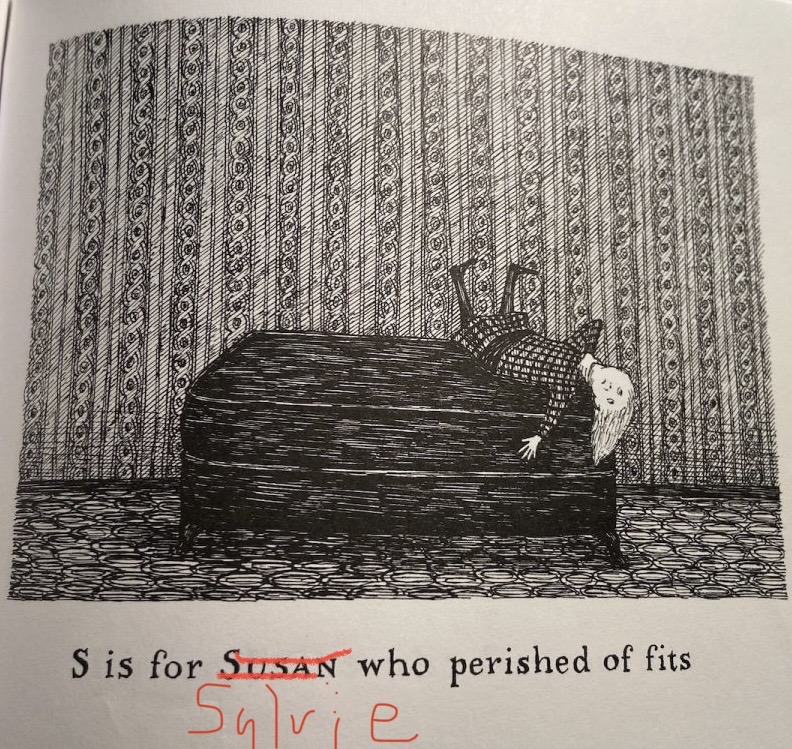
    With apologies to Edward Gorey (The Gashlycrumb Tinies: Edward Gorey’s Alphabet of Death)

    “Death comes equally to us all, and makes us all equal when it comes” – John Donne

    “Memento Mori” (Remember Death)

    I’m not saying I think about death a lot, but my best friend’s husband has nicknamed me ‘Terminal’ Sylvie.  Perhaps a dozen or so years working as a palliative care nurse has left me marginally more noir than what strict social mores decree, but working adjacent to the dying, holding space for their final insights and experience, and catching glimpses through the eyes of those close to death, is a life-altering awakening. It’s difficult to capture with mere words, but as a little old lady… in waiting, let’s just say I feel a certain readiness to share what I’ve learned from the front row seats, as close as anyone can get without taking to the stage themselves.

    Those near death understand a secret thing that we do not. Once you’ve been assigned an expiration date, you come to fully understand that there is nothing that we can truly own, nothing tangible or material that we can keep, there is no permanence, there is only the love we give away, the investment we make in others, and the ripple effect our actions have, for good or ill, is our only real legacy.  Between you and me, I’m hoping for a bit more time to invest my ‘goodwill’ stock and watch my portfolio grow, but I know that nothing is promised.  I try to stay awake to the end game and challenge myself never to overlook an opportunity for kindness.  My record is sketchy at best, I’m a work in progress, of course, but I caution you now, that treating death as a taboo topic and putting our heads in the sand is ill advised, at best.  A good death takes a little planning, and that starts with one irrefutable truth – that no matter how healthy or fit, rich, or connected (spiritually or otherwise), clever or credentialled you may be…no one is getting out of here alive.

    Let’s start with the easy stuff – a quick review of the logistics.  A few years ago, I attended a national palliative conference in Ottawa. There were a lot of very interesting and learned speakers there, but the lecture that got my complete attention was a presentation entitled ‘Getting ready to go.’  The lecturer provided some significant demographic data that suggested that the death trajectory as we currently know it, complete with nursing home beds, hospice care and access to in-hospital palliative care, may not be available to us.  That is to say, we don’t currently have the capacity to accommodate the glut of Boomers that will die in a very concentrated time period.  There is no more room at the ‘End of Days’ inn.  The lecturer advised looking for community resources as we will almost certainly be dying at home. So have a look around you…know any docs or nurses, maybe have your kids practice injecting an orange or two … just thinking out loud here.

    The lecture also included a detailed inventory of ‘good death’ questions for review.  Do your kids know your passwords? Have you got a will, a DNR, a POA (medical vs financial)? What are your thoughts on MAID?  Does you religion dictate that you suffer before death?  Do you understand that if you lose cognitive capacity, MAID is no longer an option for you? Perhaps better to consider your position sooner rather than later and more important still, to communicate your ‘last orders’ to your substitute decision maker.  You have a substitute decision maker… right? Isn’t it a kinder thing to consider your options now before your children or SDMs have to bear that burden?  As a palliative care nurse, I’m reasonably confident that I can keep you comfortable as you lay dying, but my ability to comfort or mediate the pain and sadness of your friends and families sat beside you, holding vigil through the long days or possibly weeks as you lay dying… I know no medicine strong enough for that.

    It’s important to have a think about what constitutes a meaningful life and what factors detract too much from that ideal to be tolerable for you, individually.  It’s a very personal decision.  If you’re asking me, I’m thinking I could possibly tolerate a little incontinence, I’m already acclimating to the indignities of cognitive decline (the forgotten pickleball scores, the word-finding, and could any of us LOLW get home if we didn’t have our key fobs to find our cars…just today I watched a friend open the door to an SUV that wasn’t hers…pretty funny actually, and tolerable I suppose. I’m going to go on record here and say I could, in theory at least, endure a modicum of pain (reserving the option to change my mind at any time on the pain piece…huge fan of pain management…give me the drugs – all of the drugs). However, if I was confined to hospital with no chance of returning home, or if I developed a dementia that meant I no longer recognized the people I love, then maybe a nice little hospital acquired pneumonia isn’t such a poor prognosis. Maybe comfort measures only at a certain point is the most humane treatment option.

    Talk to your kids or your appointed decision makers about what you want and, more importantly, what you don’t want.  I promise you that if I brought you to work tomorrow, even for an hour or two, you would be on the phone with your loved ones by the end of day. Think about who it is you want standing around your deathbed. Invite them to dinner, open a bottle of wine… maybe three. If possible, wait for the dessert course before you dive in to the deep end…ask about their day, tell them how much they mean to you, and as you cut into the pie, begin the difficult but essential conversation about what a ‘good death’ would look like to you. A mildly uncomfortable dessert course now, will spare your loved ones from having to make unthinkable decisions on your behalf at a time when all they’ll want to do is hold your hand, share a laugh about pie night, and find the strength to say goodbye.

    Now, to the really important bit.  It’s been my experience that those who make a happy end…those who die well, are those who live well, investing themselves in the people around them, and in whom others depend.  The best death scenes I’ve witnessed are alive with love and rife with family folklore, where stories are shared of times well spent, and laughter erupts, and perhaps some tears as loved ones share their memories from over the years.  ‘The day I met your dad…the day you were born…remember that big snowstorm…the camping trip from hell…’ or any number of Christmas poemics.  I remember a famous local watercolourist whose family met in his hospital room every day at 5…Happy hour they called it.  The wine was poured liberally, a hand-picked playlist in the background, the dulcet tones of Vera Lynn, ‘I’ll be seeing you in all the old familiar places…‘, the dying man, the guest of honour, enveloped by his chosen few, every afternoon the same bespoke soundtrack, storytelling and laughter, until the music stopped.

    All we accumulate in this life, the acquisitions… the accolades…. they mean nothing in the end.  It’s more about kindness brewed on darkest nights, and passions discovered and developed in ourselves and encouraged in those around us.  What is most important in the end, are the broken hearts we helped to mend, our fortitude, our dedication, and our prowess as a friend, and all the little beauties we cultivate in whatever sort of garden we decide to tend.  What matters most I think, as you take your last breath, is the love you gave away and the joy you helped create, in the time you were here.  It’s our only job really … to love and be kind, if we can, and I have found that those who die well, with peace and with grace, find the time to be kind despite the many burdens they face… some even in their last hours and days. I will never forget a gentleman who rang his call bell at change of shift, with no ask or agenda, only to serenade his night nurse with the most beautiful rendering of ‘Fly me to the moon’ that I will ever know. I can still hear his voice a decade later, and I pray I’ll find it in myself to sing a little song in my last hours, to know such grace.

    For me death is only a door to an unseen place, a speed bump between this world and what comes next, ‘it is the last unprinted snow‘ (Stoker). I think of it as a final adventure, a quest, a magical mystery tour. I know for many it may seem scary… the travel restrictions are untenable, you travel alone, no company, no carry on.  I think the only thing we get to take are the string of moments when we are fully awake… the Fly me to the Moon occasions of human connection, a cache of all the unspeakable beauty we are capable of conjuring … a steadfast heart, a gentle word, an earnest ear, the softest kiss.  All the love we give away is the only investment we need ever make, and the only prayer we need ever pray.  But if, like me, you’re looking to hedge your bets, to grow a little more in the time you have left, there are three little questions I like to ask now and again: am I honouring my gifts, have I learned to love true, and is the world a slightly better place, even a smidgeon, because there was you? If you can answer these questions with any degree of satisfaction, I can almost promise you a beautiful death, where a parting glass will be raised in your name and those who loved you best will stand together in the “coke machine glow” that was you and mourn the loss of your incandescant light.  In the meantime, dig out your rolling pin…it’s time to make pie.