“The crone must become pregnant with herself, at last she must bear herself, her third self, her old age, with travail and alone. Not many will help her with that birth.” (No Time to Spare – Ursula K. Le Guin)
“When howling gale is rattling doors, or call of lonely wolf is heard, or cry of raven on the wing, or crack of frost upon the ground, tis she, tis she, tis she. (Calleach – Siobhan Mac Mahon)
Less than a week before Christmas, when family matriarchs are customarily exiled to Santa’s sweatshops, wrapping gifts like Edward Scissorhands, and frosting shortbreads until our collective glycemic index reads “critical,” I decided to take a night off from the Christmas chain gang. I ventured out on a dark and stormy night, in the company of a close friend of comparable vintage, to attend a workshop that promised to introduce, depict, and interpret the power and majesty of the Crone, a feminine archetype, traditionally the last in a triad, after maiden and mother. The Crone, often portrayed in our culture as a warty hag, complete with kerchief and shawl, is cast as the most powerful as well. A sage, a witch, a guardian, a memory keeper, a storyteller…these are just a few of the crone synonyms we might try on for fit, as we move into this last, magical, and mysterious phase of feminine folklore.
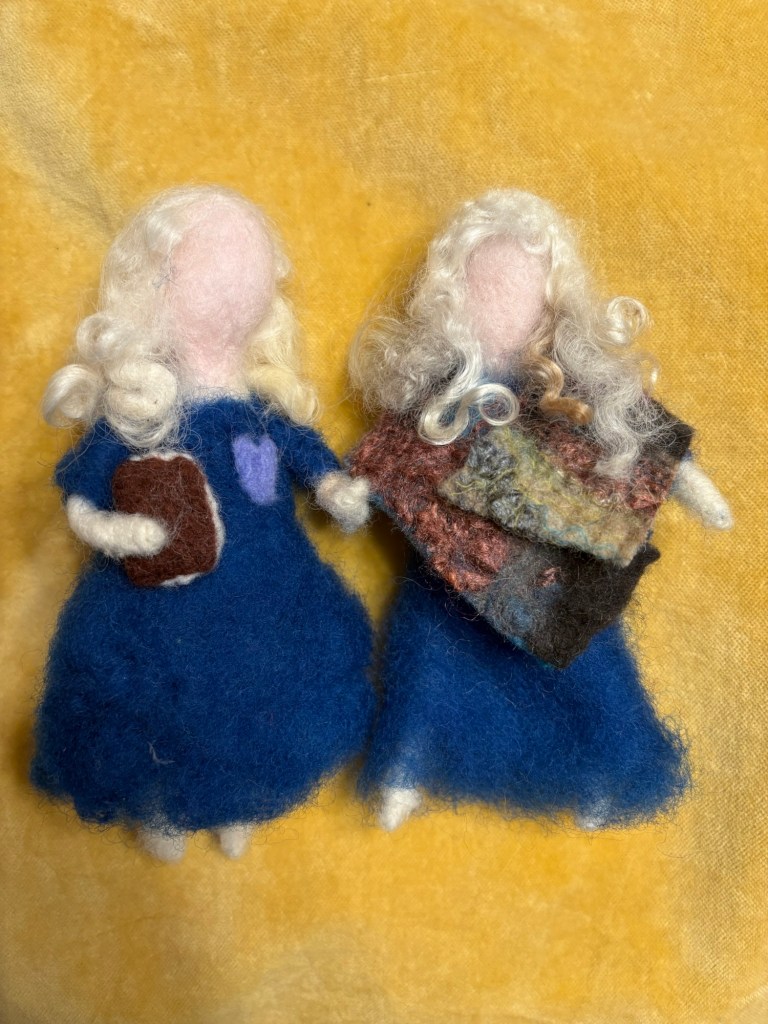
The workshop was led by a woman who called herself a ceremonialist, a Cailleach, or “veiled one” in Gaelic mythology, who helps people transition through significant life events. Like so many formative moments in a woman’s life, it began with a fairy tale and the promise of a little-old-lady felted doll of our own making by night’s end, so we charged our tenuous social batteries, did battle with our homebody hearts, discussed whose eyesight was least perilous for an after dark adventure, packed a journal and a sacred object, as directed (Jesus …will there be sharing), and set off on our quest to Encounter the Crone.
Sat close to the sea in a small conference room, the wind outside serenaded us like a siren call, a slow whistling sea shanty, and the doors rattled loudly, heralding the night’s import, like the ghost of Christmas past. We were offered tea and invited to sit around a makeshift altar decorated with bones and stones and candlelight. We added our own holy relics: jewelry passed down from our mothers, artwork, a pinecone, a bird, a doll, the shell of a sea urchin, a heritage Christmas angel, and a witch stone, known for its magical protective properties. We were 12 women together, artists and academics, nurses, and teachers, travelling in the dark, a winter’s walk to honour our experiences, mine for meaning, and navigate together a transformation to feminine elderhood, a privileged freehold of wisdom and authenticity, sovereignty and self-possession. The magic in the room was a palpable thing…not enough to levitate… first time out mind, but strong enough to elevate us all. I’m certain it surprised no one in the room when the lights went out and we were forced to close our circle prematurely, but not before we built something true and lasting together.
The fairy tale recited so beautifully by our host was the story of Vasilisa the Beautiful, a kind of hybrid Cinderella and Hansel and Gretel. Our heroine, Vasilisa, is gifted a tiny doll with magical properties from her dying mother, that protects her throughout a perilous journey to safety. Spoiler alert she lives a full life and eventually returns to her origin story, living out her days as an elder in the forest. The tale is simple but rich in imagery and metaphor. We were asked to share the images that lingered in our mind’s eye. The death scene between mother and daughter and the gift of legacy, chicken legged furniture, the impossible task of finding poppy seeds in dirt, a metaphor for discernment, and a fire torch crafted from a skull, the instrument that leads to the story’s denoument, all had honourable mention.
For me, the lasting power of the story was not an image but an incantation. Vasilisa called upon the power of the doll reciting, “Little doll, little doll, drink your milk my dear, and I will pour all my troubles in your ear, in your ear.” The notion of a talisman for the storms of life, a mother’s magic, an enchantment to conjure a place of safety in our darkest hour, when we’re not sure our own strength will hold; to call on the inherited love of our ancestors and open a portal of protection, or peace abiding….definately worth the price of admission. Were we leaving the workshop later that night with such a prize in our possession, a felted doll infused with magic, a protective cloak spun from our collective sacred offerings? What sorcery was this? I started thinking maybe I should leave the house more often, even as a tempest raged outside, and Christmas at ours, still only half conjured.
Properly incentivized we turned our attention to working with archetypes. We chose a role from the alter at the center of our circle. Interestingly no one chose the same archetype. There were so many wonderful choices. I passed on Hag, and Old One, Elder and Witch. Hearth Keeper and Herb Wife didn’t quite fit either. We had a Weaver and a Word Witch, I remember. My friend, selected Sage. A new grandmother, she is interested in legacy building and passing down family tradition and wisdom. I picked Storyteller. I’ve always been addicted to story. It’s my preferred way to learn. For me it’s high art, allowing us to live a thousand lives in one, a talisman against loneliness, a cure for myopia and polarization.
After sharing our selections and thoughts around the archetype alter, we moved, some of us more tentatively than others, to worktables set up for needle felting, a dangerous, dexterous art, that comes with small sharp stabbing needles and raw wool to be shaped and prodded into small objets d’art, a felted little old lady…in waiting. I wish I could tell you there was no blood lost but I’m sure I wasn’t the only hag there to stifle a silent scream that night as the needle pieced my presumably pre-loved stabbing pillow, and caught the delicate skin beneath my fingernail. Maybe the bloodletting is part of the spell, maybe human sacrifice is the elixir that makes the doll magical. All I know is that I stabbed my doll a thousand times or more before she came to life in my hands and the stabbing was oddly therapeutic (“psycho -killer…qu’est-ce que c’est”). I plan to continue my felt making education and have already created a companion for my doll, but maybe I’ve shared too much. Still, friends are important…even felted friends.
The power went out when I was attempting to style my doll’s hair. Every woman will understand the import of such a moment. Our felting mentors came to the rescue and held cell phone flashlights for us to finish this crucial phase in the work. Suffice to say, I was never so happy to own such unruly, unkept tresses. It was the work of a moment to complete the effect and even in the dark I recognized the crone I held in my hands as my own, a story keeper and maker, a sovereign in the final decades of her reign, confidant in her unique gifts, generous in her attention to those she held dear, and determined to live intentionally, according to her values and passions until her last moments in this realm.
I was afraid the storm raging outside would prevent our eclectic circle from sharing our thoughts on the dolls we created. Insatiably curious, I had an almost visceral need to know how the others would answer the last question on the agenda for the night, “If your inner doll could speak to you tonight, what would she say?” One doll spoke of cultivating more trickster energy, to seek opportunities to laugh and have fun, another counselled that there was always something new to learn and explore, others said to ask for help and not to imagine we can do it all ourselves, that it’s ok to be messy, to rest, to be steadfast, to practice unconditional self-love, to keep moving, to offer guidance, to stand in the wind, to practice childlike wonder, and to embrace and celebrate all the beauty within.
I know the doll is just a small, symbolic, hand-built ornament, but it feels so much bigger than that to me. I know we make our own magic, but I also know that there was a wisdom teaching waiting for us in the dark that wintry night, an introduction to “crone-ology,” a threshold for letting go of all that no longer serves us and a turning point in the pages of our story. You may cackle, but I have plans to build my doll a small house with a door that opens with ease, so whenever I need to hold her close and feel my mother’s magic near, I’ll find her waiting for me there, her spell unbroken, a warm cloak of protection against the storms of life.
 Little Old Lady … in Waiting