Tag: adventure

  • The Richness of Retreat

    .

    “Silence is also a conversation” – Ramana Maharshi

    “Be a loner. That gives you time to wonder, to search for the truth.” – Albert Einstein

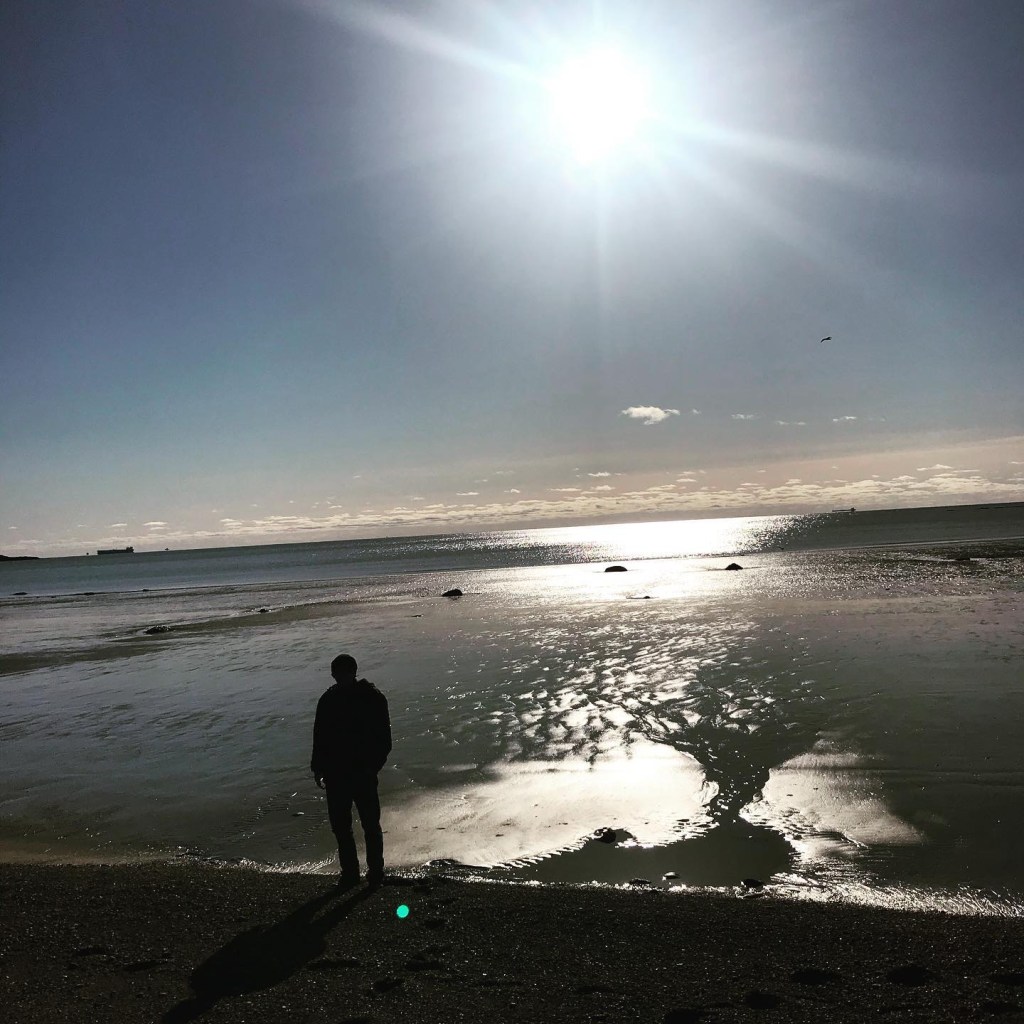
    I have never lived alone, and at 59 and a half, I can count on one hand the number of nights I’ve spent alone in my home.  So, when my daughter announced that she was off to Australia for a fortnight, and asked if I might cat sit, I decided to embark on a private retreat of my own, a silent, mind-spa staycation, an experiment in the single life, an escape to a ‘room of one’s own’. The setting was LOLIW perfect… posh, urban, ceilings to God, a spiral staircased brownstone apartment in the heritage quarter, the dream home of a much younger version of myself.  The street was Orange, the mood, indigo, and the first song I danced to, with abandon, in far too many years, was Yellow.

    I have always shared living space with close friends or loved ones.  I have never experienced the kind of solitude and silence that singletons exalt in daily, the bliss of soundless mornings, the peace of uninterrupted afternoons, the effortless, evening meal for one, or the coveted hours spent in one’s own sweet company, time whiled away without reference to the wishes or inclinations of another living soul. To keep one’s own good counsel and consult no one else (save an agreeable cat with excellent manners and clear boundaries) on how best to spend the day…what a gift to give yourself, perhaps most especially as a little old lady in waiting. There is a magic to be mined, an enchantment, a real richness of experience to be savoured in retreat. 

    As with any adventure, I overthought and planned every minute detail down to the quick. I packed separate bags for the gym, for work, and for pickleball. I made sure to include enough loungewear and smalls to avoid even the notion of laundry, and a series of comfy sweaters and toasty wool socks, as you do, unfamiliar with the heating in my new abode, a Canadian girl down to  my bones. One can’t be too careful when it comes to creature comforts.  I prepared and packaged enough food to last me about ten days, individually portioned, so I wouldn’t be troubled with cooking or cleaning dishes during my retreat.  I planned to supplement my defrostables with a few evenings of restaurant meals, I was on vacation after all…there were friends to be met, and those naan nachos from Thandi’s are a siren call that cannot be ignored.

    My car was already packed the morning I set off to drive my daughter to the airport. I kissed my husband and hugged my son and small geriatric dog goodbye.  A little old lady herself, I had a quick word and cuddle with my last true dependent.  I let her know it was alright if she had an accident or two in my absence, as the menfolk aren’t as attuned to her bathrooming pecadillos, an easy concession as I wouldn’t be there to look after any mess.  I wished her well and promised to make it up to her.  We settled on half my breakfast bacon for a period no shorter than one year, and a promise that she could come away with me next time.  Oh yes, spoiler alert, there will be a next time.

    After imparting a steady stream of last-minute motherly advice to my savvy, world travelling daughter, advice she did not need, but tolerated as best she could, I watched my baby pass through security, before discarding whatever illusion of control I still harboured, and then, mentally slipping off my mother cape, a favourite cloak, I turned with a little tear in my eye, before going dark, the start of a full-blown smile forming on my lips. I was a stranger in a strange land, alive to the endless opportunities that waited for me. I decided on a quick stop to Costco (I mean …I was in the neighbourhood) for a few emergency supplies…ready made bacon, the Christmas fruitcake (singletons host friends too) and then it was straight back to the little uptown palace I would call home for the next two weeks, party of one.

    I made my escape in mid-November, an excellent time of year for retreat, just at the onset of the introspective months of the Canadian winter, but before the circus of Christmas pageantry that engulfs most matriarchs in December and doesn’t let go until after New Year’s day. For the first few days I sat in a kind of meditative slumber, wonderstruck by the tidied rooms, the luxurious silence, the fragrance of aloneness, the cadence of a single set of steps. I floated from room to room, I listened to the voice of a girl set free from a set of inherited instructions for living, a voice that spoke softly at first, but eventually commanded my entire attention. 

    Most of what she told me is private of course, you understand, what happens on Orange stays on Orange, and anyway it would probably be lost in translation.  I can share that I never once felt lonely during my retreat, that it took several days to miss the loved ones I live with, and if there were any monsters under the bed I slept in alone at night, they kept to their dark recesses and didn’t intrude on my peace. Suffice to say, I was away long enough to remember that there is no better counsel than your own, there is no truer friend than yourself, and if you’ve been neglecting that friendship, then it is time to take yourself away for a long overdue conversation, the kind where you listen more than you speak. Our words can physically influence the world around us, most especially the words we recite incessantly to ourselves silently, in a closed circuit.  The truth is that every cell in our body is listening to us, which makes the quality of the interior dialogue so critical. Do we settle for questions like, “what’s for dinner?” or even “where to travel next year?”  or do we ask ourselves how we might best build joy today? Or “what exactly Elliot meant when he wrote, “I grow old…I grow old…I shall wear the bottoms of my trousers rolled. Shall I part my hair behind?  Do I dare eat a peach?’

    If you, like me, prefer Elliot’s poetry to a cookbook, these are the essential rules of retreat. There must be quiet. Your mind must be calm and unleashed from the concerns and demands of those closest to you.  So much of our action in life is economically or socially determined. Even love can feel like a Chinese finger trap some days. As we get older the claims of our immediate environment, our preferred living arrangement, can be so pervasive that we can actually lose sight of ourself in the family photograph, beneath the Wifee sweatshirt, behind the sacred veil of motherhood, to the woman who waits within like a nested Russian doll  We can become so consumed with what we perceive as the requirements of daily living; nutritious meals, a tidy home, daily exercise, the social scene, that we forget ourselves and our real work, discovering and exploring the beauty and mystery that lies within.

    Finding a quiet place to stoke your inner fire is an essential and sacred ritual, an absolute necessity for every little old lady in waiting. If you can’t get away for a dedicated retreat, then lay claim to a certain hour every day, a space of time inviolate to family or friends, where the news of the world cannot reach you, and where you do not recognize or acknowledge what is owed to others.  A space where you are free to simply experience who you are, and what you might be, a place of creative incubation, a venue to challenge your everyday assumptions, to grow, to follow the winds of your own inclinations, to feel your courage, and to care for yourself, like the treasure you are.

    At first it may feel like you’re wasting time.  If that is your experience, at least initially, I would encourage you to hold fast, it is, after all, your time to waste. We have a limited lease of time apportioned to each of us, and whether you spend that time truly awake or asleep in the detritus of daily living is entirely up to you.  Life has no pause button or rewind setting.  If you read this blog post all the way to then end, each of us is 5 minutes closer to our demise than when you started.  If you can stay present to this moment, if you can be here now, and genuinely engaged in pursuits that bring you joy, then you know the secret to a beautiful life. So often we become embroiled in activities we do not relish and have not chosen for ourselves but believe are required of us.   Fresh from my retreat I have begun to question everything I habitually tell myself needs doing. I engage in small acts of rebellion as often as possible.  I eat cereal for dinner some nights, my bed often goes unmade, sometimes I skip the gym to write or read …there is a feathery owl atop my Christmas tree this year, slightly askew, and it has never looked more beautiful to me.  I hold space for myself to wonder and to consider questions outside the realm of my daily routine. “Do I dare eat a peach?”

    It’s true that to create a pleasant and harmonious environment in our lives together with loved ones we need the cooperation of all those we choose to hold close in our immediate circle, but pleasure carried within ourselves, within our own body and mind, and within that part of ourselves that has no name, that is our business alone. This dark season of early nights and twinkling lights, I wish for you a happy retreat…I invite you to cast your eyes to the wintry sky, to stand alone sometimes, to “look at the stars and see how they shine for you.”

  • In Conversation with Jan Lucy

    I wasn’t looking for a new friend when I met this captivating woman.  She was waiting for me in what we now refer to as the ‘therapy pool,’ the LOLIW early morning aquacise class at the local YMCA.  A large part of me believes she was sent to me by someone who now ‘walks invisible.’ Jan’s scientific rationalist core would smile at the notion, but there are days when I believe I have her half convinced in the power of a good God Box.  Exquisitely kind, intelligent, politically progressive, community minded, and sea-loving, Jan moved to Saint John from Ontario with her husband, Don, three years ago to be close to the water in retirement. 

    Graduating with a degree in English from the University of Guelph, a proud Guelph ‘Griffin’, excelling in competitive swimming, Jan lived and worked for much of her career as a campus administrator at a satellite campus of Nipissing University in a small Ontario town called Bracebridge, cottage country for the rich and famous including such stars as Stephen Spielberg, Goldie Hawn and Martin Short.  ‘I bumped into Kurt Russell at a bar once,’ she laughs. 

    Born in Picton, Ontario, her early childhood was spent in Germany as her father was a meteorologist seconded to the military. She grew up in Ottawa and met her husband by putting an ad in the Toronto Star classifieds. ‘Where are all the Alan Aldas in the world?’ she wrote.  ‘He was a feminist, he was a humorist, and he was political,’ she explains. She received 44 responses. ‘Don was in my ‘no’ pile,’ she laughs.  ‘It was my girlfriend who pulled out Don’s letter and said, ‘What’s wrong with this guy?‘  So, I wrote to him, and he wrote back and the rest, as they say, is history.’

    After a series of unsuccessful pregnancies and adoption attempts, Jan eventually privately adopted her first child, Vincent, from Brazil.  ‘It was my labour,’ she remembers, describing the painful journey that eventually led to the great joy of bringing home their first son.  ‘When he was 4, I knew I really wanted another child and so it was back to Children’s Aid to begin again. This time it was different. Now we were considered a ‘black family,’ and so it was more a case of how many do you want?  We went to the front of the line and through a progressive adoption process we eventually welcomed our second son, Omar.  I was 39 by the time he arrived, and he was like a kitten climbing the drapes.’

    Since arriving in Saint John three years ago, Jan, socially dexterous, with charming old-world manners, and an earnest desire to connect and give back, has worked with new Canadians helping them navigate and acclimate, she has become an active member of the Saint John Naturalist Society, engaging in  ‘citizen science’. and data collection, and is a member of the Lift Community Choir, singing and supporting local causes. Most days she can be found hiking or bird watching in our beautiful province in the company of her husband, Don, and her LOL dog, Siskin.

    Tell me your life story in seven sentences or less? 

    I grew up the youngest of 3 children in a loving home. I lost my father at aged 14, when he died in a British-European plane crash…no survivors.  I went to the University of Guelph and received a degree in English where I was also a Guelph Griffin, a synchronized swimmer.  I have been married to my husband Don for 38 years, after meeting him through the Toronto Star’s Companions Wanted section. I have 4 children, two stepdaughters and two adopted boys…I like to say they were all born in my heart.  I worked for 20 years as a campus administrator for Nipissing University’s Muskoka campus where I had the best students and faculty to grow along with.  I moved to Saint John three years ago at the age of 64, buying my house online, not knowing what would come next or who I would meet.

    What is the best thing about getting older?

    The best thing…is that I’ve had the opportunity to get older.  So many people don’t. Whether it’s disease or accidents or suicide…and I think maybe it’s because of Vincent (son) being ill… and family member struggles with mental health…this idea that it could end for any of us.  So just to make it this far has been great…I hope I still have many more years, but you don’t know.

    What is the worst thing about getting older?

    Feeling like I’m running out of time…and again maybe it’s because my dad died so suddenly…he was only 46, that I worry about my life being taken away from me before I’m finished doing the things I want to do.  I’ve always been a big list maker and I like to accomplish many things in a day. What’s that old expression, “I want to arrive at the graveside all dishevelled, skid in and say, ‘Wow, what a ride!’ I don’t want to sit in a lazy boy…that’s not my thing.

    If you could retain or retrieve one quality from your youth, what would it be?

    Being more playful, I think.  I grew up with this ‘What will the neighbours think?’ mentality.  So not worrying so much about what’s expected, not worrying if your socks match.  I almost didn’t give my husband a second date because he didn’t put his cutlery together on his plate.  Or when someone is coming over…are there dust balls?  I was more playful as a younger woman.  We stayed outside and played until the streetlights went out.  So, I find if I’m given an opportunity now, I try to be more spontaneous, less wary.

    What’s the most important lesson you’ve learned so far?

    I don’t know who said it to me about your impact on your environment or on the world…that a single drop of water can overflow a cistern or a well… so not to underestimate what your small gesture or your small action can do, positively. So, I try to lift others up…I need to listen more…I know that…but by listening… if others want my advice, to try and provide what is needed. I also know I need that too. So…we all struggle in life, and I guess that’s why I love the pool so much…and why we call it the ‘therapy pool.’ It’s sharing those struggles that helps us remain optimistic and hopeful. And celebrating the high notes too, like when your son asks to speak to your friend on the phone, because he knows she is important to you.

    Do you have a favourite quote?

    “Don’t tell me not to worry, the things I worry about never happen.” (Unknown author). The other thing that my mother used to say all the time that kind of ties in to that is…’this too shall pass.’  And the whole idea that anxiety happens in the past or in the future but not when you are truly here, in the present.

    Do you have a favourite word?

    I do. It’s a made-up word, it’s ‘snigg.” So my mom and my grandmom were very progressive with their use of technology…I think they were probably emailing before I was.  My mom meant to type, after a very sentimental message, the word ‘sniff’…like after a sad story, ‘sniff’.  But typed ‘snigg’ instead.  So we’ve all taken on this accidental word whenever we come across anything sentimental or that touches our heart, we’ll always write ‘snigg,’  And what’s kind of cool is that my son does it now too, so it’s a three generational thing now.

    Describe your perfect day.

    This one was a little more challenging for me, but it has to do with water…being near water, being on it, being in it…that’s where the day starts…with water.  And then learning, I’d like to learn something and whether that’s something I’ve read, something I’ve researched, gone to a lecture or a play, but something that I’ve learned.  And lastly sharing thoughts and time with friends. 

    If you could have tea with anyone, real or fictional, dead, or alive, who would it be and what would you talk about?

    So… I thought about this one and I think it would be my mom’s mom, my grandmother. She was born in 1894. I just thought she was amazing.  She was an equal partner in her marriage to my grandfather who was Professor Emeritus of Botany at the University of Alberta.  She always felt it was important to be an intellectual equal with him and provide him with companionship.  She was pretty educated for her era as well.  She attended Alma College, a liberal arts college, but she also helped my grandfather type and illustrate his work for his PhD. And she raised two amazing, strong women, my aunt and my mother.  One of the stories that sort of exemplifies her is that on her 100th birthday there was a big reunion of family and she remembered everyone’s name, what they did, what their partners did, and asked wonderful questions.  Also, that same year, she was in a nursing home at that time, and she played the Virgin Mary and was on the front page of the Victoria paper wearing her blue scarf and holding a live baby, a little brown baby.  Before she died, there was a picture of her in the pageant by her bed, and her last words to my mother were, ‘I like to look at that picture and imagine I’m holding baby Vincent.’ Snigg.

    Another story is that when she first learned that I was moving in with Don, my grandmother’s response was, ‘Does she have a prenup?’ And then, I have a gay older brother, and it was just at the peak of the AIDS epidemic when he came out and he didn’t know how she would respond, and he went to her apartment and said, ‘am I allowed to come in?’ and she just reached out her arms to him.  So, I would like to have a discussion with her around how she became so wise, beyond her years, when there was homophobia, there was racism, and women were subservient in society…what drew her to be more? What was her thought process?

    Tell me three things that bring you joy.

    Taking some risk..like joining a choir…I mean, not bungee jumping, but I guess maybe moving to New Brunswick. I think sometimes life can be too comfortable. Do you know the story about the lobster?  The whole thing about how a lobster grows…how it has to shed its shell because it’s getting too tight, and becomes very vulnerable because it doesn’t have its hard exoskeleton. It could be dashed against the rocks…but to grow it  has to shed its shell. I always loved that story.

    The other is obviously learning new things. I never thought I would be a bird watcher until I moved here.  I love the fact that we are so multicultural here too because where I used to live it was very white…boring…one dimensional.

    And then helping others…which is a big part of my experience in Africa. It started with my sister probably fifteen years ago or more when she went on her dream vacation to Tanzania, and she met a young safari guide who had dreams of owning his own safari vehicle. She befriended him and helped with a website and referring some clients and creating itineraries for guests.  The guide’s wife was a schoolteacher, but she donated her salary back to their community.  They are incredibly lovely people and wanted to do more for their village. The guide eventually became a village elder and reached out to my sister for some help, initially for water, and then for a school.  They started very small… educating the village children and then as time progressed and climate change was affecting their livestock and food, our family became more involved.

    We ended up doing a sibling safari and as part of that, my brother who is a huge permaculture believer, suggested we might bring in a specialist from Kenya who had some success there, to see if there were possibilities for the village. We thought if they could start a small farm, then they could harvest the fruits and vegetables to feed the school.  They started teaching farming skills in the school and the kids began working with the permaculture and redirecting water runoff, and within 3 months they were feeding the kids at the school. After that some of the mammas started planting as well and the school expanded, and we were able to fund kids who couldn’t afford school fees through the ones who could, and the garden was expanded to 7 acres, and they sold the extra produce.  This all happened over the course of many years but we still talk to the village the first Friday of every month. I asked them once if I could ever be a Maasai chief.  Women don’t traditionally have much position, but I was told, not long ago by that same guide who my sister befriended, ‘Jan, you’ll be happy to know, I have three women on my advisory board now.’ Helping others brings me joy…we’re a ripple in the pond.

    Name a guilty pleasure.

    I try not to feel guilty…but I do. It’s around sweet things, specifically chocolate…really good chocolate. I never feel guilt over a kitkat…I mean going out and spending a fortune on high end truffles, because it’s money for sugar.  I feel like it’s a drug and it seems so silly and petty and something I should just let go of but at the same time, as it provides me with pleasure, why should I feel guilty about it…why don’t I deserve it?

    Do you believe in life after death? What does it look like?

    Ahh…I wish I did. I believe energy leaves me when I pass.  I want to hope there is something … maybe it’s living with a scientist. I don’t think there is, but I’ve also had these things happen…and I can’t explain it …so maybe there is something beyond what we know…but I don’t know what it is.  Is it the pearly gates…I don’t think so.  When I went on my sibling safari with my brother and sister…we were in Kenya and we were sitting at a resort and this man was wandering around singing, and all of a sudden he started singing ‘You Lift Me Up’ by Josh Groban  which was my mother’s funeral song and my brother and sister and I all looked at each other…I mean…in the middle of Africa…a song so meaningful to us all.  So, it’s those kind of things, but at the same time…I don’t know.

    What would you like your eulogy to say?

    I think I would like it to say…and this is a big task but…’She left the world a little better than when she arrived.’

  • The Art of Happiness

    “I must learn to be content with being happier than I deserve.” – Jane Austen

    “Letting go takes a lot of courage. But once you let go, happiness comes very quickly” – Thich Nhat Hahn

    Happiness is a slippery state of being, an elusive, inconstant companion. Like a feckless lover or an indifferent cat, it’s never near at hand when you need it most. It’s approach is often unheralded, it’s visit, never long enough, it resists all enticements to stay. It cannot be captured…it will not be held…we cannot keep it. It is as impermanent as an ice cream on a hot summer afternoon, as fleeting as a first kiss, or a glass of fine wine, it lingers briefly, and disappears into the realm of memory. The art of happiness sits haplessly in the space between our first world sense of entitlement, and our readiness to cultivate a sense of wonder, that magnifies the trace elements of happiness drawn from everyday dealings. Little things like the dog’s yawn, the carol of the wind in the trees, the smell of freshly brewed coffee, or the uncalled-for-kindness of a stranger can, with practice, conjure a sensation of peace, an ‘invisible cloak’ of contentment, protection against the certain storms of life. There are glimmers everywhere if we learn to spy them, and they can sustain us, even on our darkest days, if we apprentice in the art of happiness.

    First lesson – kill all expectation of happiness. It’s Buddhism 101, the first noble truth, ‘Life is suffering.’ Happiness is not our baseline or our birthright. We don’t deserve it, and we can’t earn it. We are not on some episode of Friends with a laugh track running every 30 seconds. Chandler Bing died of drug use disorder, and Rachel’s husband left her for Angelina Jolie. We’re in the ‘real’ people, and to quote the venerable Monty Python, ‘Life’s a piece of shit…just remember it.’ (It works better if you sing it). My kids would say that that’s a bit dark or defeatist, but I’m with Schopenhauer and the Pessimists, you need a sense of humour to get through the tragicomedy we call life, and ‘the safest way of not being very miserable is not to expect to be very happy.

    Buddha’s second noble truth is that we’re the problem…we are the root of all our suffering…we build our own hell. The art of happiness is to desire less…stop trying to make the world conform to our preferred narrative…that way lies madness. Relax…we control nothing… and anyway, sometimes bad news is good news in disguise, if we wait long enough. It is a mighty thing to slay your expectations and lay yourself open to your share of frustrations, disappointments, and loss. My mother always told me that ‘acceptance is liberation.’ She was a very wise woman, a gift earned from enduring her measured cup of sorrows.

    William James wrote ‘We need to stop deciding how we want things to be and then getting ourselves upset when things don’t turn out that way.” Easier said than done Willie, especially when you discover the last piece of cake gone, or the poop your geriatric dog deposits on the dining room floor every night.  Still, I say give it a try next time you’re provoked by an uncapped toothpaste, a Sunday driver when you’re running late, a rainy day when you wanted it fine.  Start there and when you’re ready you can move on to little old lady sized stuff, like chronic pain, or learning about a friend’s new cancer diagnosis, or loosing someone you loved very deeply…someone you thought you could keep forever…a loss that feels like the sky’s gone out and taken all the stars away. It gets a little harder to wash down then, even with a good red.

    James would say, ‘If you believe feeling bad, or working long enough will change a past or future event, then you are living on a different planet, with a different reality system.’ He’s right of course. we can’t get so mired in the shitty pieces of our story that we miss the good bits…the glimmers.

    We can’t be ‘shiny, happy people’ all the time and I guess we shouldn’t even try. Don’t we need a certain measure of malcontent to get anything done? It’s only unhappiness, disappointment and disenchantment that puts our clay feet on the floor every morning, isn’t it, that fuels our pursuit of wisdom…some magic beans to make the daily grind a bit more palatable? If we were happy all the time, we’d stay at home all day and roll around in it, wouldn’t we, hedonists supping on donuts and Netflix until our brains and our bodies turned to mush.  That’s Hotel California my friends…’and you can never leave.” (Again, much better if you sing it with me)

    If we can’t capture happiness and keep it caged, as we might like best, then we can cultivate habits and practices that invite happiness in, offer her tea and something sweet to encourage a long and robust relationship.  Gratitude is the first and best invitation to happiness that I’ve discovered.  It is that great looking glass that magnifies all the beauty and riches around us, large enough for us to see all that we have been allowed to keep… legs that take us walking, minds that may still read and discuss, running water still clean enough to drink, maybe even a hand to hold.  I’ll add to this the extraordinary occasion for a fine cup o’ tea and in good company.  Vonnegut suggests we recite in such moments of clarity, ‘If this isn’t nice, I don’t know what is.”

    We must fall in love with the beauty that is all around us.  Cast our eye about ourselves each morning and count our blessings.  Oscar Wilde wrote that ‘most of us are living in the gutter, but some of us are looking at the stars.’  We need to look for the glimmers.  They’re everywhere once you start practicing: the dance of late summer leaves, the first line of a new book, or that feeling of being understood…an easy, effortless fellowship that lets us know we’re not alone.

    Friendship is the second essential pillar in my study of happiness.  Friends come in many shapes and sizes.  They can be fictional, or four-legged, they can be blood, and people we grew up with, or choose to grow old with, but more often than not you’ll find them out roving on some adventure.  They arrive unexpectedly, a happy surprise, and their company can feel like coming home after a long time away, or a gift you didn’t know to ask for, but have wanted your whole life. ‘The secret Alice, is to surround yourself with people who make your heart smile, it’s then, only then, that you’ll find wonderland.’

    If you’ve not yet landed in Wonderland, then I suggest you take a break from your own troubles and concerns and look around you for a way to help others with theirs.  Service is chapter 3 in the little old lady book of happiness.  My brother was in love with Emily Dickinson, she was a dear friend of his.  She wrote, “If I can ease one life the aching, or cool one pain, I shall not die in vain.”  I say do harm to no man and never miss an opportunity to do a kindness. Be a light for others.  I love the old Indian proverb, ‘Blessed is he who plants a tree under whose shade he will never sit.’ To my mind there is no better way to cultivate your own happiness than to contribute to the happiness of others, unseen, unacknowledged and with great humility. If we’re all made of the same stuff in the great fabric of being, then watching out for a dropped stitch here and there only makes good sense…keeps us all from unravelling. 

    If we can stay with the knitting analogy for a minute, then I suggest that the fourth practice in this little old lady’s guide to a happiness, is to keep to your knitting every day.  The work we choose to do is key to practicing good happiness hygiene. If you love your work, then every day is a delight and you’ll be a success, no matter the weight of your wallet. That’s not to say you won’t have to find some job to keep you in beer and bread and a roof over your head.  But you must never let those necessary hours detract from your real work, the work you recognize as your own. And if you haven’t yet found this work then, to quote Ms. Dickenson once more, you must be ‘out with lanterns, looking for yourself.’ 

    John Muir the great naturalist counsels that ‘nothing dollerable is safe.’  That’s the way, he implies, to Thoreau’s ‘life of quiet desperation.’ I say be curious, go adventuring, stretch yourself beyond your imagined limits, investigate, take yourself away, let yourself go quiet.  Your work will find you…artist, teacher, carer, baker, candlestick maker…it matters not.  Trust only that which speaks to your soul, that engages you wholly, that causes you to lose time and that you can’t wait to get back to again each day on rising. ‘It’s foolish for people to want to be happy,’ wrote Georgia O’keeffe, ‘our interests are the most important thing in life.’ ‘Happiness,’ she said, ‘is only temporary, but our interests are continuous.’

    Lastly, and maybe most importantly, happiness lives principally in the present moment.  We need to slow down and stay grounded here in the now, and as the Stoics suggest, ‘do every act of our lives as though it was the very last act of our lives.’ All the greats say the same. To quote my favourite Buddhist, Thich Nhat Hahn, we must ‘drink our tea reverently, as if it is the axis on which the world revolves.’ ‘Eternal life’ wrote Wittgenstein, ‘belongs to those who live in the moment.’  But the poets say it best, To see a world in a blade of grass…heaven in a wildflower.’  It’s that moment when the musician understands that he is not only the strings of the instrument he plays on, but also the music that fills the room and touches the heart strings of everyone who hears.  There can be no higher experience of happiness to my mind then being fully present and awake to your surroundings.

    If you asked me the raw ingredients of my own happiness, I would quote Tolstoy, ‘Rest, nature, books, music, such is my idea of happiness.’ I also try to practice what my brother taught me… to live in a state of radical amazement.  E. B. White urged us to ‘always be on the lookout for wonder.’ So, I get up each morning and try to look at the world in a way that takes nothing for granted. The art of happiness lies in extracting it from commonplace things and as a little old lady in waiting, I’ll give the last word to that old sage, Socrates, ‘Let’s enjoy ourselves,’ now, ‘It’s later than we think.’

  • Death, Dying and other Unmentionables

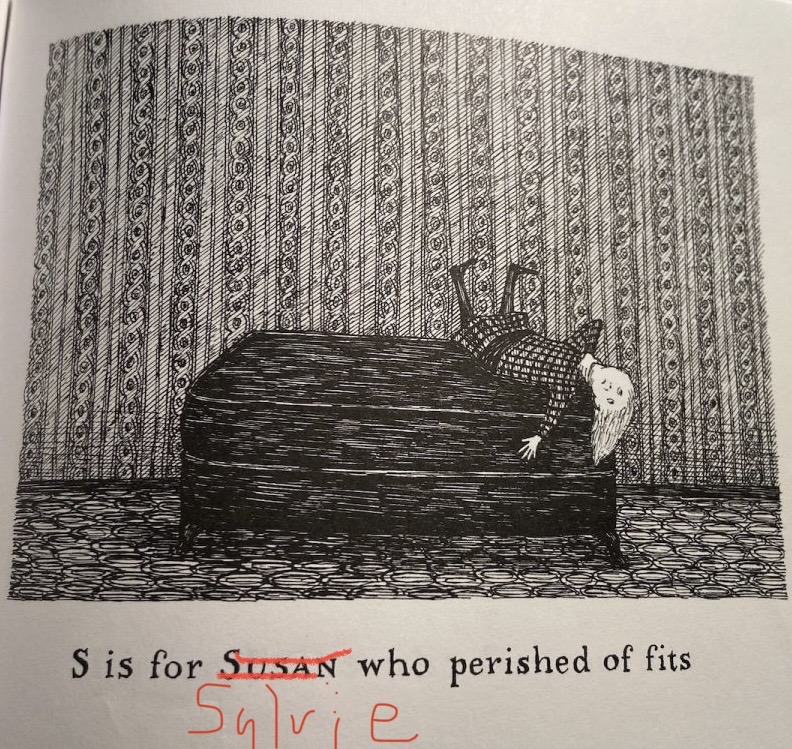
    With apologies to Edward Gorey (The Gashlycrumb Tinies: Edward Gorey’s Alphabet of Death)

    “Death comes equally to us all, and makes us all equal when it comes” – John Donne

    “Memento Mori” (Remember Death)

    I’m not saying I think about death a lot, but my best friend’s husband has nicknamed me ‘Terminal’ Sylvie.  Perhaps a dozen or so years working as a palliative care nurse has left me marginally more noir than what strict social mores decree, but working adjacent to the dying, holding space for their final insights and experience, and catching glimpses through the eyes of those close to death, is a life-altering awakening. It’s difficult to capture with mere words, but as a little old lady… in waiting, let’s just say I feel a certain readiness to share what I’ve learned from the front row seats, as close as anyone can get without taking to the stage themselves.

    Those near death understand a secret thing that we do not. Once you’ve been assigned an expiration date, you come to fully understand that there is nothing that we can truly own, nothing tangible or material that we can keep, there is no permanence, there is only the love we give away, the investment we make in others, and the ripple effect our actions have, for good or ill, is our only real legacy.  Between you and me, I’m hoping for a bit more time to invest my ‘goodwill’ stock and watch my portfolio grow, but I know that nothing is promised.  I try to stay awake to the end game and challenge myself never to overlook an opportunity for kindness.  My record is sketchy at best, I’m a work in progress, of course, but I caution you now, that treating death as a taboo topic and putting our heads in the sand is ill advised, at best.  A good death takes a little planning, and that starts with one irrefutable truth – that no matter how healthy or fit, rich, or connected (spiritually or otherwise), clever or credentialled you may be…no one is getting out of here alive.

    Let’s start with the easy stuff – a quick review of the logistics.  A few years ago, I attended a national palliative conference in Ottawa. There were a lot of very interesting and learned speakers there, but the lecture that got my complete attention was a presentation entitled ‘Getting ready to go.’  The lecturer provided some significant demographic data that suggested that the death trajectory as we currently know it, complete with nursing home beds, hospice care and access to in-hospital palliative care, may not be available to us.  That is to say, we don’t currently have the capacity to accommodate the glut of Boomers that will die in a very concentrated time period.  There is no more room at the ‘End of Days’ inn.  The lecturer advised looking for community resources as we will almost certainly be dying at home. So have a look around you…know any docs or nurses, maybe have your kids practice injecting an orange or two … just thinking out loud here.

    The lecture also included a detailed inventory of ‘good death’ questions for review.  Do your kids know your passwords? Have you got a will, a DNR, a POA (medical vs financial)? What are your thoughts on MAID?  Does you religion dictate that you suffer before death?  Do you understand that if you lose cognitive capacity, MAID is no longer an option for you? Perhaps better to consider your position sooner rather than later and more important still, to communicate your ‘last orders’ to your substitute decision maker.  You have a substitute decision maker… right? Isn’t it a kinder thing to consider your options now before your children or SDMs have to bear that burden?  As a palliative care nurse, I’m reasonably confident that I can keep you comfortable as you lay dying, but my ability to comfort or mediate the pain and sadness of your friends and families sat beside you, holding vigil through the long days or possibly weeks as you lay dying… I know no medicine strong enough for that.

    It’s important to have a think about what constitutes a meaningful life and what factors detract too much from that ideal to be tolerable for you, individually.  It’s a very personal decision.  If you’re asking me, I’m thinking I could possibly tolerate a little incontinence, I’m already acclimating to the indignities of cognitive decline (the forgotten pickleball scores, the word-finding, and could any of us LOLW get home if we didn’t have our key fobs to find our cars…just today I watched a friend open the door to an SUV that wasn’t hers…pretty funny actually, and tolerable I suppose. I’m going to go on record here and say I could, in theory at least, endure a modicum of pain (reserving the option to change my mind at any time on the pain piece…huge fan of pain management…give me the drugs – all of the drugs). However, if I was confined to hospital with no chance of returning home, or if I developed a dementia that meant I no longer recognized the people I love, then maybe a nice little hospital acquired pneumonia isn’t such a poor prognosis. Maybe comfort measures only at a certain point is the most humane treatment option.

    Talk to your kids or your appointed decision makers about what you want and, more importantly, what you don’t want.  I promise you that if I brought you to work tomorrow, even for an hour or two, you would be on the phone with your loved ones by the end of day. Think about who it is you want standing around your deathbed. Invite them to dinner, open a bottle of wine… maybe three. If possible, wait for the dessert course before you dive in to the deep end…ask about their day, tell them how much they mean to you, and as you cut into the pie, begin the difficult but essential conversation about what a ‘good death’ would look like to you. A mildly uncomfortable dessert course now, will spare your loved ones from having to make unthinkable decisions on your behalf at a time when all they’ll want to do is hold your hand, share a laugh about pie night, and find the strength to say goodbye.

    Now, to the really important bit.  It’s been my experience that those who make a happy end…those who die well, are those who live well, investing themselves in the people around them, and in whom others depend.  The best death scenes I’ve witnessed are alive with love and rife with family folklore, where stories are shared of times well spent, and laughter erupts, and perhaps some tears as loved ones share their memories from over the years.  ‘The day I met your dad…the day you were born…remember that big snowstorm…the camping trip from hell…’ or any number of Christmas poemics.  I remember a famous local watercolourist whose family met in his hospital room every day at 5…Happy hour they called it.  The wine was poured liberally, a hand-picked playlist in the background, the dulcet tones of Vera Lynn, ‘I’ll be seeing you in all the old familiar places…‘, the dying man, the guest of honour, enveloped by his chosen few, every afternoon the same bespoke soundtrack, storytelling and laughter, until the music stopped.

    All we accumulate in this life, the acquisitions… the accolades…. they mean nothing in the end.  It’s more about kindness brewed on darkest nights, and passions discovered and developed in ourselves and encouraged in those around us.  What is most important in the end, are the broken hearts we helped to mend, our fortitude, our dedication, and our prowess as a friend, and all the little beauties we cultivate in whatever sort of garden we decide to tend.  What matters most I think, as you take your last breath, is the love you gave away and the joy you helped create, in the time you were here.  It’s our only job really … to love and be kind, if we can, and I have found that those who die well, with peace and with grace, find the time to be kind despite the many burdens they face… some even in their last hours and days. I will never forget a gentleman who rang his call bell at change of shift, with no ask or agenda, only to serenade his night nurse with the most beautiful rendering of ‘Fly me to the moon’ that I will ever know. I can still hear his voice a decade later, and I pray I’ll find it in myself to sing a little song in my last hours, to know such grace.

    For me death is only a door to an unseen place, a speed bump between this world and what comes next, ‘it is the last unprinted snow‘ (Stoker). I think of it as a final adventure, a quest, a magical mystery tour. I know for many it may seem scary… the travel restrictions are untenable, you travel alone, no company, no carry on.  I think the only thing we get to take are the string of moments when we are fully awake… the Fly me to the Moon occasions of human connection, a cache of all the unspeakable beauty we are capable of conjuring … a steadfast heart, a gentle word, an earnest ear, the softest kiss.  All the love we give away is the only investment we need ever make, and the only prayer we need ever pray.  But if, like me, you’re looking to hedge your bets, to grow a little more in the time you have left, there are three little questions I like to ask now and again: am I honouring my gifts, have I learned to love true, and is the world a slightly better place, even a smidgeon, because there was you? If you can answer these questions with any degree of satisfaction, I can almost promise you a beautiful death, where a parting glass will be raised in your name and those who loved you best will stand together in the “coke machine glow” that was you and mourn the loss of your incandescant light.  In the meantime, dig out your rolling pin…it’s time to make pie.

  • On Travel and the Importance of Periodically Upending your Setting

    “A journey is a person in itself; no two are alike.  And all plans, safeguards, policing, and coercion are fruitless.  We find after years of struggle that we do not take a trip; a trip takes us.”  – John Steinbeck

    We shall not cease from exploration, and the end of all our exploring will be to arrive where we started and know the place for the first time.”  – T.S. Elliot

    Hemingway in his novel, A Moveable Feast, wrote, “Never go on trips with anyone you do not love.”  Perhaps that’s because you might be tempted to leave them en-route if you cared for them any less.  Travelling despite all the anticipated splendour and excitement, the unforgettable moments, and the memory making, can be hard graft. Navigating in unknown streets, deciphering foreign languages, walking 20000 steps a day, and surviving only on world class pastries and untested wines…these are mighty challenges indeed and not for the faint of heart, or poorly heeled as it turns out.  Little old lady in waiting to little old lady in waiting, sandals that feel like sneakers, at least pre travel, are still sandals … but honestly can you really be expected to pair Reeboks with a slip skirt after 50?

    The demands of travel and its accompanying tribulations, can test even the most tenured and enduring relationships.  I am recently arrived back on the continent from a tri city European tour with a much-loved Gen Z daughter.  As you may expect, she outwalked, out navigated, and generally out travelled me at every turn.  She slept better, she knew when to stop and insta the roses, and, maybe most importantly, she knew how to work a travel boundary, to carve out space for herself within the confines and constancy of the vacation vortex.

    The donning of air pods was my cue to retreat behind the veil of a novel where we both exhaled deeply into much needed solitide.  Alone, together, we enjoyed daily retreats from the uncensored, stress-born commentary characteristic of unconditional love. That is to say, we, at times, annoyed the “fodors” out of each other.  Still, after a few days at home, each immersed in our own self soothing rituals (Cortados, yoga, pickleball, Netflix), I can, after less than a week in-country, regard our time away as a perfectly sublime excursion with my favourite girl in the world. I have the pictures to prove it. But this trip has got me thinking about the true value of travel and in particular, the part that comes home with us… the part we get to keep.

    Jon Kabot Zinn in his much lauded book, “Wherever you go, there you are,” suggests that no matter how many miles from home you travel, you can’t escape yourself.  Kabot Zinn goes on to say some very powerful things about mindfulness and I can’t recommend his work highly enough, but as to his initial premise … I have some notes. I think travel changes you in significant and lasting ways.  Free from the hamster wheel of our daily lives and the safety of our usual routines, we are forced to navigate differently, to tolerate the stress of unknowing in a foreign landscape, and, if we’re lucky, we may begin a process of unbecoming.  Without the mirror of our usual relationships and roles, who are we…without the reflecting pool of our everyday lives?   Answer…whoever we want to be.

     As a little old lady in waiting, travel is a tremendously liberating experience, far more intoxicating than the constant stream of eye candy and the sugar coating of clean rooms and meals made by another’s hands.  There was wine on occasion, of course, but that wasn’t the real elixir.  Free of the demands of everyday life, walking and watching our principle occupation, my mind was let loose to travel too, with a renewed intellectual energy reminiscent of years long past,when I had only my own path to consider. In Budapest I stood near “the shoes” on the Danube and felt a little disoriented by my freedom.  I was  steeping tea in a strange teapot, brewing a history of ideas that belonged to a much younger, more politicized version of myself. In Vienna, I was bedazzled by beauty at every platz and struck by the metaphorical significance of the German aphorism, “Auch die pause gehort zur musik” (the rest, or silence also belongs to the music). In Prague, the city of Kafka and Kundera, I felt immersed in a dark story book setting and began narrating a conversation inside myself that is still ongoing.

    I think it was David Mitchell in Cloud Atlas, who wrote, “travel far enough, you meet yourself.”  I couldn’t agree more.  Travel never goes completely as expected.  I’m referring here to the missed flights (never… ever book impossible to get concert tickets  within 48 hours of touch down); the too packed itinerary (trying to do everything ensures you’ll enjoy nothing); the high season, overcrowded attractions ( Mona Lisa mosh pit in June); and the disasterous over-hyped venues( read the reviews my friends – the Szechyny  spa in Budapest looks like a refreshing break from the castles and cafes, but in truth it’s a 3rd rate, dirty aquatic center whose thermal pools are tepid at best). The point is the seasoned traveller knows how to wash off the detritus of a disappointing day  with a good pinot grigio and the promise to buy yourself a small objet d’art to remember the day ironically. 

    The planning and negotiation of a journey is a labour of love, an entity all it’s own, but once you land at your destination, all plans are fluid and so must your approach and acceptance of “what is” be,  because fretting, bemoaning and catastrophizing about what a journey “is not”, is  a waste of your travel budget, literally and figuratively.  Maybe if you’re say…a highly structured, control-loving mom, a trip hiccup is an invitation to float (2025 aspirational word of the year) to be frivolous or dare I say, even selfish.  Maybe a daughter takes the helm and suddenly you’re transported to a very pink Viennese café that sells an ice cream called Kardinalschnitten, that apparently corresponds to the colours of the Catholic Church and tastes like God herself is inside.  Before you know it you’re having a serious conversation about God’s existence and what a poor chalice language is when it comes to discussing she who has no name.  Or maybe a highly anticipated classical concert enjoyed on tortuous church pews gives way to a meaningful discussion of uncomfortable life choices, the importance of maintaining a relationship with yourself, and the longing for a space of one’s own; a beautiful setting for your baby to announce her decision to leave home. 

    The point is that without the usual trappings of life, the social cues, the roles and masks we all wear, we are free to reinvent or re-imagine ourselves.  We meet ourselves on distant shores and it’s the best kind of homecoming.  Travel changes you, if you let it.  You are not the same person as when you left, maybe only in small ways but it’s there, this tiny voice inside; the woman who tasted God in an ice cream and decided to cherish herself like someone she loves, or the girl who bought a new watch in Vienna, and knew it was time to leave home.

    The Dalai Lama suggests “Once a year, go someplace you’ve never been before.”  He doesn’t say why but I believe he is prompting us to open our minds and experience all things with new eyes. St Augustine wrote that “the world is a book, and that those who do not travel read only one page.” I think he’s right.  I have been an armchair traveller all my life but have only found opportunity to travel in the real world in the last decade.  It is a different kind of education, a remembrance of who we are, an understanding of our own acquired lens on the world.  Anais Nin knew a secret thing.  She said “we do not see things as they are, we see them as we are.”  I read this truth in a book long ago, but I understand it best because of my travels.  I have had many occasions to remove my glasses in transit, en-route, in unfamiliar terrain, to see things with different eyes.  It’s knowing that our glasses are there at all that has the power to transform, to make all that we left at home, new again, and that, I guess, is the real enchantment of travel…a reawakening. It’s the part we get to keep, long after the unpacking.