Author: Sylvie Fitzgerald

  • Death, Dying and other Unmentionables

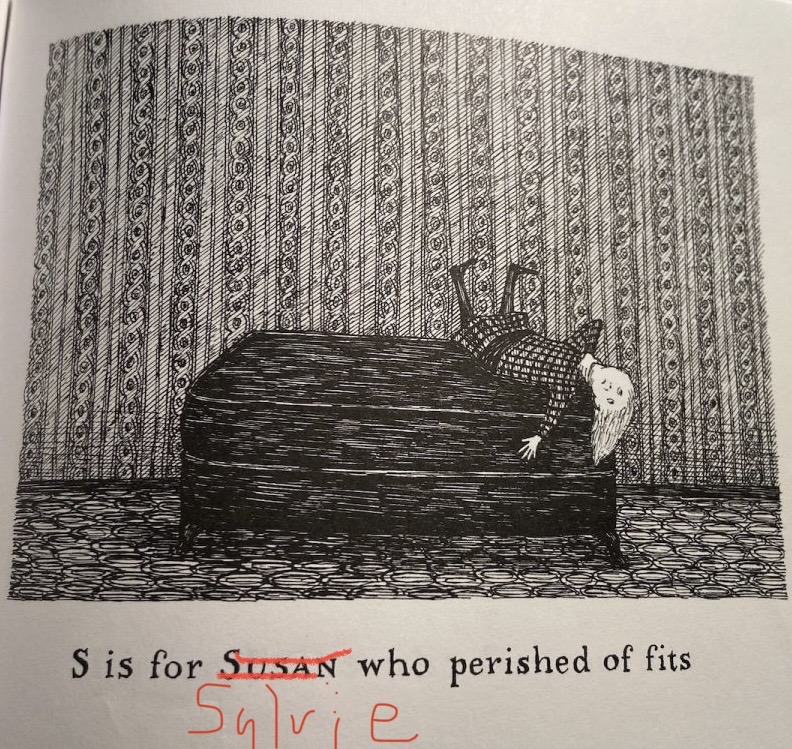
    With apologies to Edward Gorey (The Gashlycrumb Tinies: Edward Gorey’s Alphabet of Death)

    “Death comes equally to us all, and makes us all equal when it comes” – John Donne

    “Memento Mori” (Remember Death)

    I’m not saying I think about death a lot, but my best friend’s husband has nicknamed me ‘Terminal’ Sylvie.  Perhaps a dozen or so years working as a palliative care nurse has left me marginally more noir than what strict social mores decree, but working adjacent to the dying, holding space for their final insights and experience, and catching glimpses through the eyes of those close to death, is a life-altering awakening. It’s difficult to capture with mere words, but as a little old lady… in waiting, let’s just say I feel a certain readiness to share what I’ve learned from the front row seats, as close as anyone can get without taking to the stage themselves.

    Those near death understand a secret thing that we do not. Once you’ve been assigned an expiration date, you come to fully understand that there is nothing that we can truly own, nothing tangible or material that we can keep, there is no permanence, there is only the love we give away, the investment we make in others, and the ripple effect our actions have, for good or ill, is our only real legacy.  Between you and me, I’m hoping for a bit more time to invest my ‘goodwill’ stock and watch my portfolio grow, but I know that nothing is promised.  I try to stay awake to the end game and challenge myself never to overlook an opportunity for kindness.  My record is sketchy at best, I’m a work in progress, of course, but I caution you now, that treating death as a taboo topic and putting our heads in the sand is ill advised, at best.  A good death takes a little planning, and that starts with one irrefutable truth – that no matter how healthy or fit, rich, or connected (spiritually or otherwise), clever or credentialled you may be…no one is getting out of here alive.

    Let’s start with the easy stuff – a quick review of the logistics.  A few years ago, I attended a national palliative conference in Ottawa. There were a lot of very interesting and learned speakers there, but the lecture that got my complete attention was a presentation entitled ‘Getting ready to go.’  The lecturer provided some significant demographic data that suggested that the death trajectory as we currently know it, complete with nursing home beds, hospice care and access to in-hospital palliative care, may not be available to us.  That is to say, we don’t currently have the capacity to accommodate the glut of Boomers that will die in a very concentrated time period.  There is no more room at the ‘End of Days’ inn.  The lecturer advised looking for community resources as we will almost certainly be dying at home. So have a look around you…know any docs or nurses, maybe have your kids practice injecting an orange or two … just thinking out loud here.

    The lecture also included a detailed inventory of ‘good death’ questions for review.  Do your kids know your passwords? Have you got a will, a DNR, a POA (medical vs financial)? What are your thoughts on MAID?  Does you religion dictate that you suffer before death?  Do you understand that if you lose cognitive capacity, MAID is no longer an option for you? Perhaps better to consider your position sooner rather than later and more important still, to communicate your ‘last orders’ to your substitute decision maker.  You have a substitute decision maker… right? Isn’t it a kinder thing to consider your options now before your children or SDMs have to bear that burden?  As a palliative care nurse, I’m reasonably confident that I can keep you comfortable as you lay dying, but my ability to comfort or mediate the pain and sadness of your friends and families sat beside you, holding vigil through the long days or possibly weeks as you lay dying… I know no medicine strong enough for that.

    It’s important to have a think about what constitutes a meaningful life and what factors detract too much from that ideal to be tolerable for you, individually.  It’s a very personal decision.  If you’re asking me, I’m thinking I could possibly tolerate a little incontinence, I’m already acclimating to the indignities of cognitive decline (the forgotten pickleball scores, the word-finding, and could any of us LOLW get home if we didn’t have our key fobs to find our cars…just today I watched a friend open the door to an SUV that wasn’t hers…pretty funny actually, and tolerable I suppose. I’m going to go on record here and say I could, in theory at least, endure a modicum of pain (reserving the option to change my mind at any time on the pain piece…huge fan of pain management…give me the drugs – all of the drugs). However, if I was confined to hospital with no chance of returning home, or if I developed a dementia that meant I no longer recognized the people I love, then maybe a nice little hospital acquired pneumonia isn’t such a poor prognosis. Maybe comfort measures only at a certain point is the most humane treatment option.

    Talk to your kids or your appointed decision makers about what you want and, more importantly, what you don’t want.  I promise you that if I brought you to work tomorrow, even for an hour or two, you would be on the phone with your loved ones by the end of day. Think about who it is you want standing around your deathbed. Invite them to dinner, open a bottle of wine… maybe three. If possible, wait for the dessert course before you dive in to the deep end…ask about their day, tell them how much they mean to you, and as you cut into the pie, begin the difficult but essential conversation about what a ‘good death’ would look like to you. A mildly uncomfortable dessert course now, will spare your loved ones from having to make unthinkable decisions on your behalf at a time when all they’ll want to do is hold your hand, share a laugh about pie night, and find the strength to say goodbye.

    Now, to the really important bit.  It’s been my experience that those who make a happy end…those who die well, are those who live well, investing themselves in the people around them, and in whom others depend.  The best death scenes I’ve witnessed are alive with love and rife with family folklore, where stories are shared of times well spent, and laughter erupts, and perhaps some tears as loved ones share their memories from over the years.  ‘The day I met your dad…the day you were born…remember that big snowstorm…the camping trip from hell…’ or any number of Christmas poemics.  I remember a famous local watercolourist whose family met in his hospital room every day at 5…Happy hour they called it.  The wine was poured liberally, a hand-picked playlist in the background, the dulcet tones of Vera Lynn, ‘I’ll be seeing you in all the old familiar places…‘, the dying man, the guest of honour, enveloped by his chosen few, every afternoon the same bespoke soundtrack, storytelling and laughter, until the music stopped.

    All we accumulate in this life, the acquisitions… the accolades…. they mean nothing in the end.  It’s more about kindness brewed on darkest nights, and passions discovered and developed in ourselves and encouraged in those around us.  What is most important in the end, are the broken hearts we helped to mend, our fortitude, our dedication, and our prowess as a friend, and all the little beauties we cultivate in whatever sort of garden we decide to tend.  What matters most I think, as you take your last breath, is the love you gave away and the joy you helped create, in the time you were here.  It’s our only job really … to love and be kind, if we can, and I have found that those who die well, with peace and with grace, find the time to be kind despite the many burdens they face… some even in their last hours and days. I will never forget a gentleman who rang his call bell at change of shift, with no ask or agenda, only to serenade his night nurse with the most beautiful rendering of ‘Fly me to the moon’ that I will ever know. I can still hear his voice a decade later, and I pray I’ll find it in myself to sing a little song in my last hours, to know such grace.

    For me death is only a door to an unseen place, a speed bump between this world and what comes next, ‘it is the last unprinted snow‘ (Stoker). I think of it as a final adventure, a quest, a magical mystery tour. I know for many it may seem scary… the travel restrictions are untenable, you travel alone, no company, no carry on.  I think the only thing we get to take are the string of moments when we are fully awake… the Fly me to the Moon occasions of human connection, a cache of all the unspeakable beauty we are capable of conjuring … a steadfast heart, a gentle word, an earnest ear, the softest kiss.  All the love we give away is the only investment we need ever make, and the only prayer we need ever pray.  But if, like me, you’re looking to hedge your bets, to grow a little more in the time you have left, there are three little questions I like to ask now and again: am I honouring my gifts, have I learned to love true, and is the world a slightly better place, even a smidgeon, because there was you? If you can answer these questions with any degree of satisfaction, I can almost promise you a beautiful death, where a parting glass will be raised in your name and those who loved you best will stand together in the “coke machine glow” that was you and mourn the loss of your incandescant light.  In the meantime, dig out your rolling pin…it’s time to make pie.
  • In Conversation with (Iwona) Maria Kubacki

    I first met Maria Kubacki when we were still teenagers.  She was a friend of my brother’s… think artsy, intellectual, an outsider, by choice or design. Recently arrived home to Saint John from a Toronto private school, she was the iconic, underground campus ‘it’ girl, a ‘Lit chick’- all cat’s eye eyeliner, black tights, and arthouse lipstick.  She was clever and cool, straight out of a Sally Rooney novel, this quixotic mix of edge and vulnerability that was foreign and familiar all at once.  Her style acumen was just the pretty wing man for her real talent, an unpretentious academic mind, a well-spoken confidence, and a reverence for the written word.

    Fast forward 40 years, Maria, a fellow little old lady in waiting (possibly in denial) forwarded her initial remarks with a disclaimer: “I’m a little embarrassed and intimidated by this. I don’t want people to think, ‘who does she think she is?’ I have no particular accomplishments. I’m just answering these questions as a fellow little old lady in waiting who is in the thick of middle age and thinking about how to make the most of the last third of life.” This same little old lady in waiting, earned a Master of Arts degree in English Literature and has worked as a book reviewer and freelance writer as well as an associate editor, and editor.  Currently she lives and works in Ottawa as a communications manager for the federal government. She took up writing fiction a few years ago and has published her short stories.  She is married to a lovely man named Ken and has two twenty-something children, Jane, and Mike. She sidesteps the 7-sentence limit of the first interview question so adeptly, using a series of semi-colons, dashes, and ellipses, that I had to allow it. Maria Kubacki is still very clever…and cool, maybe even more so as a little old lady…in waiting.

    Tell me your life story in seven sentences or less? 

    I was born in Warsaw, came to Canada when I was 4 ½, lived in Quebec City briefly and grew up in Bathurst in the 70s, where we were one of the few immigrant families, but it was pretty idyllic …double-dutch in the street with my friends, summers at Youghall Beach. I went to high school at a girls’ boarding school in Toronto where I was more focused on smoking, drinking and New Wave music and fashion than on my education, and where I started going by my middle name, Maria, instead of Iwona (my actual first name, pronounced Ee-vohn-ah and mangled by nearly everyone because of the “w”), or Yvonne (what everyone called me in Bathurst because it’s the French version of Iwona) – it was fairly common back then for immigrants to change their names to something easier for Canadians to pronounce, but it was weird and embarrassing to me to have all these names, and sometimes still is, as my parents, Polish family and friends still call me Iwona (or Iwcia, the diminutive, pronounced Eef-cha)…Bathurst friends and some cousins call me Yvonne, and everyone else calls me Maria.

    I never knew what I wanted to be when I grew up, but I loved reading – my parents were and still are big readers so we always had lots of books in the house, and also I learned English the summer I turned 9 from a British family from the Isle of Man who had all kinds of children’s classics all over their house, the Narnia series and that sort of thing – so I ended up getting a BA and then MA in English at UNB.

    I was quite lost in my twenties and dragged my MA on for many more years than I care to admit, but during that time I started doing freelance writing as a way to earn a bit of money and avoid my thesis – art reviews for a magazine called Arts Atlantic, and book reviews for the Telegraph Journal, which eventually led to a job as associate editor and then editor of the New Brunswick Reader, the Telegraph’s weekend magazine.

    I got married and had my two kids in Saint John before moving to Ottawa where we have lived for 22 years and where I wrote for the Ottawa Citizen and worked as a writer/editor at what was then Canwest News service (now Postmedia).

    For the last 16 years I have been working as a communications manager for the federal government and recently I started writing and publishing fiction, which I had never even thought about doing until I turned 50.

    What is the best thing about getting older?

    People always say things like not caring what others think anymore, or not sweating the small stuff. Sadly, I still sweat the small, medium, and large stuff – I sweat all of it. I haven’t yet reached the part of getting older where you’re relaxed and just flowing and enjoying life. I’m still in the thick of it – middle age, work, responsibilities. I think the “best thing about getting older” hasn’t come yet, or maybe I’m just doing it all wrong.

    What is the worst thing about getting older?

    Becoming set in your ways and more reluctant to try new things, acting and thinking like you are even older than you are. You’re drunk and high a lot more when you’re young, maybe that’s why you’re more open to new experiences then.  Children are like that naturally…they’ll be friends with anyone, they’ll try new things, and as we age, we tend to stick to what’s familiar, what we know we will like, people like us etc. Our world can get smaller and smaller.

    If you could retain or retrieve one quality from your youth, what would it be?

    Being open to life, people, and experiences.

    What’s the most important lesson you’ve learned so far?

    Children and dogs have it all figured out – be in the moment, and enjoy every little thing, every day. Our beloved golden doodle, Tippy, who we had to put down a few years ago, was still chasing rabbits, making new friends, and wagging her tail the night she died.

    Do you have a favourite quote?

    Does anyone actually have a favourite quote or do they just Google “famous quotes” when asked? I don’t have one off the top of my head, but whenever I see one from the Stoics, it resonates – like the Marcus Aurelius one at the top of your blog, which I love and need to meditate on every day, because I don’t think I am living my life this way now: “Think of yourself as dead. You have lived your life. Now, take what’s left and live it properly.”  I have lived a pretty cautious, small life. My anxiety, a lifelong affliction, has always held me back in life, even when I was younger. I would like to become a more fearless or at least less fearful person. Do more, see more, travel more. One of the reasons that it’s fun to read and write is that we all only have one life to live, and we have to make choices, and for some of us fear holds us back, but through writing and reading we can vicariously live many lives. 

    Do you have a favourite word?

    ‘Actually‘ – with index finger held up, because I’m a bit of a know-it-all, as my family and friends will tell you. One anecdote: on a family trip to Florida we took a drive through a ritzy area in St. Petersburg where there were big mansions…so we’re driving around  and all having a nice time, and we drive by this house that has these ornate pillars and my sister-in-law says ‘oh look, there are statues of dolphins on them’ and I was trying to fight the reflex and telling myself, ‘don’t do it’  and then it just came out, ‘Actually, I think they’re manatees.’ Everyone just rolled their eyes at me but they actually were manatees! It’s become part of the family narrative. 

    Describe your perfect day.

    Any day when I’m on a beach anywhere, in almost any weather, or just somewhere near the ocean or near water. It could be Venice, or Seven Mile Beach in Grand Cayman, or Bar Harbor, Maine. Or Brackley Beach in PEI, Sandbanks Provincial Park, Saints Rest in Saint John.  I think it connects back to happy memories of growing up in the Maritimes, spending a lot of time at Youghall Beach in Bathurst every summer throughout childhood and my teen years, and then living in Saint John for many years going to places like Cape Spencer, the Irving Nature Park, St. Martin’s.  I guess to me water also feels very open to possibility.  I think I like imagining what’s on the other side of the ocean. I also love the feeling of being on the water, I love kayaking… it’s just very freeing. 

    If you could have tea with anyone, real or fictional, dead or alive, who would it be and what would you talk about?

    I know people often say Jane Austen, Shakespeare, or Churchill but I can read them, no need to have tea with them. I love Jane Austen, but I think she would be really catty and judgmental in real life – I would be afraid of her. Maybe hanging out with Churchill while he sat around in his pink satin undies and robe while drinking and trying to figure out how to defeat Hitler might have been cool. But I think what I would really like is to have tea with both my grandmothers, although separately. I would ask them about their lives in Poland. My mother’s mother had a farm outside Warsaw and raised 5 children during the Second World War. She was not educated but was very smart, wise, funny, kind, and resourceful. She was milking the cows at like 4 am, made all the kids’ clothes by hand…during the war, German soldiers took over their farm and the kids all had scarlet fever as well …and somehow, she managed to keep everyone alive. And found time to make beautiful hand-embroidered tablecloths.

    My father’s mother was very ahead of her time.  She went to medical school in the 1920s when there was a “numerus clausus” – a quota that only allowed 10 % of the students to be women, and she was smart and tough enough to be one of the 10%. She did a PhD and was a specialist in internal medicine. She also loved to travel and trying new foods and was sporty and adventurous – she would rent scooters for her, my dad and his brother and they would all go adventuring together.

    Tell me three things that bring you joy.

    My family and friends. Walking/hiking/kayaking. Travelling almost anywhere, whether it’s a day trip near Ottawa, a road trip to New York or New England, or Europe. I’m going to cheat and list way more things because many things bring me joy. Going to museums, big or small, almost anywhere. Cappuccinos and spritzes. Chocolate. Music. Going to movies at the Bytowne, our local rep cinema. Conversations about life with my kids, Jane, and Mike. Family dinners with the kids and my parents. Rewatching favourite movies and TV shows with my husband, Ken – Remains of the Day being the movie we rewatch most often, because it’s perfect in almost every way – from the writing and the acting to the period costumes and interiors and the incredibly sad but beautiful score.  Ken and I also like making up our own words to songs and making ourselves laugh. Sometimes we also meow songs – we don’t remember why we started doing that, but I think it was when our kids were little, but anyway it makes us laugh. It’s not possible to list just 3 things.

    Name a guilty pleasure.

    Taking a day off just for myself to do whatever I want. Or years ago, when my kids were little, Ken and I would sometimes take an afternoon off work to go to a movie just the two of us.

    Do you believe in life after death? What does it look like?

    I don’t really think about it. It’s probably just oblivion – we probably just get reabsorbed into whatever the universe is made of…ashes to ashes, dust to dust. But if there was some kind of life after death, it would be nice if it were an eternal sleep where we dream forever and get to be with everyone we loved and experience everything we ever wanted to but did not get to experience in life. In this eternal dreamworld I hope I get to fly, and look down over the earth, like Google Street view, but better.

    What would you like your eulogy to say?

    I guess my kids would be writing my eulogy. I hope they say I was a decent human being who taught them to be decent people. I think they might say that I gave unsolicited advice very freely, but I hope they feel that sometimes it was good advice. I hope they also remember our Amazing Race-style family trips where I made them see and do everything, even if we were exhausted and our feet were sore from walking 20,000 steps a day.

  • On the Merits of Becoming a Maker

    “Every child is an artist.  The problem is how to remain an artist once he grows up.” – Pablo Picasso

    “When my daughter was about seven years old, she asked me what I did at work.  I told her that I worked at the college – that my job was to teach people how to draw.  She stared back at me, incredulous, and said, ‘You mean they forgot?’”     – Howard Ikemoto

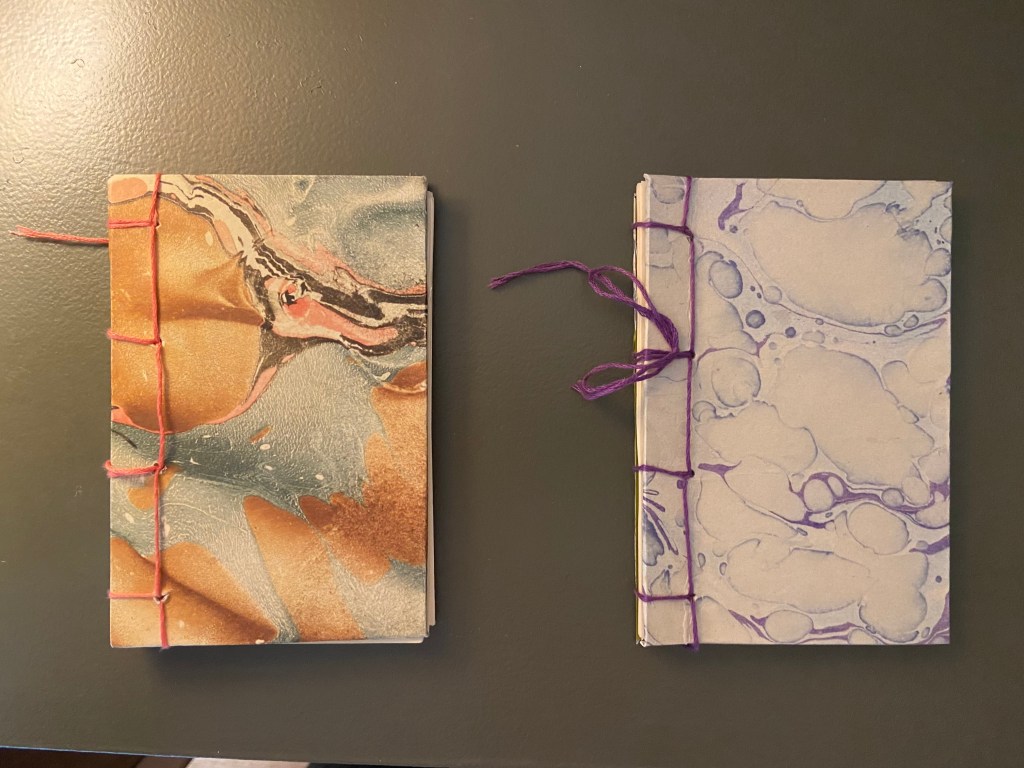
    On the recent occasion of my 59th birthday I signed myself up for a workshop on the ancient art of Japanese book binding. I’m not what you would call ‘crafty’, at least not in that sense of the word… a maker of things. I’ve never successfully knit a whole sock, my Christmas decorations come from Canadian Tire, and my sour dough starter-baby died of neglect…twice. I thought it might be the right time to reawaken my inner maker and so, accompanied by my daughter, an artist with a defined skill set, we entered a beautiful old heritage building, the library of my youth, and found seats on the second floor, which once housed the reference section. (For my Zoomers, I refer here to a time before almost every academic question could be answered with a thumb scroll on your smart phone, from the comfort of your couch.)

    We little old ladies in waiting may not have had to walk 10 miles to school through drifts of snow as tall as we were (Boomer narrative), but we did have to leave our homes to look for the answers. We juggled 50-pound encyclopaedias searching for the illusive truth or some reasonable facsimile.  We took notes in an ancient script called cursive.  It was the dark ages kids, before the information age and the internet, before group work started trending and you could pawn the research part off on the kid who would rather disembowel himself than speak in public. 

    But I digress…awkward segue back to the book binding workshop, the setting for a timely and reflective lesson in humility and a powerful endorsement of the restorative power of making art. We were provided with all the necessary materials including what looked like a small ice pick or a long sharp little doorknob. I believe the proper term is an awl, and we were advised not to use it if we weren’t confidant in handling the tool.  ‘Look for a helper’ the instructor advised, making direct eye contact with me as she did so.  I tried not to take it personally, but it did take a little of the glitter off my crafting confidence. I’m happy to report that I wielded that awl like a card-carrying Cape Breton craft guild member.  No blood was lost, and at the end of the day, my paper was pierced to a standard capable of being assembled in a perfectly adequate journal.

    There were a few challenges of course. The eye of my sewing needle was too small to see, my thread refused to cooperate, I may have been overzealous with the glue, and at one point I fell so far behind in the binding instruction I was forced to go freestyle.  I looked over at my daughter for clarification but, after accurately assessing the situation, she shook her head and whispered “I can’t help you” with a smug little art-savvy smile on her face.  I sensed some residual anger about wasting a high UV summer afternoon in musty smelling rooms. There was definitely a mean-girl twinkle in her eye as she effortlessly wove her journal together, her hands adept to any artistic enterprise.  In the end, the teacher took pity on me and salvaged my journal.  I was… accommodated.  It was my birthday after all, and I wasn’t leaving without a finished product.

    A few hours later, sitting by the sea with my bestie, a very successful artist herself, attempting to salvage a little birthday esprit with a few pre-dinner cocktails (code name beach walk), I began to unpack the experience and consider the merits of engaging in art for its own sake, process over product.  How did it feel to create something ? I hand crafted a beautiful journal, with complete artistic control over design and construction…well, maybe not complete control… but every choice, every small flaw or mistake, was my own. It felt…nourishing, making something from scratch, even with unpracticed, non-nimble hands. Cultivating your inner maker feels a lot like play. It’s like leaving your mind for a time and living only in your hands. You spend a few hours purposefully, intentionally, unplugged and unreachable, and when playtime is over you have this lovely little objet d’art, perfectly imperfect, bespoke, hand crafted, and all by you, a maker in the making. 

    In today’s highly specialized world, unless you work as an artist or maybe an entrepreneur, we have, as individuals, lost touch with what it feels like to conceive, design and produce a finished product completely on our own.  Most of us are cogs in the machinery of industry.  We contort ourselves to fit the spaces defined by the job market.  We make ourselves small to succeed as cogs and move up the ladder to coveted cog spots, perhaps with a corner cog office, but in the end, unless you are designing your own work and workday, whether your uniform is a set of scrubs, a pair of overalls, or a thousand-dollar suit, it still says cog in the small print of your contract.

    In Ancient Greek mythology, Procrustes was a thief who offered travellers a bed for the night and then stretched those too short, or cut off the limbs of those too long, to make them fit the bed’s dimensions.  In many ways I feel like I’ve been sleeping on a Procrustean bed my entire working life, perhaps earlier if we consider the public school system as pre-employment prep, conditioning children to conform to an unnatural or arbitrary standard, “a veal-fattening pen” (Copeland) for the cog culture.

    As a quasi-retired, little old lady in waiting, I’m more than ready to embrace the artisan in me. I’m interested in work of my own choosing, designed, and created entirely by me. While I may never be a master book binder, I’m not ready to abandon the maker mindset quite yet. I think a fiber art class in the Fall might suit, or perhaps a creative writing assignment to chip away the icy cold months of the long, reclusive Canadian winter.  I remember enjoying drawing and painting as a younger woman and I may still have all the tools needed to make a cosy east-cost hooked rug, art to keep out the cold. 

    The experience of engaging in making art is tremendously satisfying, especially if your inner maker has been starved to the point of mummification.   I propose making artist dates with yourself: writing morning pages, evenings of experimental cooking, or maybe even acquiring a knitted sock mentor.  Treat the artist within like an honoured guest who inspires and delights and brings out your highest self.   What I’m suggesting is pursuing a path of gentle exploration to set you inner maker free.  Above all, and this is crucially important, never… ever allow your left-brain critic to cut its razor sharp teeth on your vulnerable right-brain art, with its practiced vivisectional rigor. 

    Making art is a clarifying experience.  It opens us and illuminates everything we are inside. The art we produce as little old ladies in waiting may never pay the electric bill, but becoming a maker is an investment in yourself that pays incalculable returns. For me, good art elicits emotion and deals with questions of meaning.  Likely too high a bar for evaluating one’s own artwork.  I’m pretty sure none of my experiments in becoming a maker will ever garner any critical praise. What I do know is that consummating the creative impulse is an immensely pleasurable and stirring experience and one this maker in the making plans to chase habitually and unreservedly.

  • The Reading Room – Issue 2

    “If a book is well written I always find it too short.”

    Jane Austen

    A book review is a highly subjective exercise and so, in the interest of full disclosure, as a Little Old Lady in Waiting, I know you won’t be surprised when I tell you that I like little old lady subjects and settings. I like my people past their prime and living by the sea or someplace equally sublime. I like subtle, nuanced, tender narratives with a philosophical bent and characters who feel like friends I’d like to know. People who have lost important relationships and parts of themselves, and know its possible to keep on existing…people who understand that ghosts are real…people who have paid a price for their place in the story. Layer in fresh, visceral language that routinely makes you stop to reread or recalibrate your breathing and I’ll stay with you untill the very end, and when it’s over, I’ll take a little piece of you with me.

    The rating system I assign is roughly as follows:

    10/10 – The illusive unicorn. “Your heart understood mine”

    9/10 – I loved this book, it changed me in some way

    8/10 – Great read. I’m still thinking about it

    7/10 – A good read. I’d pass it to a friend

    6/10 – Adequate I suppose

    5/10 – Flawed in some subtle but no less dissapointing way

    4/10 – Major story flaw (cardboard characters, poor pace, sledghammer story-craft)

    3/10 – The author has failed the reader, the editor should be escorted from the building

    2/10 – No… just no

    1/10 – I will never get those hours back


    I have long admired the personal and professional life of Agatha Christie. I’m a fan. I’ll read anything about her work and career and so when I discovered The Christie Affair in a used book store it was a little like finding a thrift-store cashmere cardi in a colour that suits. The Christie Affair is Nina de Gramont’s first novel and takes as its subject the eleven days that Christie went missing and the marital discord that immediately proceeds it. In the novel, Chistie’s husband, Archie, is conducting an affair with a younger, Irish woman named Nan O’Dea who reads like Saoirse Ronan from the film Brooklyn , a clever compassionate character that carries the story in many ways, and has a compelling back story of her own. The book becomes a multi layered mystery to be solved, complete with a war weary police detective, a tragic love story, and a satisfying tale of revenge. I loved the characters, the post war UK setting and the glimpse into Christie’s private world. 7/10

    There was a lot of buzz about this book on social media and a sequel already in print, so I picked up a copy of this novella for a vacation read. It’s marketed as a transformation story of a young woman who drops out of her life and spends a year reading in the cramped upstairs quarters of a family run second-hand bookstore. A perfect story premise for a bookish woman of any age. Set in Tokyo, the heroine of the book is a love spurned 25 year old named Takako, a non-reader, immersed in a hip deep depression post a humiliating break up, when she accepts the invitation of her eccentric uncle to live and work at the Morisaki bookstore. This is Yagisawa’s debut novel and it did not deliver on any level. The characters are unsympathetic, the story line is non existent, even the theme, ostensibly the joy of reading as a transformative experience is poorly executed. The most generous thing I could write is that any merit or charm Yagisawa may have conjured in his original work is wholly lost in translation. 1/10

    Peggy is the fictionalized portrait of Peggy Guggenheim, American heiress, art collector and feminist icon who begins life as a New York debutant and becames embroiled in the bohemian Paris of the 1920s, dallying with the likes of James Joyce, Emma Goldman and Samual Beckett. Peggy, begun by Rebecca Godfrey who passed away in 2022, was finished by the author’s good friend, Leslie Jamison and in some ways the story does feel like two separate books. The heiress is portrayed as a poor little rich girl who suffers the loss of a beloved father who goes down with the Titanic, a dear sister who dies in childbirth, and a son lost via a dissolved marriage with an abusive, parasitic poet. She is snubbed by an anti-semetic society as a Jewess, and ridiculed in the boheniam art world as little more than “a wallet.’ Despite her millions she has the reader’s sympathy as an intelligent, philanthropic outsider with a keen understanding and appreciation of the post war modern art movement. This fictional biography is an interesting look into the elite world of early 20th Century New York aristocracy as well as post WWI Paris and the intellectuals who mingled there and became known as the lost generation. 6/10

    Depressed mid 40’s academic, Phoebe Stone, distraught after her husband leaves her for another woman, her career stalling, her geriatric cat found dead at home, decides to treat herself to an expensive evening gown and a posh holdiay at a decadent hotel, all with the intention of killing herself. A dark tale indeed, except Espach’s voice is so intelligent and noir comic that the reader tags along despite the downer of our heroine’s final destination. Enter the wedding people who descend on the hotel as the only other guests and, despite their annoying, narcissistic and waspish ways, they ineveitable disarm, distract, and detour our hero’s journey. The setting, Newport, Rhode Island, is a charming backdrop to Espach’s first novel, but the real winner is her smart heroine whose thoughts, suicidal and otherwise are always authentic and relatable and rife with literary references that appeal to readers who are fans of the Brontes and Virginia Woolff. A great book to pass to a friend with a Litt degree and an appetite for a dark night of the soul. 7/10

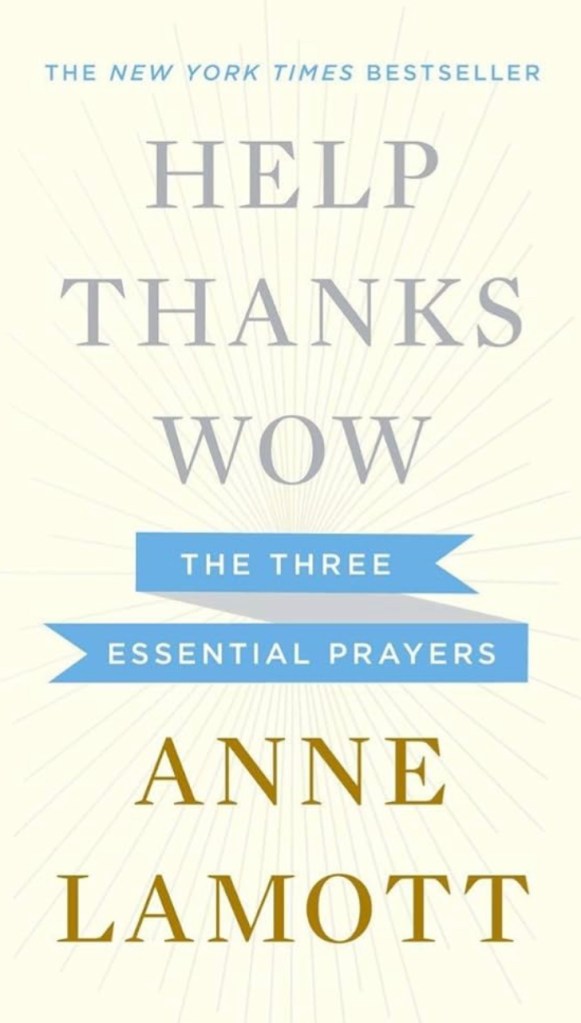
    Anne Lamott’s book, Help Thanks Wow is a call to prayer as well as a prayer tutorial for the uninitiated and the out of touch. It is a book about gratitude and finding perspective and it is an invitation to cultivate a state of wonderment. Lamott’s simple, comical and self deprecating style could charm even the most determinined non-believer. She keeps it simple, three one word prayers to recite, to hold fast through the tough times, and to stay mindful and intentional through the mundane everyday; to look for the good, and experience all the beauty that lies in wait for us if only we have the eyes to see it. I found Lamott’s style and non-denominational approach inviting and pragmatic. She didnt alienate her readers with old fashioned God talk, “asking an invisible old man to intervene.” She understands there are no words for the ‘broken hearts of people losing people’; there is no fixing the unfixable. But prayer as a spiritual experience, a one word incantation that helps you become more generous, more patient, more kind to yourself and others, there surely can be no harm in such a practice. I loved Lamott’s comical, tender, and real life prayer book, made for misfit souls of all ages. 7/10

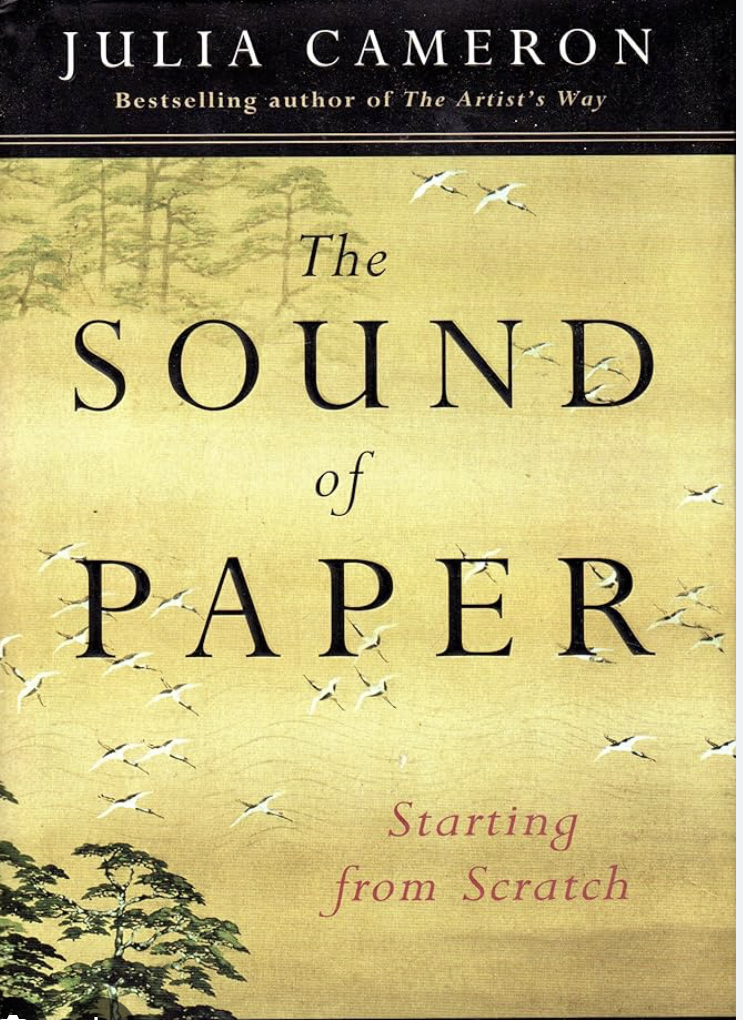
    Julia Cameron, best known for her book , The Artist’s Way, delivers a comparable artistic toolbox for writers who work with story craft, routinely tackling the often intimidating blank page to create meaning and art. The Sound of Paper is essentially a workbook with a series of exercises and disciplines designed to open the creative narrative approach, so often stymied by a writers own critical voice, that values product over process and atacks fledgling writing projects before they’ve had a chance to mature. Cameron’s writing drills are designed to explore and develop your authentic voice, to place emphasis away from a perfect script, with a series of self care indulgences that cultivate a safe space for creative work, and structured play projects designed to reignite a love of writing. Daily rituals include walking, and morning pages, and being open to the idea of working poorly, breaking free of the ego’s need to be brilliant, and instead contenting ourselves to being functioning wordsmiths, with the freedom to embrace new forms. This is a perfect gift for any writer looking to learn or advance her craft. 8/10

    Emilia Hart’s Weyward, chronicles the lives of three Weyward witches, separated by generations but related by blood; the three principle characters include , Altha, on trial for witchcraft in the 16th Century, Violet, at the mercy of an opportunistic father and an unscrupulous suiter in the 1940s, and Kate, the victim of present day domestic violence. Their stories highlight a history of patriarchy and misogeny that targets powerful women and condemns or attempts to harness that power. I’ve always enjoyed a good witch story, ever since I watched Bell Book and Candle with Kim Novak and Jimmy Stewart. The Weyward witches are more like botanists with animal familiars, less broomsticks and incantations. The book is at its best drawing attention to the understated, undocumented power that exists between women, “the most feared…and the most potentially transforming force on the planet.” The story’s pace is a little slow moving in the first half, and the book reads a bit like three separate novellas with tie-ins too carelessly woven, and coming too near the book’s close. I have read better witcherature and while Hart’s story gets a passing grade, it didnt put a spell on me. 6/10

    I read this book several years ago but as it is always on my night stand and as I am continuously rereading passages, a review seems in order. I have recommended this book to many, many friends, particularly those who have experienced their first ‘shot across the bow’, a personal health scare, and have come face to face with their own mortality. If I still have the capacity to read and understand this book’s ancient teachings as I lay dying, this will be the last book I hold . I take great comfort in its thesis that what we are has no beginning and no end…what was never born may never truly die. I can hear the critique of my scientific rationalist friends prpeparing their remarks as I write, but the little old lady that waits in me, made peace with Pascal’s wager decades ago.

    I Am That was first published in 1973 and is a collection of teachings from the great Hindu spirtitual teacher and seer, Nisargadatta Maharaj. This book takes its title from the Upanishads and delves into who we reallly are, “nothing perceivable, or imaginable,” and is a guidebook to cultivate an awareness of our natural state. Topics include acceptance, the way through pain, a ‘do no harm’ discipline and is a call to “wake up” from the daydream that enchants us. Reading this book is like donning a cloak of grace or a cape that insulates us from fear of death. I cannot recommend it highly enough, particularly for readers who have received a disappointing diagnosis and believe their time is finite. 9/10

  • In Conversation with Dr. Margaret Anne Smith

    I sat down with Margaret Anne Smith at a local coffee house with a reputation for good lattes and a spectrum of social justice projects that support many marginalized members of our community.  It seemed a fitting setting for a conversation with a woman who is, among other things, an advocate for the disenfranchised, sitting on the board of a harm reduction enterprise that supports people living with addiction.  Margaret Anne Smith holds a PhD in English Literature, specializing in 20th Century poetry, and has taught her entire career in the post-secondary setting.  She is an academic, a teacher, a poet, and a fiber artist.  She is married, a mother of two, and has the sort of old-world integrity and essential goodness that makes you believe that we are not without hope, no matter what unbelievable chicanery we witness daily on the evening news.  As I listened to her speak, I couldn’t help thinking of the power of a single individual to effect great change in the world around her, especially one armed with a sharp analytical mind trained to notice what others do not see, and gifted with a clear, insightful voice to ask the right questions.  She is currently at work on a book of poetry that celebrates local coastal beauty and lure.  It is a collection I very much look forward to reading someday.

    Tell me your life story in seven sentences or less? 

    I grew up in Saint John and…same sentence… moved back here on purpose, after spending a dozen years away.  I love my extended family and friends. I have been married to David for 36 very good years. We have two great kids. I live near the Bay of Fundy. I am a teacher. I am a reader and a writer.

    What is the best thing about getting older?

    Learning…I was going to say discovering, but it’s not like a momentary discovery, there is no switch that flips, there’s no ‘aha moment’… it’s a gradual process of learning what I care about. And the other side of it, is learning what I don’t give a fuck about, and that list has changed with time.

    What is the worst thing about getting older?

    Joint pain and not being able to see as well as I want to in my 50s. That’s the part that surprised me, the pain came so much earlier than I anticipated.  I’m on the cataract waiting list which depresses me, but I look forward to losing the heavy progressive lenses.

    If you could retain or retrieve one quality from your youth, what would it be?

    My knees and my feet to be honest.  It’s not my optimism…it’s not my hope, it’s not my energy level I’m worried about losing …it’s my joints. I had envisioned at this age, those walking trips in Europe, but there’s no chance.  I couldn’t physically do it… it’s my knees. I want to be able to hike for ten kilometers and I just can’t.

    What’s the most important lesson you’ve learned so far?

    I think it’s probably learning the difference between spending your energy on things you cannot change and spending your energy on things you can.  And that exists on several levels   So there are things that maybe I cannot change about myself,… my feet hurt, I can’t take a walking trip across Ireland. Ok…goodbye to that idea, and now what can I do instead? Because I think spending your energy on things you can’t change makes you bitter, and we don’t want to be bitter little old ladies in waiting… because it would be easy, wouldn’t it?

    So that’s personal, so now let’s take it to the next level to the people in my circle.  There are certain things I can’t change, and you can invest in those relationships but there are some things you just absolutely cannot change.  I like Glennon Doyle’s Podcast?  It’s called “We Can Do Hard Things”.  It’s American and its funny as hell, and they interview  a lot of interesting people and one of the great episodes is about  how to fortify yourself for the holiday season in terms of dealing with your family and expectations.  A great piece of advice he gives is ‘Be not surprised’ because you know Uncle Bob is going to go down the same road he took last year, so don’t be outraged and horrified by it, just adopt an attitude of ‘yeah, whatever, I still love you,’ when people behave in ways they have always behaved, ‘be not surprised.’

    Jewel has a song I really like from 1998, I’m dating myself here, it’s called Life Uncommon. She says ‘no longer lend your strength to that which you wish to be free from.”  It’s about using your voice and that  speaks to me now…where do you use your energy… where do you use your voice.

    The other part of that question is what you do about the global piece and that is much more difficult right now.  I try to be selective and pick the bite-sized things that I can do.  I joined the Board of Avenue B that operates on a harm reduction model.  I have no lived experience with addiction myself, or in my circle, but I thought I can be on the board.  I’m good at policy and procedure…and I try to make choices with some integrity. I don’t live in a tent, I’m not a drug user, but l am devastated by the inhumanity that’s everywhere in our cities and small towns now and how people are being treated so badly and left out.  We talked about water fountains at the meeting last night.  If you were thirsty and unhoused…where do you go?   

    Do you have a favourite quote?

    Yes, it’s a quote by Vaclav Havel.  I like it because he distinguishes between hope and optimism. It’s a quote from his time in prison.  His language is beautiful of course, but for me the beauty is that he isn’t saying, it will all be fine…because so often it is not fine. He takes hope from being a big cartoony rainbow thing and makes it real.

    “The kind of hope I often think about (especially in situations that are particularly hopeless, such as prison) I understand above all as a state of mind, not a state of the world. Either we have hope within us, or we don’t; it is a dimension of the soul; it’s not essentially dependent on some observation of the world or estimate of the situation. Hope is not prognostication. It is an orientation of the spirit, an orientation of the heart; it transcends the world that is immediately experienced, and is anchored somewhere beyond its horizons.

    Hope, in this deep and powerful sense, is not the same as joy that things are going well, or willingness to invest in enterprises that are obviously headed for early success, but, rather, an ability to work for something because it is good, not just because it stands a chance to succeed. The more unpropitious the situation in which we demonstrate hope, the deeper that hope is. Hope is not the same thing as optimism. It is not the conviction that something will turn out well, but the certainty that something makes sense, regardless of how it turns out. In short, I think that the deepest and most important form of hope, the only one that can keep us above water and urge us to good works, and the only true source of the breathtaking dimension of the human spirit and its efforts, is something we get, as it were, from “elsewhere.” It is also this hope, above all, which gives us the strength to live and continually to try new things, even in conditions that seem as hopeless as ours do, here and now.”

    Do you have a favourite word?

    Sea…as in the ocean. The word sea represents all kinds of things metaphorically but for me it is both a personal, and local place of refuge…it always has been …since I was old enough to ride my bike off the cliff, which I did by the way…I was a free-range kid in West Saint john.  I might edit that out for my mother.

    There is something timeless about the sea… I love the rhythm, I love the sound.  It’s also a metaphor for connection, wrapping around the globe, and it’s a measuring stick for what we are doing to the planet which is a big concern for me.  I think because we can see the trees being cut down and we can see the trees on fire on tv, it’s a little harder to ignore, but we could go to Bayshore this morning and think all is well…and it’s not.  We need to pay a bit more attention… we need to pay a lot more attention. 

    Describe your perfect day.

    Sunshine. Great coffee. The ocean.  My husband and my kids and their partners and nothing planned. 

    If you could have tea with anyone, real or fictional, dead, or alive, who would it be and what would you talk about?

    Given the state of the world, I want to sit down with Greta Thunberg.  Three reasons.  She is young and we need to listen to the younger voices, about everything. I mean look at where the power is…still in the hands of old rich white guys and that has to change.  Secondly, she is willing to make incredible sacrifices for the future. I’m interested in asking her, why, what do you see, what do you envision, what are you giving up and what are you giving it up for?  Three would be the climate crisis, it’s going to cook us and were pretending it’s not.  I want to talk about that.

    Tell me three things that bring you joy.

    Real conversations.  Real, not honest, because even honest conversations have a few lies in them.

    David, Kevin, and Maureen …from the beginning all the way to this morning.  So much joy in that little family of mine.

    Time outdoors.  Some of it goes back to the free-range childhood.  Total freedom.  It might have been an illusion, or it might have been quite real, that no one was paying any attention to us kids.   We were free, and time outdoors reminds me of my freedom.  Also, as an artist I appreciate the changing light and the shadows cast by the sun and the changing colours of the season.  My shoulders lower when I step out the door.

    Name a guilty pleasure.

    Ice cream. Too much fat, too much sugar but it hasn’t made me give it up.  It’s a favourite treat.

    Do you believe in life after death? What does it look like?

    I do believe in life after death, but I don’t know what it looks like.  And I don’t even have an assumed visual. I think when I was young, I did have an idea that was based on a religious tradition…heavenly gates…clouds. So now I think there is so much beauty and goodness, despite the horrors, and I don’t think those things can just come to an end.  There has to be something else.  My sense of what that is has changed, because I think there is something else for the right whale as well, and for the pigeon on the roof… that we’re all part of this interconnectedness that we can’t really, fully appreciate now and maybe our great joy in the afterlife is coming to understand what that interconnectedness means.   

    What would you like your eulogy to say?

    I boiled it down to two things. First, I want my children to write it, and I trust them. Second, and how’s this for a mothers’ control, I hope they would say that they saw that I remained engaged until the end of my days.  I don’t like the word engaged… maybe passionate, passionate is better, engaged is so psycho-ed, or maybe that I cared, but that’s too Hallmark.  Passionate works, and passionate about what doesn’t really matter…maybe when I’m 80 I’ll be passionate about my pansy collection.

  • The Revenue of Rest and Experiments in Daytime Napping

    “How beautiful it is to do nothing, and then to rest afterward.” – Spanish Proverb

    “Shut your eyes and see.” – James Joyce

    I have always resisted the arguable allure of rest, and the notion of daytime napping triggers a little anxiety somewhere deep in my little old lady amygdala.  I’m not sure we need to investigate exactly why that is …well …ok, since you asked, it could be fear of lost finite time, or years of positive reinforcement for multi-tasking and maximizing efficiencies… go to work, work out, work at home, homework.  For most women, rest is the thing you do 15 minutes before you pass out at the end of the day, while you’re making a to do list for tomorrow, right? Well, those days are done.  The truth is, and I’m going to whisper this bit in italics, as a little old lady in waiting, there is not all that much on my to do list anymore.  I have more free time than ever before. Shhhh … experiments in daytime napping in progress.

    After a few weeks of unstructured bliss in your retirement infancy, you may, like me, find yourself contemplating the most optimal use of your time, and exploring the scientifically proven compensations of good sleep hygiene and the merits of ritualized rest seems a suitable starting point. Leading sleep experts advise 8 plus hours of sleep a night.  That’s a big piece of life pie that we’re never getting back, so just how essential is rest, if our goal is to savour as much pie as possible.

    The world hangs, quite literally on a good night’s sleep. Mathew Walker, a leading neuroscientist, in his book, “Why We Sleep”, points out that we conduct a worldwide experiment on the significance of sleep twice a year during daylight savings time. Walker’s research indicates that when we Spring ahead, effectively losing an hour of sleep, bad things happen.  After only one hour of lost sleep, there are more reported traffic accidents, heart attacks, and suicides, and judges even hand down harsher sentences.  Conversely, when we gain an hour of sleep in the Fall, the opposite is true, with statistically less incidences in all categories. Message received… sleep is good and, according to Walker, more sleep is better, indicating that most of us aren’t getting enough.

    My husband is like a Zen master when it comes to the impromptu snooze.  I find myself studying his napping habits, squinty eyed, coveting his capacity to drift off into restful slumber without a moment’s hesitation, and wonder why it is that the idea of a little mid-afternoon siesta seems so anathema to me.  Despite my inherent discomfort with the practice of daylight dozing, my little old lady in waiting body and mind is telling me, even now, that it’s time to embrace the nap habit and all of health benefits associated: enhanced relaxation, mood, alertness and improved performance, reaction time and memory. Staving off cognitive decline is something I have a keen interest in and so, properly incentivized, I have begun experimenting with taking rest when tired, no matter what time of day.

    Right now, I’m setting my timer for 30 minutes, and skulking back to bed for a midday nap.   I feel a little self-conscious, but two coffees in, I am still sleepy.  It’s a sunny day, my deck is calling, the dog needs to be walked, the breakfast dishes are still strewn across the counter, I could be reading right now, but I’m choosing to prioritize my neuroplasticity, I’ll see you in 30. (Half hour time lapse) Initial clinical trials are not promising. When the alarm sounds, I can report only a half hour of horizontal ineptitude, eyes closed, mind wide awake and running, nary a wink of sleep.  But I have had some thoughts…a million of them in fact, a chaotic, slip stream of consciousness that feels like the opposite of rest.  What I feel now, after a botched nap, is the sensation of lost time.  Time I could have been, writing, reading, walking, even cleaning, or maybe just figuring out how to con someone else into making dinner tonight. Also, there is the added aggravation of renewed sleep fatigue, the brain fog that accompanies your first several hundred vertical steps, not to mention the bed head.

    Alas, maybe napping is not for me.  I know what you’re thinking… give it another go, the Land of Nod wasn’t built in a day, I mean even babies know how to nap.  How hard could it be?  But the truth is I have always found focused mental or physical activity, engagement for lack of a better word, far more restful that actual sleep.  Maybe that’s just how people like me…the tired, the cranky, rest, or maybe I just don’t excel at rest, at least not yet. I’m willing to continue my daytime sleep trials but between you and me, I’ve lowered my expectations considerably.

    Perhaps before I attempt a master class like daytime napping, I need to do some preliminary work in getting comfortable with doing nothing…not so easy as you might imagine. Simply to sit, without occupation, no task, no agenda, seems a little like walking into the men’s room by mistake, the crib of some slack teenage manboy in the middle of a growth spurt, or maybe the diary of a little old man in waiting.  I’m not sure I have enough testosterone for this.

    What I do know is that there is kind of gold to be mined in each of us, and rest is how we frack it.   Not only does it allow our brains to reset to the so-called default network that lights up like a Christmas tree when we are at rest, it also opens a conduit to connect disparate ideas and potentially solve problems in new and imaginative ways.  This is the value of going quiet, being still and resting.  Stopping the assembly line of constant activity for a short time each day, turns out can be pretty productive.  Quiet can be very loud, and some of our best ideas are born in stillness.  Rest is being re-branded as the radical new prescription for many of the ills of modern life. Anne Lamott writes, “almost everything will work again if you unplug it for a few minutes…including you.”  So, while practicing doing nothing might make me feel uncomfortable, and even incompetent, at least initially, the contemplative, creative, and therapeutic inducements of doing nothing are too persuasive to ignore. 

    Little old lady to little old lady, I highly recommend a daily discipline of doing nothing. Being still, learning to simply be a “silent witness” watching the world unfold, a world oblivious to all our attempts to contain or control it, maybe that’s enough of challenge for a nap novice like me. You’ll think of a million things you could be doing.  It’s hard to resist the seductive lure of a checked off to do list, the ever-present temptation of a clean house, the silent scream from the heights of a towering TBR pile, but tomorrow instead of a nap, I’m shooting for 30 minutes of sitting and doing nothing, I’m scheduling nowhere to be. 

    Join me. Just steal away somewhere, alone, maybe near a window where you can hear the birds sing and smell the morning air.  Practice doing nothing before your morning workout, before breakfast, before you think about the demands of the day.  Don’t open a book, or a journal, or your phone, don’t even begin a conversation with your cat; don’t allow anything to come before you and nothingness.  After a while the art of doing nothing, resting in stillness, starts to feel like a holy thing, a mystery to be  illuminated. Just go quiet for a time and see what you can hear. I listen to the breeze in the trees, the flap of a bird’s wing in flight, the dog’s yawn, the tread of morning walkers, my own heart beating, and always the ticking of a clock.  Sometimes the silence is deafening. Thoughts will come and go like clouds floating in the sky, I watch them like they belong outside myself, and then I Iet them float on by.  This is how I know for certain that “I am not my thoughts, I am the one who hears them.”  And that is an immeasurable treasure, mined after only a single day of doing nothing.

    Author’s post script

    A successful daytime nap experiment was conducted within one week of commencing clinical trials. It is my working hypothesis that a daily discipline of doing nothing is a statistically significant independent variable.

  • On Travel and the Importance of Periodically Upending your Setting

    “A journey is a person in itself; no two are alike.  And all plans, safeguards, policing, and coercion are fruitless.  We find after years of struggle that we do not take a trip; a trip takes us.”  – John Steinbeck

    We shall not cease from exploration, and the end of all our exploring will be to arrive where we started and know the place for the first time.”  – T.S. Elliot

    Hemingway in his novel, A Moveable Feast, wrote, “Never go on trips with anyone you do not love.”  Perhaps that’s because you might be tempted to leave them en-route if you cared for them any less.  Travelling despite all the anticipated splendour and excitement, the unforgettable moments, and the memory making, can be hard graft. Navigating in unknown streets, deciphering foreign languages, walking 20000 steps a day, and surviving only on world class pastries and untested wines…these are mighty challenges indeed and not for the faint of heart, or poorly heeled as it turns out.  Little old lady in waiting to little old lady in waiting, sandals that feel like sneakers, at least pre travel, are still sandals … but honestly can you really be expected to pair Reeboks with a slip skirt after 50?

    The demands of travel and its accompanying tribulations, can test even the most tenured and enduring relationships.  I am recently arrived back on the continent from a tri city European tour with a much-loved Gen Z daughter.  As you may expect, she outwalked, out navigated, and generally out travelled me at every turn.  She slept better, she knew when to stop and insta the roses, and, maybe most importantly, she knew how to work a travel boundary, to carve out space for herself within the confines and constancy of the vacation vortex.

    The donning of air pods was my cue to retreat behind the veil of a novel where we both exhaled deeply into much needed solitide.  Alone, together, we enjoyed daily retreats from the uncensored, stress-born commentary characteristic of unconditional love. That is to say, we, at times, annoyed the “fodors” out of each other.  Still, after a few days at home, each immersed in our own self soothing rituals (Cortados, yoga, pickleball, Netflix), I can, after less than a week in-country, regard our time away as a perfectly sublime excursion with my favourite girl in the world. I have the pictures to prove it. But this trip has got me thinking about the true value of travel and in particular, the part that comes home with us… the part we get to keep.

    Jon Kabot Zinn in his much lauded book, “Wherever you go, there you are,” suggests that no matter how many miles from home you travel, you can’t escape yourself.  Kabot Zinn goes on to say some very powerful things about mindfulness and I can’t recommend his work highly enough, but as to his initial premise … I have some notes. I think travel changes you in significant and lasting ways.  Free from the hamster wheel of our daily lives and the safety of our usual routines, we are forced to navigate differently, to tolerate the stress of unknowing in a foreign landscape, and, if we’re lucky, we may begin a process of unbecoming.  Without the mirror of our usual relationships and roles, who are we…without the reflecting pool of our everyday lives?   Answer…whoever we want to be.

     As a little old lady in waiting, travel is a tremendously liberating experience, far more intoxicating than the constant stream of eye candy and the sugar coating of clean rooms and meals made by another’s hands.  There was wine on occasion, of course, but that wasn’t the real elixir.  Free of the demands of everyday life, walking and watching our principle occupation, my mind was let loose to travel too, with a renewed intellectual energy reminiscent of years long past,when I had only my own path to consider. In Budapest I stood near “the shoes” on the Danube and felt a little disoriented by my freedom.  I was  steeping tea in a strange teapot, brewing a history of ideas that belonged to a much younger, more politicized version of myself. In Vienna, I was bedazzled by beauty at every platz and struck by the metaphorical significance of the German aphorism, “Auch die pause gehort zur musik” (the rest, or silence also belongs to the music). In Prague, the city of Kafka and Kundera, I felt immersed in a dark story book setting and began narrating a conversation inside myself that is still ongoing.

    I think it was David Mitchell in Cloud Atlas, who wrote, “travel far enough, you meet yourself.”  I couldn’t agree more.  Travel never goes completely as expected.  I’m referring here to the missed flights (never… ever book impossible to get concert tickets  within 48 hours of touch down); the too packed itinerary (trying to do everything ensures you’ll enjoy nothing); the high season, overcrowded attractions ( Mona Lisa mosh pit in June); and the disasterous over-hyped venues( read the reviews my friends – the Szechyny  spa in Budapest looks like a refreshing break from the castles and cafes, but in truth it’s a 3rd rate, dirty aquatic center whose thermal pools are tepid at best). The point is the seasoned traveller knows how to wash off the detritus of a disappointing day  with a good pinot grigio and the promise to buy yourself a small objet d’art to remember the day ironically. 

    The planning and negotiation of a journey is a labour of love, an entity all it’s own, but once you land at your destination, all plans are fluid and so must your approach and acceptance of “what is” be,  because fretting, bemoaning and catastrophizing about what a journey “is not”, is  a waste of your travel budget, literally and figuratively.  Maybe if you’re say…a highly structured, control-loving mom, a trip hiccup is an invitation to float (2025 aspirational word of the year) to be frivolous or dare I say, even selfish.  Maybe a daughter takes the helm and suddenly you’re transported to a very pink Viennese café that sells an ice cream called Kardinalschnitten, that apparently corresponds to the colours of the Catholic Church and tastes like God herself is inside.  Before you know it you’re having a serious conversation about God’s existence and what a poor chalice language is when it comes to discussing she who has no name.  Or maybe a highly anticipated classical concert enjoyed on tortuous church pews gives way to a meaningful discussion of uncomfortable life choices, the importance of maintaining a relationship with yourself, and the longing for a space of one’s own; a beautiful setting for your baby to announce her decision to leave home. 

    The point is that without the usual trappings of life, the social cues, the roles and masks we all wear, we are free to reinvent or re-imagine ourselves.  We meet ourselves on distant shores and it’s the best kind of homecoming.  Travel changes you, if you let it.  You are not the same person as when you left, maybe only in small ways but it’s there, this tiny voice inside; the woman who tasted God in an ice cream and decided to cherish herself like someone she loves, or the girl who bought a new watch in Vienna, and knew it was time to leave home.

    The Dalai Lama suggests “Once a year, go someplace you’ve never been before.”  He doesn’t say why but I believe he is prompting us to open our minds and experience all things with new eyes. St Augustine wrote that “the world is a book, and that those who do not travel read only one page.” I think he’s right.  I have been an armchair traveller all my life but have only found opportunity to travel in the real world in the last decade.  It is a different kind of education, a remembrance of who we are, an understanding of our own acquired lens on the world.  Anais Nin knew a secret thing.  She said “we do not see things as they are, we see them as we are.”  I read this truth in a book long ago, but I understand it best because of my travels.  I have had many occasions to remove my glasses in transit, en-route, in unfamiliar terrain, to see things with different eyes.  It’s knowing that our glasses are there at all that has the power to transform, to make all that we left at home, new again, and that, I guess, is the real enchantment of travel…a reawakening. It’s the part we get to keep, long after the unpacking.

  • The Reading Room

    ‘The best moments in reading are when you come across something – a thought, a feeling, a way of looking at things – which you had thought special and particular to you. Now here it is, set down by someone else, a person you have never met, someone even who is long dead. And it is as if a hand has come out and taken yours.’ – Alan Bennett


    ‘The first thing that reading teaches us is how to be alone.’ – Jonathon Franzen

    Author’s Note

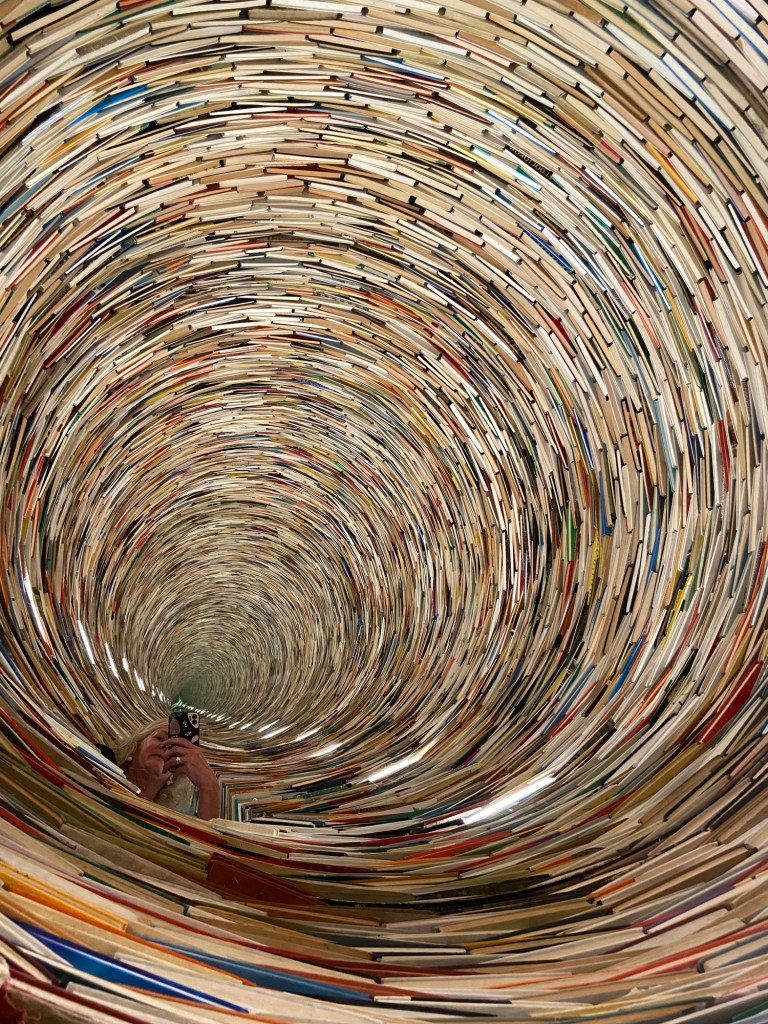
    I have an insatiable appetite for story.  Books – their bindings, the cover art, their texture, and deckled edge… even their smell and, most especially, the marks and notes left by other readers – everything about them appeals to me.  I maintain a small library at home, I get uneasy when my TBR pile runs low, and have even planned trips around famous bookstores and libraries.  I felt teary the first time I entered the iconic Strand Books in NYC; I needed a moment to myself in the reading room of the Boston Public Library, and I could probably write a short story about my visit to The Bodleian in Oxford or Shakespeare and Company Bookstore in Paris. There is a small town in Wales, Hay-on Why, known as the ‘town of books’ due to its many bookstores, and I hope to visit it next summer with an oversized empty suitcase to celebrate my 60th birthday. 

    Perhaps my love of reading stems from a lonely adolescence, or maybe it has more to do with what I consider to be my best and worst quality…curiosity;  but I’m never happier than when I’m settling into someone else’s narrative.  For me, every book I open feels like a clue to the secret of ‘Life, the Universe, and Everything.’  Books find their way to me or I to them, often by happenstance, and seemingly at the exact time I am most ready to receive them. Others sit in small dusty piles in every conceivable corner of my home, waiting for the right moment to renew our acquaintance. I plan to spend an unhealthy percentage of the life hours I have left, turning pages, devouring stories and exploring answers to questions that greater minds than mine have plumbed. To that end I present to you The Reading Room, a new blog series showcasing a smattering of books, earnestly read, and scantily reviewed by a  Little Old Lady in waiting.


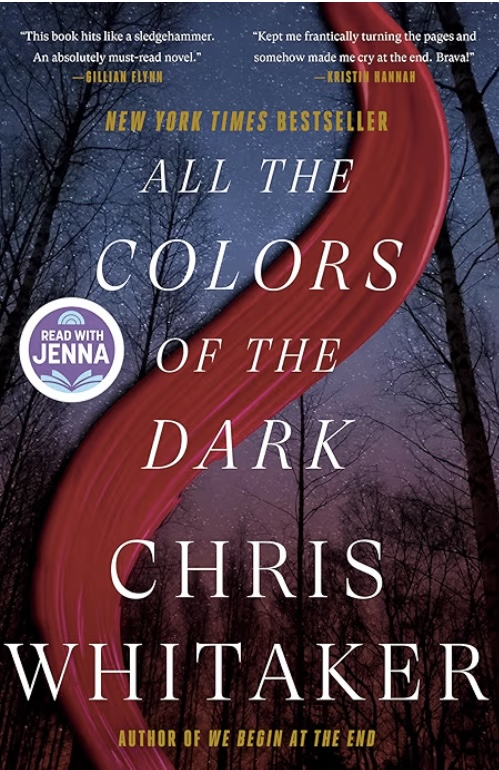
    All The Colours of the Dark is marketed as a thriller, a prosaic airport page-turner, but it did not hold me in suspense.  Set in the 1970’s, it’s the story of a traumatic childhood event and a lifelong hunt for a serial killer.  Although the book disappoints as a would-be whodunit, it is far more interesting as a study of the enduring bonds of childhood friendship, and the dialectic between good and evil inside each one of us, setting the reader up for an interesting examination of what exactly goes into the making of a hero/villain.  The book meanders down paths it need not have taken and does not satisfactorily resolve, but it includes characters that I will remember long after the close of the story including a career alcoholic and art dealer who had me hanging on his every word.  For him alone I give Whitaker – 7/10

    Easily one of the most enjoyable reads for me so far this year, Strout is a favourite author, and her story, set in a small town in Maine, is peopled with well-developed characters from previous books including Olive Kitteridge, Lucy Barton and Bob Burgess. Ostensibly the plot revolves around a murder investigation, but the book is really about the ordinary everyday events that make up a life and the stories we tell each other in quiet asides, on walks or with cups of tea in conversation with the company of people we call our own.  Strout can tell me everything and anything she chooses.  Her novels are packed with the kind of true to life details that strike at the heart of all good narrative and readers can’t help but pull up close to her stories and sit a spell. – 9/10

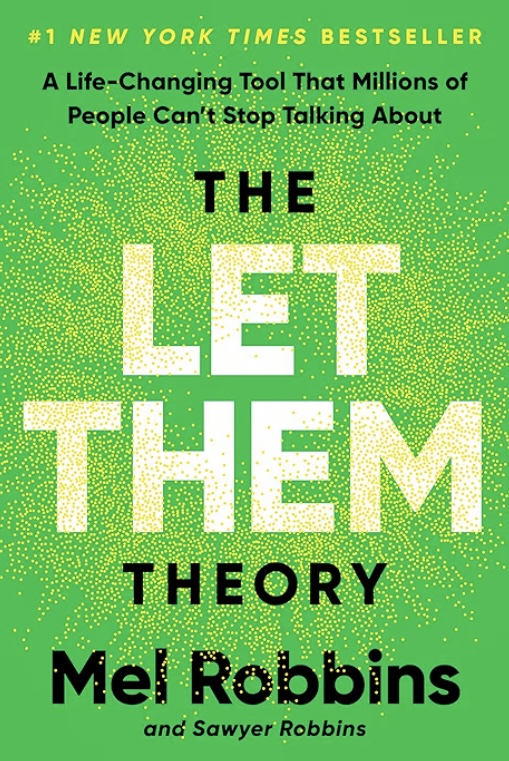
    My daughter passed me this book and while it is not my preferred genre the buzz on my socials piqued my curiosity. In summary, the book is a highly accessible, basic retelling of some ancient wisdom remarketed for the modern-day attention span. A reworking of Stoicism 101 or the Buddhist practice of detachment, the book’s easily digestible maxims, ‘Let them’ and ‘let me’ stuck with me and made their way into my everyday life, at work, and at home with my adult children.  Every time my inner control freak was tempted to interfere in matters outside my sphere of influence, I recited her magic words and presto my life became a lot let stressful. ‘Let Them’ gives you permission to stop trying to steer anyone else’s course but your own…marvellously freeing.

    Robins also plies her tools to romantic relationships and reading those chapters I couldn’t help but wish I’d had access to this wisdom in my early to mid-twenties before I learned how to believe people when their actions showed me who they were. Acceptance of what ‘is’ is a liberating experience, and Robbin’s book is a powerful tool for reclaiming your own power, directing your energy to the only thing any of us can control, our own words and actions. – 7/10

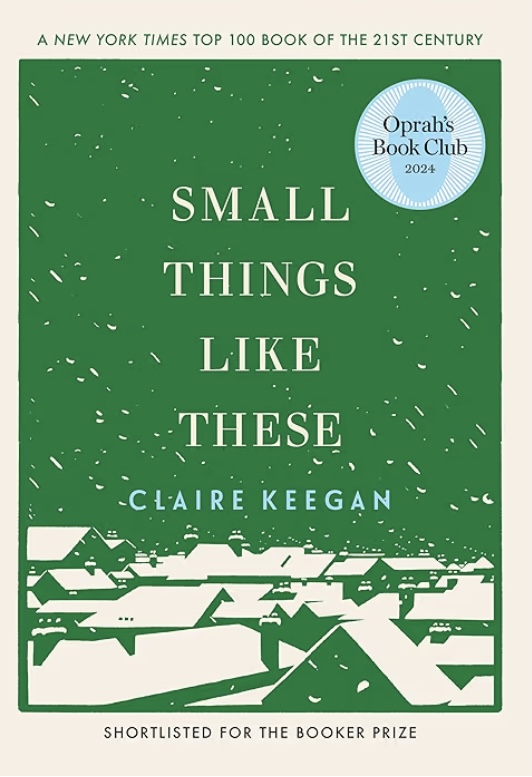
    Small Things Like These is the first book I have read by Claire Keegan, but it will not be my last.   The slender novella has been made into a film starring my current cinematic crush, Cillian Murphy.  Set in 1980s Ireland, Keegan looks at her country’s relatively recent history of housing unwed mothers in laundry workhouses, run by the Catholic Church, where young women were physically and emotionally abused and forced to live in squalor. The protagonist, Bill Furlong (Cillian), is a compassionate and virtuous man who must decide between doing the right thing and risking almost certain formidable consequences for his family. The story line is compelling, but the party piece of the book is Keegans’ evocative, lyrical language that grounds the reader in a kind of cultural cellar transporting us to a dark, cold, shameful place where ‘so many things had a way of looking finer, when they were not so close’  –  9/10

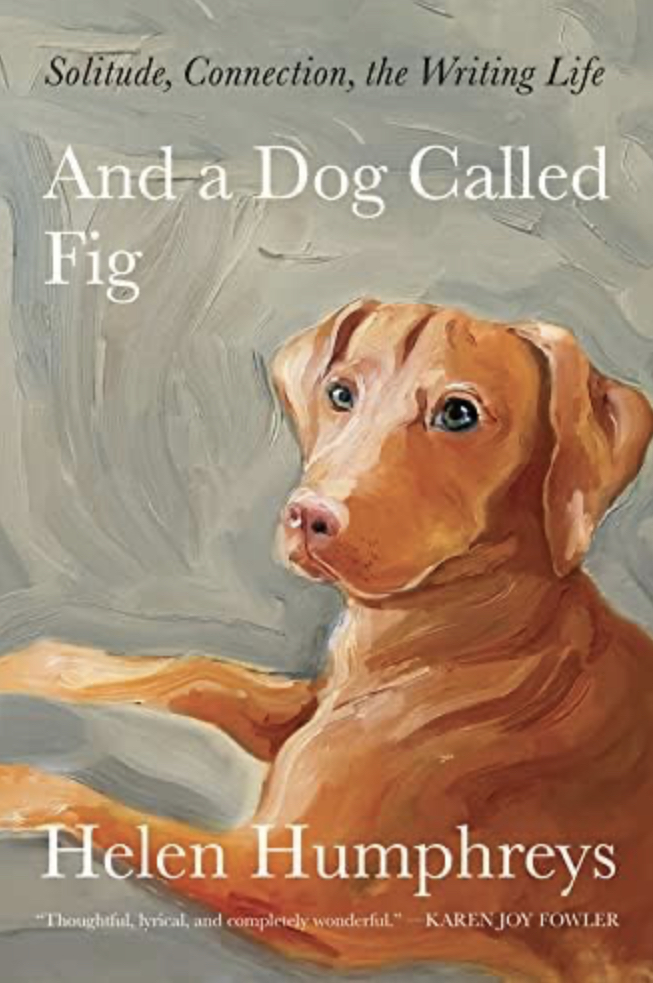
    Helen Humphries is another favourite writer.  She could probably write about the head of a pencil and make it compelling for me. So, when I pick up one of her books and read that it’s about dogs and writing, it’s kind of a perfect day in the making.  The book chronicles the first several months of life with a new puppy as experienced by Humphries,  herself a little old lady in waiting, and the story chapters are configured around the writing process with a few nods to other famous writers and their canine companions.   Somehow the story falls short and, for me, I’m pretty sure it has more to do with the author’s nonfiction competence as compared with her narrative voice which never fails to hit the high notes.  I was a little bored inside her dog-eared story.  – 6/10

    Bletchley code breakers, Prince Philip as a young lover – The Rose Code is set in WWII Britain in a time when women were liberated from their homes and allowed to be active members of society, and  brilliant women were needed for the war effort.  The whole book was like a large piece of decadent cake with a nice cup of tea.  Throw in an asylum, a betrayal, and a story told in reverse and Quinn delivers another delicious read where smart girls showcase their grit, and live happily ever after, even without their prince.  A lovely few hours leisure – 7/10

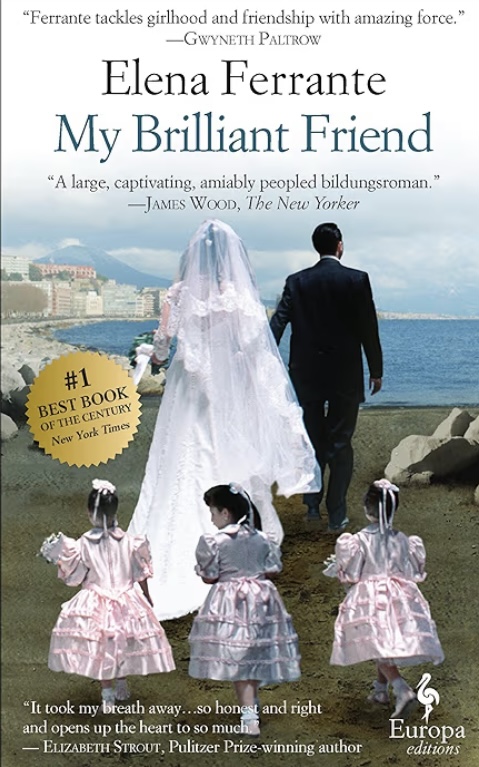
    This title is the first in a series of 4 books that chronicles a lifelong friendship between two brilliant women who grow up in Naples between the wars in an Italian ghetto where access to education is a rare privilege that only one of them is afforded.  Their lives cross back and forth across socio-economic lines and class distinctions in a gripping tale of survival and emancipation as each woman finds her strength and eventual escape from a world they have each outgrown.  The book begins and ends in mystery.  The story is atmospheric and dynamic and beautifully written with a special focus on the hard-won independence of Italian women in the 60’s and 70’s.  I don’t know which of the two friends I admired most in Ferrante’s story, but I highly recommend the books to anyone who understands the joy of forgetting you are reading, so fully immersed in the lives of the characters that you are virtually transported to their world. – 9/10

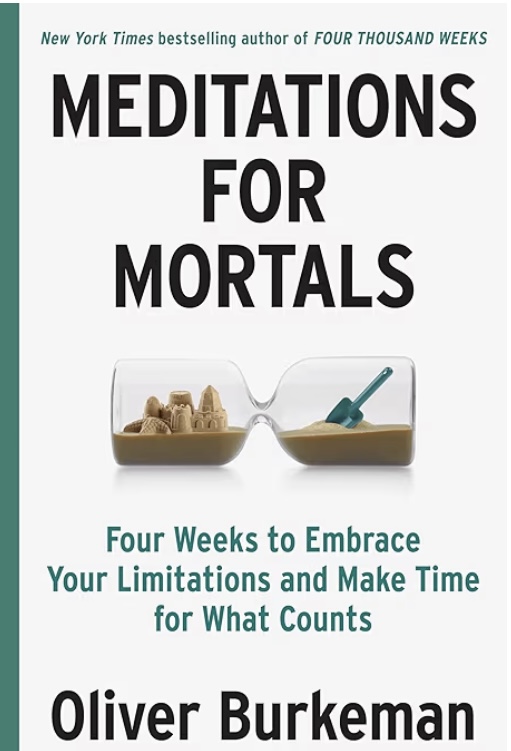
    This book is a sequel or companion book, to Burkeman’s previous bestseller, Four Thousand Weeks.  Both books, I strongly suggest, are worth your finite time.  Comparable to The Subtle Art of Not Giving a F*ck, Burkeman, previously a popular Guardian columnist, reads a bit more existential and cerebral and aims less for efficiency and more for enchantment.  His book helped me enormously in coming to terms with the fact that life is unfolding right now…not later when I’m more prepared or when I’ve completed X,Y and Z on my must do list.  Immersing yourself in Meditations for Mortals is a bit like going on retreat. It’s a reawakening, and a memento mori that none of us are getting out of here alive, especially we little old ladies in waiting whose book might more aptly be titled, One Thousand Weeks.  Thumbs way up on this one – 9/10

    Note bene

    If you have any book suggestions please leave a comment. I would be thrilled to know what you are reading 📚.

  • Little Old Lady to Little Old Lady Wisdom

    Sister Rhona Gulliver


    Author’s Note: The following profile is the first in a series of interviews based on a standardized set of questions designed to illicit insights and wisdom from Little Old Ladies in waiting. For me the exercise might be likened to what London black-cab apprentices refer to as ‘The Knowledge’; a mapping or learning the grid…the Grand Dame essentials, all the best bits and bobs to be discovered on the road to little old ladydom. The guiding spirit behind the profiles is best captured in a line by Rilke; “I want to be with those who know secret things, or else alone.”  I hope to interview women with considered and varied life experience, interesting and unusual career paths, a sprinkling of accolades, and maybe a smidgen more than their just share of “je ne sais quoi.”  

    The very first person that came to mind, satisfying all qualifiers, was Sister Rhona Gulliver.  I consider Rhona one of the most learned and wise women of my acquaintance.  She has a sharp intellect, a rich interior world, and a well-established and dearly appreciated wit.  She is a writer and an artist, with the singing voice of a sweet young girl, and the conversational acumen of a late-night radio host.  She has a genuine love of people, asking questions that open up all those who enter her realm, and paying us the ultimate compliment of her complete attention.  She may be the most skilled listener I have ever met with an unparalleled capacity for friendship. 


    Tell me your life story in seven sentences or less?

    What I have done… I attended 7 universities including Dalhousie, McMaster, Ottawa, as well as Dublin City University searching for a career and life values.

    Where have I been… I’ve been engaged three times to be married, looking for romance and companionship. I entered the Congregation de Notre Dame in Montreal in 1970 to become a religious sister and after three years they told me to go home. I had come to know and love the foundress, Marguerite Bourgeoys, of Notre Dame. Ten years later I entered the Sisters of Charity in Saint John and it felt more in keeping with the career I had chosen, leading to a deeper spirituality and giving of my gifts to others.  I worked many years in the community as a nurse, social worker, family councillor, and teaching at Queens University specializing in forensic psychiatry. My desire through life was to encourage others to learn and experience the best they could and give back to others.

    What is the best thing about getting older?

    The best thing is that you have less responsibility, and you can speak your mind without worrying too much about whether someone is getting upset… you also take things with a grain of salt.

    What is the worst thing about getting older?

    Always worrying that something else will go wrong with your health… some little thing that hurts. Your health starts to deteriorate and there is nothing you can do about it… you’re at the back of the line.

    If you could retain or retrieve one quality from your youth, what would it be?

    Dancing… I love to dance. I took lessons until I was 14 or 15 and then it wasn’t cool anymore. I’d like to dance again.

    Do you have a favourite quote?

    Yes, it’s a quote my great grandmother told me.

    “When you educate a man, you educate a man. When you educate a woman, you educate a generation.”

    Do you have a favourite word?

    Kretzimah” (Unfamiliar with this word, I requested a definition)

    I made it up. It means you’re soft or enjoyable, a gentle person… it describes everything delightful.

    Describe your perfect day.

    One that I would be free of all responsibilities – the telephone, visitors… with time to paint and write poetry, to read and have some spiritual time for rejoining my connection with God… maybe pieces of chocolate here and there.

    If you could have tea with anyone, real or fictional, dead or alive, who would it be and what would you talk about?

    Pierre Elliott Trudeau. I find him very fascinating. He broke the rules of etiquette and of government. He did what he liked to do. We would have a swinging good time. We could talk about everything: great books, philosophy, theology, politics. There aren’t that many you can talk to about such things.

    Do you believe in life after death? What does it look like?

    Yes, I believe in life after death. Most of life is getting ready for death. Life isn’t always pleasant but after this life all will be revealed, and the feeling of love will be so powerful you won’t have time to think of anything other than the love of God. Sometimes in this life after traumatic things have happened, I have contemplated suicide, but in the end, I thought I might be cheating myself of a higher form of love. I don’t mean to say that suicide is sinful, I mean that the more you can accept and survive the hard times, the greater your capacity for love… for other people, for yourself, and for God.

    Tell me three things that bring you joy.

    Chocolate. People. The Arts – painting, singing, music.

    Name a guilty pleasure.

    I like flirting with men. My brothers always told me if I kept my mouth closed, I could find a better boyfriend.

    What would you like your eulogy to say?

    I came… I was… I went.

  • On Mothers, Mothering, and the Mother Choice

    “Making the decision to have a child is momentous. It is to decide forever to have your heart go walking around outside your body.” – Elizabeth Stone

    “You are my sun, my moon, and all my stars” – E.E. Cummings

    Author’s Note:

    The decision to become a mother and the experience of being a mother is highly individual and personal.  My thoughts on the matter are based solely on my own experience of being mothered, becoming a mother myself, and a recent discussion with my adult children about the pros and cons of choosing to become a mother (parent).  The following essay is an opinion piece, not intended to critique or explore anyone’s choice or experience but my own.  It is part love letter, and part cautionary tale, as written by a little old lady…in waiting, the mother of two twenty somethings who recently asked, incredulously, “If you got to do it all over again, would you still choose to become a mother?”

    This post is dedicated to everyone who has ever asked themselves if motherhood was for them and, however they answer, a celebration of the right to choose and define that role on their own terms.  There are many ways to mother, and we need not be corseted by traditional paradigms.  As every mother knows, there is a bottomless well of love inside to bestow on all those whom we choose to call our own.


    A few months back I was walking into a glass fronted store when I caught my reflection in the entrance.  It was my mother’s face that stared back at me, and not my own.  It shocked me at first, and then a feeling of such unexpected happiness and peace came over me, as though she was there with me for a moment, and covertly always close by, watching over me, even when she “walks invisible”. My mother passed away suddenly almost ten years ago now, a massive hemorrhagic stroke at the age of 82.  She was old, I guess, but I didn’t know it.  She had survived breast cancer and open-heart surgery and she was very much alive and present in my life, my companion most days, and my first and closest friend always. There are days when I miss her so badly, I surrender to the emotion, I crumple, and after a time I rise and try to remember everything she taught me about life, including how to be a mom.

    My mother, like so many women of her generation, stayed at home with us when we were growing up, and her constant companionship and attention informed our understanding of our worth.  Surely, we must be important if we could command so much of her time.  In those early years our family did not have much in the way of material wealth, but I was blissfully unaware. I felt like a princess because that’s what I saw in my mother’s eyes when she looked at me.   She didn’t work outside our home, so our humble abode was spotless. There was always a home cooked meal for dinner, and most days a cookie as big as your head when I got home from school.  And so beget a lifelong addiction to sweets … but that’s another post.  It’s always the mother’s fault.

    My mother took her work seriously.  She saw her role as the keeper of the home and the keeper of our hearts.  She never cared if we earned good grades, or made AAA sports teams, but she was hard core when it came to the inner workings of our moral compass.  She was always our True North and is largely responsible for what I have come to refer to as a strong Catholic sense of guilt.  We were just as rotten as other kids, of course, but Mom made sure we learned how to feel bad about it afterwards.  She was a master class in empathy and a maker of men who will, 9 times out of 10…perhaps with a little prompting, attempt to do the right thing…if convenient, especially with the promise of a sugary treat for good behavior. And I guess if we’re talking world peace and the survival of the planet and, you know,…the human race, there can surely be no more important work, no higher goal than making sure the next generation feels a bit bad about not being good.

    My own daughter, aged 24, has a slightly different take on the whole mothering concept.   She recently returned home from her first peer group baby shower with a serious case of “ick”.   Although she was happy for her friend, near bursting with an almost fully baked baby, she was a little disgusted by the idea of body sharing with what she currently considers a kind of parasite, and as a qualified nurse she is more than a little horrified by the idea of the coming out party.  It doesn’t take Psych 101 to understand in my small, Catholic guilted heart, that as her mother, I must be to blame.  Did I overshare when I recounted her own birth story, that in the absence of an epidural, if I could have gotten off the birthing gurney and thrown myself out the window, I would have.  Too much?  I mean it was still one of the best days of my life…right?  I didn’t have the heart to tell her that pregnancy, labour and delivery are the easy parts. 

    The truth is that I felt very much the same about becoming a mom when I was in my 20’s. I’m still not sure what happened to make me change my mind: falling in love, the biological imperative, socialization, FOMO.  I don’t know how it happened… well, I mean, I know how it happened …I’m just not sure exactly when or how the idea first came for me. I only know that when it came it was a complete knowing, not some indifferent or half-hearted decision.

    “Would I do it again,” they asked me, would I choose to become a mother knowing all that I know now about the sacrifices, the highs and lows, the weight of the responsibility and the constancy of the relationship?  Of course, I told them what every mother must, that knowing and loving them as I do, I could never choose differently.  But a little later that same evening I gave their question a more rigorous and honest consideration.  I thought about what I had willingly given up or done without to accommodate the mother role.

    I spent 12 years at home with my kids in their formative years.  I had never mentally prepared myself for that kind of mothering, I had my mom set up to be the 9 to 5 Nanny, but after her heart attack, it became clear that I had just landed a full-time position well above my aptitude test.  Let’s just say I wasn’t a natural. I had never really learned to play, I had the patience of a gnat, I hated crafting, and organized sport remains a mystery to me to this day.  I had only the vaguest understanding of toddler milestones.  Looking back on those challenging years I will admit it wasn’t all idyllic or Instagramable.  Being a mother is, without a doubt, the hardest job I’ve ever had.  It’s a learn-as-you- go deal with no gentle onboarding.  The hours are unacceptable, the pay is shite, and the performance reviews can be eviscerating.

    The pragmatics of mothering, the meal prep and lunch bags, the homework, the chauffeuring and learning to tolerate the child centred activities: the birthday parties, the bowling alleys, the soccer fields and hockey arenas… all of that can be managed.  For me, by far the hardest part of being a mother is that you’re “only ever as happy as your unhappiest child.”  The scraped knees and fevers, the broken hearts, the car accidents, and the plethora of little wounds that befall our children are far more agonizing than anything we could experience ourselves. The mother bond is like a Chinese finger trap and cuts deep when tested.

    Despite all the hard graft of mothering, the blessings…the gifts far outweigh the grievances.  I am not the person I was before I became a mother.  My children changed me.  Mother love is the fiercest, most intense, highest frequency, unconditional love that we can experience.  No one… no one will ever love you like your mother does.  Motherhood is a transformative experience.  It taught me humility and patience, it showed me how little we can control and how much we have to be grateful for every day we get to spend together.  Even as adults my kids continue to help me grow with their contemporary take on what constitutes a life well lived and their insights on how we should best spend our time. To be clear, I am in no way suggesting that cohabitating with twenty somethings is easy.  It is not.  But the Zoomer zeitgeist does keep things interesting.

    In short, being a mother, in my experience, is both the best of times and the worst of times.  Would I choose to become a mother again, with the perspective of time, and the convenient memory of a woman well past the heavy-lifting years of mothering – an emphatic, “yes.” Adding up all the mom hours I have logged over a lifetime, do I sometimes wonder what I might have accomplished had I spent that time in pursuit of projects more in keeping with my natural inclinations  – again “Yes.”  Do I crave a more serene environment with less shoes at the door, fewer dishes in the sink, with more time to read and walk and wonder, without consideration of anyone’s needs but my own?   “Perhaps.” Do I sometimes fantasize about an alternate life where I am a lady of leisure and letters, in Rembrandt-lit rooms filled with books, reclining in a Chaise-lounge overlooking the sea… CBC radio my only company?  Of course, I have…Moms are human beings too you know.  Did I live up to the bar my own mother set?  Did I do my job well?  Am I the True North that will help guide my children in making decisions that align with their values and beliefs when it is my time to “walk invisible?”   I hope so. All I know for sure is that I would rather be a merely adequate or average mother to my two darling descendants than an excellent anything else.

    If you’re still searching for the perfect gift for Mother’s Day, take some advice from a little old lady in waiting – make dinner, wash the dishes, clean the house, do the laundry, and if you still live at home, maybe take yourself out for the day.  Give your Mom some time to herself, time to remember the woman she was before you owned her entire heart, in the days before your chapters of her story, when she belonged only to herself.